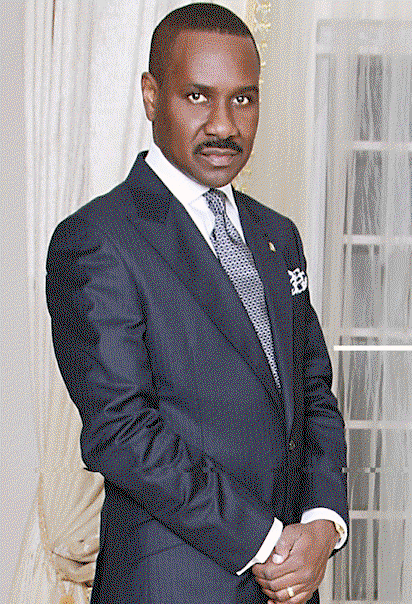
By Ebele Orakpo
Upon completing his primary school education in Ibadan and secondary school in Kings College, Lagos, Ighodalo, who is a fellow of the Institute of Chartered Accountants of Nigeria, fellow of the Chartered Institute of Taxation and a member of the Nigerian Institute of Management, went on to the International School, University of Ibadan for his A-Levels.
 Thereafter, he proceeded to England where he obtained a BSc. combined honours in Economics and Accounting in 1982 from the University of Hull in the United Kingdom.
“I started working with Price-Water House in Lagos, now called Pricewaterhouse Coopers. When I left Price-waterhouse in late 1984/early 85, I did a few businesses here and there and finally started Ighodalo-Ighodalo and Co in 1987 as a firm of chartered accountants.
I began to build it up from there till today where we are now called SIAO which is a merger of four firms. One of our partners has gone back into banking so we are now three founding partners and a total of about six or seven other partners.
“We like to think that SIAO is between numbers five and seven depending on what yardstick you use. I have been in accounting business since 1987 and we have been together as a partnership since 2005,” said Ighodalo who sits on the board of 12 non-governmental organisations.
Coping in Nigeria’s business environment:
“Nigeria has a very challenging business environment especially for accounting practice where there is still this dominance or over-dominance by what we call the big four, the international accounting firms. A lot of people tend to want to go to them because of their reputation and because they have been in business for a very long time. So there is what we call crowding out of the younger indigenous accounting firms.
This is really affecting accounting practice in that a lot of people are not encouraged to start their own firms or to go into public accounting. Everywhere else in the world, they have a way of encouraging indigenous firms like reserving certain jobs for indigenous firms or they manage the jobs in certain percentages like in South Africa and China so that younger firms are encouraged to grow.
“In terms of reputation and in terms of international network and reach, there is no way a 20-year-old firm can have the reputation of 100 or 150-year-old firm, so they crowd the younger firms out a lot so what we are trying to do now is to get the government in Nigeria to encourage indigenous firms by having a local content policy in this area as they have in the oil sector and even in the legal sector.
No foreign firm can come into Nigeria and practice law. Every legal firm is an indigenous firm; the same is obtainable in architecture and engineering. So we need that same sort of atmosphere in accounting practice in Nigeria so that it can help the development of local firms,” said Pastor Ituah, as he is fondly called.
Encouraging indigenous firms:
Continuing, Ighodalo who is also a
member of the American Institute of Management said: “We are not saying they should not do their own business but there should be a kind of process of really encouraging indigenous firms. So that is the situation we are in right now but we thank God.
He has been faithful to us. We have grown from just, if you like, one staff, to five. I started alone and eventually, I was able to get an assistant, then a secretary, the next assistant, then an accountant and so on and so forth. By the time we merged, we had about 40-50 staff and now, we have over 100 members of staff and we are now able to compete favourably for a lot of jobs out there.”
Asked whether the accounting business is lucrative, he said: “Yes. From what I have described, there are two types of accounting. There is the accountant who is employed inside a company. Every company needs a good accountant so there is always room for a good accountant.
Then, there is public accounting which is auditing; auditing registered companies. Again, it could be very lucrative but three things are hampering it in Nigeria. These are: Crowding out by the big four who always seem to get the big ticket items. As a matter of fact, a lot of these international organisations like the World Bank, IFC and multilateral agencies that want to assist indigenous companies tend to insist that your auditor must be one of the big four; this crowds us out so it is not quite as lucrative as it should be for the indigenous firms.
“Secondly, a lot of companies that should be having their accounts audited do not do so because the policing by the government is poor, therefore, a lot of them are shelf companies or seem to be shelf companies. Some are doing very well but they don’t do their auditing, they don’t pay tax, they don’t do anything so even the government is losing quite a bit of revenue by not policing and monitoring these companies very well.
“The third thing is that a lot of others who even try, do not appreciate the services and therefore are unwilling to pay appropriately for the services so that really makes the profession rather challenging in Nigeria but elsewhere in the world, it is a bit more open, a bit more interesting; there is a lot more room because all the necessary tools to make it a good business are there.”
Looking into the future:
“We are working hard to truly institutionalize the company and to hopefully transfer it to the next generation. We are working hard on developing our junior partners and directors so that we can have an organisation that we, the three founding partners, can retire and look back and know that we worked very hard to become one of the biggest in Africa by God’s grace.
At SIAO, we believe that the approach is as important as the services offered. Thus, our approach ensures that our clients benefit immensely from our depth of knowledge and experience. We hope we get the support of government and the environment to help us achieve our dreams and it will be good for the economy because there are a few other firms like ours who need this sort of encouragement too.”
Disclaimer
Comments expressed here do not reflect the opinions of Vanguard newspapers or any employee thereof.