By Ebele Orakpo
In their bid to bridge the massive digital divide between rural villages in Africa and the developed world, the School of Information Technology and Computing (SITC) of the American University of Nigeria, Yola, Adamawa State, is working on improving and increasing accessibility to telecom services as they strongly believe that better access to information on the internet, will provide new and improved opportunities for education, healthcare, commerce, and efficient delivery of government services to rural areas.
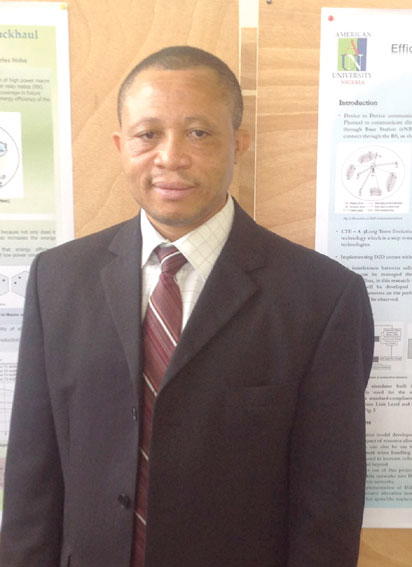
In this chat with Vanguard Learning in his office, Dr Charles Nche, an Assistant Professor and Chair of Telecommunications in SITC speaks on their research works which include the use of White Space Technology to provide wireless broadband in remote villages, device-to-device communication and heterogeneous network..
Excerpts:
Providing wireless broadband using White Space Technology:
“Here basically, we are taking advantage of the way the television works at the moment to use it to provide broadband to rural communities,” according to Nche.
Explaining how the system works, he said: “In every television station, you have certain bands or frequencies that are not used and so if we know where these stations are, within say 10 kilometres of that area, we will be able to use equipment designed specifically to use those particular channels to send broadband messages. As long as there is a television station in the rural community in Nigeria, it is a lot cheaper to locate and work out frequencies available, then use the frequencies with the special equipment to send wireless transmission over that television area.”
Advantage:
“The advantage is that at that frequency, we are able to go through terrains, through mountains, walls etc because the traditional wifi needs an antenna to be facing another antenna for it to work, so that is why it is very expensive for mobile companies like MTN and Glo with the present technology because they will have to buy the licence from government which does not come cheap and so, they will want their money back. That is why they always go to cities with high population to be able to get their money back but in rural areas with low population, they won’t be able to recoup their money.”
What it is used for:
“The economy of most rural communities at the moment is based on farming – crop cultivation and animal husbandry. They go long distances to look for market for their goods but if they have access to the internet like most city dwellers, they will be able to sell their products online, so this is the biggest advantage of having this type of technology. It provides cheap broadband to rural communities; that is what the technology is all about,” he stated.
Continuing, Nche said: “We have devices at the moment such as ipad phones, kindle (the light version of an ipad) which is very cheap and can access the internet but to do this, you need to have the internet wherever you are. For example, if you are anywhere in the world, as long as you don’t have a hot spot, a place where you can access a mast, you will not be able to connect so what we are saying is that with this type of technology using this advantage of the television, we will provide that access. So within a 10-kilometre radius, you will be able to have access.
“The other really big advantage is that by 2015, it is expected that all African countries would have migrated from analogue to digital. This is going to leave a lot of bandwidth unused because the analogue system works differently from the digital system so we will have a lot of unused frequency available for this technology. We will then be able to provide a bigger bandwidth because that is really what everyone wants so that when you are making a call, you do not experience a dropped call as a result of not having enough bandwidth as is common today.”
Device-to-Device communication:
Speaking on the second project, Efficient Resource Allocation in Device-to-Device (D2D) Communications over LTE – Advanced Band, Dr. Nche, who manages the Executive Master Programs in SITC said the D2D communication enables mobile phones to communicate directly with themselves without relaying through the base stations.
“At the moment, the way you will make a phone call using your mobile phone is that you communicate through a mast then that mast takes it to the next mast. Now, the bandwidth allocated to those wireless phones is shared by everybody which is why sometimes when you are making a call, you experience dropped call because the bandwidth is not enough to accommodate everybody.
With this system, we could be using your phone as a receptor instead of the mast so we don’t allow everybody to use the mast. Depending on the radius that we are, I could be using your phone as a receptor to the next one and the next one. So effectively, what happens is that resources are not shared by everybody, it will depend on where the communication is taking place.
“This means that if we are communicating within a smaller area, we can use your device rather than you going to the mast directly like everybody else. By using this D2D communication, we are limiting the number of people that have to use the mast which is more important if you are making long distance call.
“I can use your phone as a receptor without you realising it.
Heterogeneous Network (HetNet):
According to Nche, this is a combination of high power macro base stations with low power micro, pico and femto cells. HetNet will achieve high spectral efficiency and improve coverage and energy efficiency of the network. “We are always thinking of how to develop African nations along the lines of reducing energy use.
For example, in Nigeria, we know energy is a big issue and the way mobile phones work today is that you have homogenous networks designed in a way that you either have macro, pico or femto cells and the amount of power they need varies. Each of these cells requires different degree of power for them to work. The masts are done with either macro, pico or femto cells but a femto cell is designed to be within a smaller area eg, a room.
Now, at the moment, the way it works is that if I join a network, it is only that network I will use all through so the idea is that if we use different types of networks, we can make a clever choice. So depending on where you are, you decide which type to use. So the heterogeneous network means we mix different networks so the energy efficiency is great because now, we are able to choose.
For example, if we are going to communicate locally, why use a macro cell which is at the top end of energy consumption when we can use femto cell? If we are in middle range, we use pico cell etc. Research has shown that the energy efficiency is really good and it also comes back to this resource allocation that I explained above.
So if you tie those two things together, you will see a massive advantage. Not only are we giving you an efficient resource allocation, but we are also providing efficient energy consumption,” he stated.
Disclaimer
Comments expressed here do not reflect the opinions of Vanguard newspapers or any employee thereof.