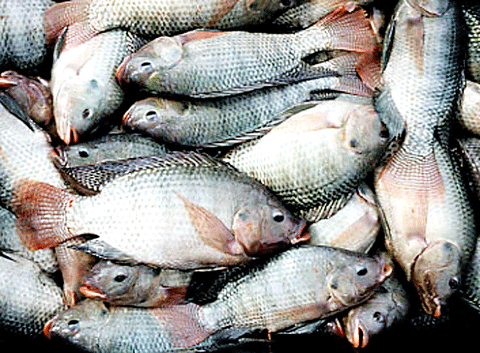
Fish
BY AKOMA CHINWEOKE
Many Nigerians may have been put at the receiving end of a policy decision by the Federal Government as the deadline for the ban on fish importation into the country approaches in the New Year.
It is believed in many quarters that the directive by the Federal Government to ban fish importation, unfolded through the Minister of Agriculture and Rural Development, Mr. Akinwunmi Adesina, is a ploy to deny the poor masses their only cheap source of protein.
Stakeholders say the policy means a hike in the price of fish ahead of the ban which takes effect by month end.
Adesina had made the pronouncement a few weeks ago during the launch of the Special Growth Enhancement Support (GES) scheme intended to boost local aquaculture production through the Aquaculture Value Chain initiative.
This was a follow-up to the directive by the Federal Government in a letter, dated October 29, 2013, to fish importers asking them to ensure that all Bills of Lading carried dates not later than October 2013 and the fish cargoes (consignments) arrived the Nigerian waters not later than December 31, 2013.
The net effect of this is that the price of fish in Lagos and other parts of the country is going up.
As at last week, a carton of Titus was selling for N13, 500, up from N10, 500 while Kotenow went for N10, 200 from N7, 500.
To justify the GES/AVC initiative, the minister claimed the aquaculture value chain would produce 400,000 tons of fish, generate extra 250,000 of table fish and 100,000 tons of value added fish.
According to the Food and Agriculture Organisation, FAO’s the State of World Fisheries and Aquaculture Report 2012, Nigeria produced 200,535 tons of aquaculture fish, representing 15.57 per cent of global production in 2010, but had an annual consumption requirement of 1.2 million metric tons based on a population figure of 100 million and per capital consumption of 12 kg per annum regarded as adequate for a normal healthy growth.
These figures reveal that even if the ambitious objectives put forward by Adesina are achieved, there will still be a significant shortfall in fish availability for consumption, not to talk of if importation was banned outright as is currently the case, as estimated production tonnages are projections and not achievable in the short term.
Some dealers disclosed that the price escalation was being driven by the anticipated ban effective month end and will last over the next four years.
The nation’s fish industry reacted sharply to the government pronouncement.
A lecturer at Lagos State University, Dr. Tosin Olarinmoye, noted that government should not be in a hurry to ban fish import since it has not made provision for alternative source of cheap protein for the poor.
He said, “It doesn’t make sense to ban fish when you are not producing enough locally.
In Nigeria, fish is the cheapest form of protein people use to supplement their protein requirements in food. Locally, we are not producing enough fish because of several reasons. One of the major reasons is that our waters have been devastated by oil pollution. Fish farmers are supposed to use a particular kind of net that should pick the specific type of fish they are looking for.But because they are not regulated, they catch all the fish, both mature and immature; they are supposed to throw back into the water into the water, but they sell them.
“As a result of over fishing, when our local fishermen go on water, they can’t even see fish of big size to catch.”
He pointed out that instead of total ban, government should work with local fish suppliers through the ministry of agriculture’s extension service and designate some areas not to be operated for some time so that the fish in the areas could be produced in big and adequate quantities.
The university don added that even after that period, they should continue to monitor the conservation areas to ensure strict compliance over a particular time.
“Let me tell give you an example of the Arugungu Fishing Festival. Because fishing is restricted in that water, every year, they must catch fish of big sizes.
This is because they have ensured that in the intervening year before the festival, nobody fishes in that river. Can’t that be done? Now we are not producing enough and we want to ban fish that people buy for N150 to N250 per kilo to eat. I think it is a bad policy and Nigerians will kick against it,” he added.
Olarinmoye posited that beyond conservation, private operators in the industry need a friendly environment to operate.
He also advised the Federal Government to encourage local fishermen by giving them low interest rate finances and inputs.
According to him, “If government does what I call government nursery where they can give fish farmers loans at subsidized rate, more Nigerians would be encouraged to go into the business.That is the kind of thing they should be doing and not to ban fish importation outrightly.
“I suggest that government should first of all do a stock taking programme to determine which species we have, how many we have; which areas do we find them and what is the local demand for them? When that is done, then, we can designate areas that need to be protected over a period of time. If that is done over a period of five years and the private sector is encouraged to increase the production of aquaculture,then, ultimately, in another 10-15 years, the number of fish import would drop to almost half.
“There is no country that doesn’t import fish because no country has
enough stock to meet local demand, and not all the fish that your citizens want that you can find in your water. So, there will always be some importation of fish. That is the truth.”
Also speaking on the issue, a nutritionist, Dr. Amarachi Okonkwo, said though the policy in itself has merit, the shotgun approach being applied by government in this case, as in many other such developmental agendas and policies, was inappropriate. He said that since local production was inadequate due to a number of reasons, which the government itself acknowledged at the inauguration of its GES project, a situation which and will persist for a long time to come, government should have applied a phased approach to the implementation of this policy, as was attempted through the failed Fadama project in the case of rice.
Okonkwo said, “Phased increment agendas to maximize local production, artisanal and aquaculture, while reducing imports gradually, would be a more workable option in the mid to long term. This is to be done in tandem with fish stock enumerations, designation of protected fishing areas, and species, strict monitoring and enforcement of fishing quotas by trawlers in local waters to reduce, and possibly eradicate the menace of overfishing, a factor militating against artisanal fisher folk and their livelihoods.”
He added that in the light of growing public trepidation and fear of the effects of the fish ban on the affordability of at least a minimal protein quota on the part of the consumers, and a loss of business for importers and bulk sellers, government would do well to reassess this controversial policy and use the Fadama project as a backdrop for arguments for a phased approach to the implementation of same.
The timing of the ban also seems particularly insensitive considering the fast approaching year end festivities. In keeping with the government directive, major shipping lines have reportedly stopped the transportation of frozen fish.
Disclaimer
Comments expressed here do not reflect the opinions of Vanguard newspapers or any employee thereof.