By Luka Binniyat, PETER DURU,
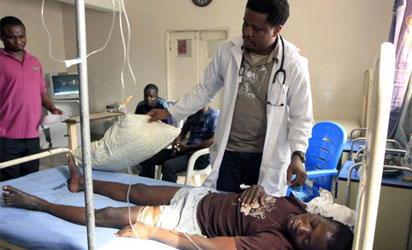
A woman, maybe in her 20s, dressed in hijab, was helped by two others more elderly ones into a decrepit, match box size room that had only a rickety bed and worn out mattress at the Hunkuyi Primary Health Care Centre, in Hunkuyi Local Area (LGA) of Kaduna state.
“Does she have a card a lready?” asked Aliyu Nuhu, the man in charge of the medical services of the LGA while he took the visiting team of reporters around the place.“Yes”, the most elderly of the two answered in a very worried anxious voice, while making their way to the bed. “This is what you see here twenty four hours everyday per week”, he said.
“pregnant women coming to give birth, and there is no midwife. And they may come from as far as 30km.

“I know that you people are looking out for the neatness of the Clinic and the kinds of facilities and equipment that we have”, he teased at the reporters, “while, as for this LGA, that is a luxury that we cannot bother about”, he said.
“Look, gentlemen, at this centre, we get on the average about 250 to 300 patients. On market days we may get as much as 500 patients”, he said of the place that is just slightly the size of a badminton court, (the entire Health Centre).
That means that some patients manage their ailments until the next market days, when dilapidated commercial vehicles moving traders and their goods to the Hunkuyi market would also take them out to the PHC, sometimes with women in labour who may have developed complications.
“We do not have a doctor here. No midwife. No laboratory. No lab technologist”, he went on.
“The fact is this: we have a total of 34 Health Facilities in Hunkuyi LGA, but we have only 81 trained staff to run them. Look at me, I am a Community Heath Worker trained by white men, and I have a Diploma from the University of Ibadan on Health Promotion and Education.
I am not a doctor, but I have to help do a lot of all kinds of works here. I leave home in the morning, and I am working round sometimes after mid-night. The pressure on us here is too much.
“Yet, in this Hunkuyi, I have received applications of 46 unemployed, qualified medical personnel, and all of then indigenes of this LGA. It is not because we don’t have them. Their applications are on the desk of the LGA Chairman. But he cannot employ them, because he has to get directive from Kaduna”, he said.
“ People are saying that even if there is embargo on employment, must these rural areas not be helped with staff out of the exigency of the time?
“I don’t believe that there should be embargo on employing health workers under the present conditions that we are. Because some of us are soon retiring and there are no replacement. People are looking for work.
“ In fact, some of this idle health personnel are even the ones that come around to render free services, out of humane considerations”, he said.
The story is the same at the Sabon Gari-Giwa Primary Health Centre in Giwa LGA of the state, about an hour’s drive from Kaduna. This centre which takes an average delivery of 10 babies a day, and 200 patients daily, does not have single microscope among others. With no generator, the Centre has been without light for three months, because it has been unable to pay for its monthly light bill of Four thousand Naira only (N4000)
For a centre that receives over 500 patients on market days, it has a Staff strength of 16, with just one Nurse.
In Unguwar Ali Gado, a suburb of Birnin Gwari town, about 300km from Kaduna metropolis lies a Maternal and Child Clinic established to cater for basic health issues of the women and children of the estimated 10,000 residents. “This Centre has 15 beds, but has a capacity to take 50”, said one of the staff who does not want his name published. “We are mainly concern with antenatal and children issues. We treat on the average about 300 of them daily. At times we get 10 deliveries a day, but we only have one delivery bed.
“Of the 17 workers here, we have only four nurses for this teeming population”, he said.
Again another grim aspect of this story is displayed at Makarfi LGA. According to findings the entire Makarfi LGA does not have a single medical doctor, not a single Pharmacist nor radiologists. It has only three nurses and three midwives on top of its staff list.
At the expansive Makarfi GeneralHospital, the story is even more vivid.
There are four Medical Doctors in the Hospital. At the time of this visit, one was on his annual leave. That leaves three of them, among them the Chief Medical Director (CMD). They have to work three shift round the cloak to treat the hundreds of patients every day.
There was this particular Nurse, who told Saturday Vanguard that he alone attends to 50 patients in his ward.
“Because of the shortage of nurses, I have been working for 24 hours everyday, and I will keep doing so for another month, until the other nurse who has put to bed returns from her maternity leave”, he said.
This is the average picture of Kaduna State owned Health Facilities in the rural areas.
Kaduna State has over 300 Primary Health Care Centres, 23 General Hospitals and is supposed a run a free antenatal Health care and for children below the age of 5 for its estimated 7 million population.
All entreaties to get relevant authorities to speak on the matter failed. After repeated calls, and a text message to the Director General to Kaduna State Governor on Media and Publicity, Alh. Ahmed Maiyaki did not yield fruits.
BENUE state : Lack of qualified hands to run health institutions
The completion of the Benue State University Teaching Hospital, BSUTH, and commencement and rendering of medical services to the teeming people of Benue state, remains one of the greatest achievements of the Governor Gabriel Suswam led administration in the last 78 months.
Though at the inception of the administration in 2007, the Governor had in line with his development blue print as encapsulated in the “Our Benue Our Future” working document, set a target of ensuring that each of the 23 local governments of the state had a General Hospital.
Soon after, the administration commenced the phased construction of general hospitals in 18 local government areas of the state that lacked the health facility.
While the construction of the new facilities were going on, some others were also being upgraded from primary health centres to full fledged general hospitals.
In the same vein, primary healthcare centres in the state also received the attention of the administration with most of them accorded tremendous facelift.
These rehabilitation and construction, were followed by the supply and distribution of basic medical equipment and medicaments valued at over N6billion, across the public hospitals in the state.
Perhaps the rejuvenation of health facilities in Benue state by the Suswam led administration, some four years ago, remains the most far reaching since the creation of the state.
Hospitals in the state were positioned for better service delivery to the generality of the people of the state.
The primary healthcare centres were functioning at their peak, the general hospitals were running while the newly commissioned BSUTH rendered medical services to the people and also served as a referral centre for all other hospitals in the state.
Most of these hospitals also enjoyed the benefit of being supplied Anti Retroviral drugs for free distribution to the herd of persons living with HIV/AIDS in the state.
The tempo with which the Governor Gabriel Suswam led administration tackled the challenges confronting the health sector at the inception of his administration actually received commendation which also led to the donation of a dialysis centre at the BSUTH by the MTN foundation.
It is pertinent to point out here that though the state government had made concerted efforts to put these medical facilities in place, the major challenge facing these hospital is the lack of qualified hands to run the health institutions especially those that are located in the rural communities.
This remains a daunting challenge that the state government must quickly find a way of tackling.
When Saturday Vanguard visited some of the general hospitals at the hinterlands of the state, it was discovered that the facilities were mostly in good shape but the medical staff to run the hospitals were inadequate and in some cases lacking.
It was also discovered that outside nurses on duty in the hospitals visited, most of the medical personnel serving at the hospitals were National Youth Service Corp, NYSC, members who serve in these hospitals and leave at the completion of their service year, hence denying their patients prolonged attention where their health situation demand such.
It was further discovered that despite the huge resources expended to put up these facilities, they have been left to deteriorate because no proper attention had been accorded to the maintenance of the institution.
Reacting to this development, a staff of Okpoga general hospital in Okpokwu local government area of the state who craved anonymity, told Saturday Vanguard that “the last time this hospital was renovated was when a team from Makurdi visited the hospital, since then no serious rehabilitation has taken place here in a long time.
”Moreover, the road leading to the hospital is also in bad shape and requires attention without which patients would continually be discouraged to seek medical attention here.
”The truth is that the people now prefer seeking medical attention in our public hospitals in Benue state because the state government took steps to upgrade facilities in all the hospitals in the state.
But my pain is that we spend so much to build these facilities but nobody cares about their maintenance, which means that in the coming few years these facilities might not be running; the situation is not peculiar to Benue state, it is a nationwide problem,” he stressed.
Disclaimer
Comments expressed here do not reflect the opinions of Vanguard newspapers or any employee thereof.