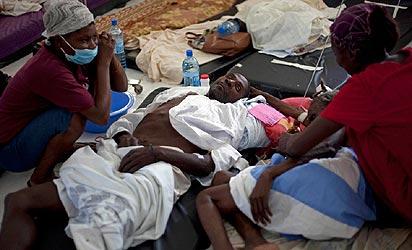
Cholera patients at a hospital
By Sola Ogundipe
LIKE a bolt out of the blue, the Lagos State Government, penultimate week, issued an alert about an outbreak of cholera in the State. Even before the announcement, fatalities had been recorded from dozens of reported cases. Prior to the announcement, similar outbreaks in the Northern part of the country had elicited concern. Latest reports from the Federal Ministry of Health, Abuja on the outbreak of cholera in the country indicated six states are affected.
Data from the apex Ministry showed the current estimate of the patterns of distribution of the outbreaks across the country totaled 1,623 cases and 86 deaths. Zamfara State led the pack with 1,110 cases, including 51 deaths; followed by Nasarawa State with 105 cases and nine deaths.
Others are Lagos State: 134 cases, four deaths; Plateau State: 130 cases, 11 deaths; Oyo State: 29 cases, six deaths and Ogun State: 115 cases and five deaths. Now there is a nationwide red alert.
Cholera is an acute, diarrhea illness caused by infection of the intestine with the bacterium Vibrio cholerae. A universal threat to public health and a key indicator of lack of social development, an estimated three to five million cholera cases and over 100,000 deaths occur each year around the world. In a cholera endemic area, outbreaks usually occur as a result of bad or absent sanitation and/or sewage services.
Cholera infection
According to the World Health Organisation, the cholera outbreak in 2010 recorded 41,787 cases, including 1,716 deaths in 222 LGAs in 18 States. Most affected states were Borno, Bauchi and Katsina. In 2011, the number of cholera cases as of October was 22, 454, including 715 deaths reported in 25 states.
The Centers for Disease Control and Prevention says cholera infection is often mild or without symptoms, but can sometimes be severe. Approximately one in 20 infected persons will have the severe disease characterised by profuse watery diarrhea, vomiting and leg cramps.
In these people, rapid loss of body fluids leads to dehydration and shock. Without treatment, death can occur within hours. It can take anywhere from a few hours to five days for symptoms to manifest.
In Nigeria, cholera is endemic and outbreaks are not unusual. Although reports of epidemics have not been consistent lately, the disease is very dynamic. One does not need much to be convinced that the stage is set for such outbreaks. Just take a look at the dirty environment, the heaps of refuse at street corners, the roads littered with garbage, the deluge of people – dozens with unwashed bodies and hands – the blocked drains, the poor sanitation facilities and lack of potable water and you’ll be convinced.
Historically, the emergence of cholera in Nigeria was evident in 1970 and in 1991. Precisely, during the last two decades, three major epidemics have occurred – in 1992, 1995-1996 and 1997. One easily recalls the 1996 cholera outbreak in Ibadan that was attributed to contaminated potable water sources. Street vended water and not washing of hands with soap before eating food were possible reasons for the 1995-1996 cholera outbreaks in Kano state. The 2010 outbreak of cholera was speculated to be directly related with breaches in sanitation and water supply.
So why are people suddenly coming down with cholera this time around? The reason is not far-fetched, according to close observers of health.
“Cholera is primarily as a result of poor hygiene,” health personnel told VF. “People acquire the infection by consuming contaminated water, seafood, or other foods. Once infected, they excrete the bacteria in stool. Thus, the infection can spread rapidly, particularly in areas where human waste is untreated.”
Lack of safe water and poor sanitation are important risk factors. For a cholera outbreak to occur, two conditions have to be met – there must be significant breaches in the water, sanitation, and hygiene infrastructure used by groups of people, permitting large-scale exposure to food or water contaminated with Vibrio cholera organisms; and cholera must be present in the population.
For instance, in the Lagos outbreak, suspected cases were allegedly contracted from food sources such as the African food salad popularly called ‘Abasha’, contaminated well-water sources, infected foods from food sellers, and other unhygienic habits.
Diarrhoea discharge
Usually, the source of the contamination is other cholera patients when their untreated diarrhoea discharge is allowed to get into water supplies. VF gathered that cholera is not likely to spread directly from one person to another; therefore, casual contact with an infected person is not a risk for becoming ill. But this does not excuse non-observance of good sanitation.
But perhaps until Nigerians learn to adopt clean and hygienic habits, there may continue to be outbreaks of deadly and potentially fatal epidemics of communicable diseases such as cholera. “The environment is too dirty. The filth is too much, even among the educated. People have not inculcated habit of cleanliness, and until they do, diseases will not go away,” said Dr. Mercy Erivea-Kuti, a senior medical practitioner at Ifako/Ijaiye General Hospital. Lagos.
Erivea-Kuti, opined that even though most persons may not have realised it, Nigeria’s population is exploding. “Everybody thinks if they come to Lagos they will pick money on the streets. People in the rural areas want to come to Lagos, so there is heavy influx, and there is problem. When about eight people stay in a room that is not well ventilated, won’t they get sick? When the environment is filthy, what do you expect?” she queried. The message is this: If you think you may have cholera, seek medical attention immediately.
Dehydration can be rapid so fluid replacement is essential. Infection with cholera can result in a range of responses, from severe and life threatening diarrhoea to mild or unapparent infections. Sanitation and nutrition are particularly important factors and it has become clear that good sanitation and hygienic practices largely prevent the disease.
Disclaimer
Comments expressed here do not reflect the opinions of Vanguard newspapers or any employee thereof.