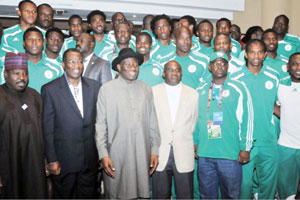
President Goodluck Jonathan poses with members of the Super Eagles.
BY JOHN EGBOKHAN
As Nigeria rolls out the red carpet today to celebrate 53 years of independence, no other sector can boast of putting the west African state in the limelight as sports has done since she attained independence from Britain on October 1, 1960.
But ironically and sadly too, no other industry has been more neglected and maligned as sports, leaving many people to ask whether Nigerian sports has gained more from this independence. Given that with independence comes the twin gains of self existence and determination to progress, can one truly say that Nigerian athletes have enjoyed these in their pursuit of excellence in the last 53 years.

A table tennis game between Rivers state and Delta State on the second day of the 18th National Sports Festival in Lagos. PHOTO; Kehinde Gbadamosi.
Even some years before independence, only few Nigerians had taken the international sports field by storm.. The likes of Emmanuel lfejuna who won a gold medal in high jump during the Commonwealth Games in 1954, Hogan Kid Bassey who became the world featherweight boxing champion in 1957 and Dick Tiger, who won the middleweight crown and later the world light heavyweight crown, readily come to mind.
It is for this reason, that despite the lofty heights reached by athletes, celebrations are muted on the sports scene because people are beginning to realize that something is not okay with the country as far as this industry is concerned.
Yes, Nigeria won the 2013 Africa Cup of Nations in South Africa, after a 19-year wait, yes we are on course to qualifying for the 2014 FIFA World Cup in Brazil; yes we won the African Athletics Championships in both the senior and junior categories; yes Blessing Okagbare won two medals, a silver and a bronze, at the 2013 World Athletics Championships in Moscow; yes we have won other notable continental sports tournaments but despite these giant strides, we still honestly know that we have fallen short of the world benchmark and even our own potential.

A brief glance at happenings in our industry makes the picture clearer.
Only last year at the Olympics in London, Nigeria returned empty-handed from the biggest sporting spectacle in the world. It was so bad that President Goodluck Jonathan had to organise a sports retreat to address the problems, so as to forestall a repeat at the Rio 2016 Olympics.
For the President, the retreat was important because after 53 years of independence, the story is supposed to be different.
Sports began to take serious roots in the country in 1963 when the National Sports Commission (NSC) began to function under Abraham Ordia as secretary. The 60s was a period of laying foundations and the only visible achievement was the qualification of Nigeria’s Green Eagles for the Olympic Games held in Mexico in 1968.
In 1973, Nigeria hosted the 2nd All-Africa Games in Lagos and also introduced the national sports festival as a way of discovering athletes to represent the country in continental and international meets. The first meeting in Lagos attracted about 6,000 athletes.
The 1970’s also witnessed some achievements. Nigeria’s senior football team won a gold medal in the 2nd All-Africa games while the country’s contingent to the Games came second on the medals table. 1976 and 1977 saw the country earning victories in continental championships through IICC Shooting Stars and Rangers International of Enugu in the Cup Winners Cup Competition.
The country’s record of achievements continued in the 1980s with series of feats especially in football. The bronze medals won in 1976 and 1978 in the African Cup of Nations were improved upon in 1980. The Christian Chukwu led Green Eagles won the Cup for the first time at the National Stadium in Lagos. In 1984 and 1988, Nigeria again got to the finals of the tournament but lost to Cameroon on both occasions.
Nigeria’s Flying Eagles qualified for the first time to represent Africa in the FIFA U-20 World Cup, Mexico 1983. They did not go beyond the first round, having lost 3-0 to Brazil, but they defeated USSR 1-0 and held Holland to a barren draw.
Nigeria’s heroics continued to soar through the 80s and 90s with numerous accomplishments, especially in football. The Golden Eaglet, made up of players below the age of 17, won the Kodak U-17 World Cup, now known as FIFA U-17 World Cup, in China in 1985 and the Flying Eagles, almost did the same at the Saudi ‘89 U-20 World Cup, losing in the final to Portugal.
Nigeria also won silver and bronze medals in the male and female categories of 4 x100m at the Barcelona Olympics in 1992.
The heroics of Nigeria’s U-23 Dream Team at the Atlanta ‘96 Olympics, where they won gold medal in the football event cum Chioma Ajunwa’s glorious feat by winning a gold medal in long jump, put an icing on the cake for Nigerian sport at the world’s stage.
Other landmarks recorded by Nigeria in international sports, such as Eaglets’ triumph in Japan ‘93 and Eagles’ qualification for the World Cup for the first time in USA ‘94 cannot be overlooked.
Above all, Nigeria’s top position at the 2003 All Africa Games, stands the country out as a land that is blessed.
The nation has also produced great sports stars like Hakeem Olajuwon in Basketball, Nduka Odizor in lawn tennis, Mike Okpara, a
Continues tomorrow
Disclaimer
Comments expressed here do not reflect the opinions of Vanguard newspapers or any employee thereof.