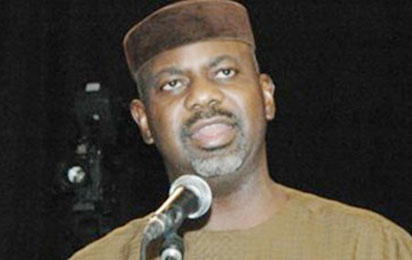
Governor Imoke
By Dayo Benson
Governor Liyel Imoke of Cross River State is one of the few privilleged Nigerians who have held prominent positions of responsibilities in the country.A one time senator and a formal minister, he is also a lawyer by profession.In this Interview, he spoke on some national issues such as calls for state police,independence of the judiciary, constitution ammendment, Taraba political debacle, as well as the legacy he is leaving behind in the State. Excerpts.
There have been renewed calls for establishment of state police in the country, do you support it?
Of course. Why shouldn’t I? Why would anyone want to contest that? I read in the newspapers that the reason you should not have State Police is that politicians would abuse it. Can we as a country and as a people use that as a reason not to have security? And everyone has bought that theory, which brings me back to the issue of awareness and getting the people to understand. Let us even assume that there are bad politicians that manipulate the police, is that the reason we are unable to sufficiently deal with crime in our society. Is that the reason for insecurity across the country?
I won’t even be governor, when (and if) the legislation for State police is eventually passed, but for me, these are some of the fundamental issues we must address if we truly want to be a federation – as I have mentioned earlier.

Governor Imoke
Constitutional amendments
True, a politician may abuse the police, so does that mean the people in that community, state, or location should be without the police or the security? It just does not make sense.
What is your view on amendment of our laws, including the Constitution?
The first question I ask to the amendment of our laws is: What benefits accrue to the people and to the economy from these amendments? And if I can’t see those benefits, then I’ll put it on the second list of amendments. I would rather prioritise. I do not think we are doing enough of that at present. I believe that as our democracy evolves, it is important that we build on our constitutional amendments, that we strengthen our legislations, while we also strengthen and build the capacity to enforce the laws. Therefore, all the stakeholders, the civil societies, the bar, the bench and of course the government have significant roles to play.
Having made the laws, it is therefore, the responsibility of those at the bar to ensure compliance with these laws. While it is also the responsibility of those at the bench to ensure, that those laws are interpreted and enforced. These are some of the responsibilities we need to develop alongside our evolving democracy.
There are a number of issues that arise, when we talk about the federation and federating units. For instance, we have what we call the State High Courts, which are truly not state high courts. They are located in the states, but the judges are appointed by the National Judicial Council (NJC). I, as a governor cannot even appoint a judge. I cannot even appoint a Chief Judge. I can make recommendations, but the NJC can reject that recommendation. The depth of our understanding of our constitution is something we must all begin to appreciate.
Looking at all of this, we must begin to ask ourselves, are we afraid of being a true federation? The technical competencies for government are domiciled in the ministries. Its either we are creating new bureaucracies or inefficiencies. For us, we don’t pay the judicial officers, we pay the junior staff. However, everyone benefits from our minimum wage.
What is the state of infrastructure in the courts in Cross River?
As I mentioned earlier, we merely provide some support for the infrastructure of the courts. They award their contracts (which I don’t mind), but we also need them to work with the competent departments in government that are responsible for them. With regards to the infrastructure of the courts, Cross River State was the model for the application of the new court systems where you now have verbatim reporting and where the judges also record their court proceedings. Despite the infrastructural development that had taken place, the judiciary has nonetheless, remained the most conservative and slow to accept these changes. But that I think is important that this arm of government continues to be strengthened.
Do you think the on-going projects in the state would be completed before the end of your tenure?
We are not at all concerned about the non-completion of projects. We have discussed with our banks, agreed on the funding structure for key projects like the Convention centre, the Golf course, and the entire new development area. The funding for these key projects is in place.
We may not complete all projects at 100 percent but with our road projects, our electrification, and other social projects, we should be able to achieve fully on these.
It is noticed that there is low crime rate in the state. How has Cross River State been able to maintain this level of security and what can other governors learn from these?
What we have done on security in Cross River state is that we have been proactive. On any security report that comes in, we try to address it upfront. We have tracking systems and we have vehicles that are equipped with tracking systems anywhere in the state. Before the conferences we had extensive meeting with the security agencies and examined the entire crime situation in the state.
What do you mean by this proactive approach to security?
We try to be proactive with security because of our commitment to tourism and we cannot afford to take chances. We fight crime and we don’t take things for granted. You would have noticed that we have banned commercial motorcyclist. We are the first state to do that and today, the benefits; in terms of crime rates are quite evident. We have a total commitment to fighting crime and we don’t take it lightly.
Most importantly, the average Cross Riverian is very hospitable and accommodating; therefore, visitors and all residents have nothing to worry about in terms of crime. The only possible crime you may find in the state is petty stealing and a few minor misdemeanors which of course we know cannot be totally eliminated.
Nigeria lost Bakassi to Cameroon, how has your government been able to cope with catering for the citizens of Bakassi?
It is a very unfortunate situation which we found ourselves. It is unfortunate that we lost Bakassi to Cameroon and it is more unfortunate that today, Cross River state is bearing the burden of that loss. Our losses are significant and it is worse on the people of Cross River more than any other. As you know, Bakassi had oil wells which were resources from which Cross River State drew from.
We had our budgets based on those projected earnings and when we lost Bakassi, the impact on our revenue was devastating. Then the citizens of Bakassi had to be catered for and we didn’t find anyone helping out in that situation. The Cross River State government had to bear that entire burden alone. You can therefore, imagine what we have been through.
The consequence of the Bakassi judgment, the non ratification of the judgment by the National Assembly has been devastating on us as a state. There are other consequences of the judgment, not just the socio- economic consequences. We had to scale down on a number of our capital projects and the judgment came at the peak of the agitation for minimum wage to which we had given our commitment. It has been quite challenging and anybody who means well for the state will easily see the grave consequences.
Cross River state lost almost all its oil wells to Akwa Ibom State in a judgment by the Supreme Court. There have been suggestions of political solutions to make up for the loss. Has that been explored with your brother governor, Godswill Akpabio of Akwa Ibom State?
Let me say that I believe that a political solution is still possible with regard to our loss of wells to Akwa Ibom State and we have not shut our doors to that.
What do you consider to be the way out of the leadership crisis in Taraba State?
Unfortunately, I haven’t spoken with the Taraba State governor since his return. So, I cannot say with certainty what his state of health is. But there are very clear provisions in our constitutions which we must be very careful about. I am sometimes amused by how sentimental people can be when they comment on such matters. It is only the medical board that can make a clear and precise pronouncement on Governor Suntai’s state of health and that board can only be set up by the state’s Executive Council to determine his state of health.
What is your take on the recently concluded NBA conference that you played host to in Calabar?
A lot has been said in the course of the conference about leadership and the challenges of nationhood. In deed, you cannot build a nation without the laws. When we talk about rule of law it is based on the presumption that there is a law in place and that is where the rule comes in, which stipulates that we obey the law and that no one is above the law. Therefore, we must first put the laws in place, and these laws may be in different forms.
It may be in the form of legislations, practices or cultural, but significantly they must exist. We do not create laws for the time; neither do we update our laws for the time. These are not good laws. What I think we see now, is an evolution of legislations and legislative processes that we have never seen and or haven’t paid much attention to. If you take a look at this quantum of legislations that has evolved over the last 14 years of our democracy, we see the significance of this. For us in Cross Rivers State, we have several legislations that have helped us.
You are one of the few Nigerian that have been priviledged to be saddled with some sort of strategic responsibilities at both the state and federal levels, and so, in the spirit of the theme of the NBA conference, what would you say has been the challenges of steering the machinery of the Cross River State government?
Like you said, I’m grateful to God for the privilege to have been in public service for a very long time. I have come to understand that the biggest challenge in governance is our processes – be it in civil service or in our political offices. Projects or assignments that should ordinarily take 90days or less would be done in 120 days or more, in the guise of ‘due process’. They accuse the system saying….”because you introduced due process, then achieving this assignment would take longer,” whereas this should not be so. If we understood due process, we will not use due process as an excuse for delays.
The second greatest challenge is the limitation of resources. The first challenge faced in governance is being able to define your programmes and implement these programmes that are beneficial to the majority of the public. I always tell my people that government should serve those who need government the most, as against serving those who make the most noise. This is a very big challenge in a developing economy.
As a government, we really have a duty and a responsibility to understand and appreciate that Cross Rivers State no matter how beautiful it is, is only as good as the poorest person in the state.
Therefore, if we do not continuously pay attention to social reforms and social welfare, then of course, we are going to continuously glorify ourselves in our own infrastructure and nice environment without necessarily having an impact on our people. So, while we continue to build nice school ‘buildings’, education remains a disaster in Nigeria, and we get glory for the school buildings.
Bigger challenge
I do not think there is any government that built schools and was not well celebrated. I’m not saying this is not good, but for me this is not what government should be about. And even getting the public to understand this, is a bigger challenge.
If we cannot do something to meet the MDGs by 2015, then as a nation, I think we should query ourselves, when smaller African countries have got it right. These are basic human development indicators, and this is what government should be about. It is therefore, important that the public that we serve understands this, even as we try to implement our initiatives.
One of the critical things that we need is the law. To be able to do what needs to be done and make great impact on the lowest class of citizens (those who may never have access to a commissioner or a governor), we must have extensive social reforms.
Disclaimer
Comments expressed here do not reflect the opinions of Vanguard newspapers or any employee thereof.