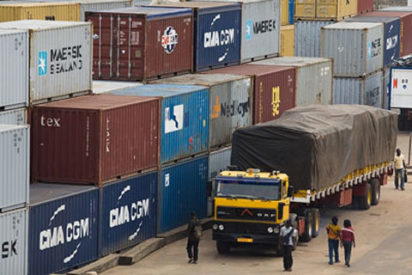
A fully loaded truck in one of the inland dry ports in the sub-region, will be delayed, harassed for bribes by the numerous security agents along the region’s transport corridor before it gets to its destination.
By UDEME CLEMENT
Dr. Godwin Oyedele Oyediji is a former chairman, Agriculture, Non-oil Export Trade Group, Lagos Chambers of Commerce, Industry, Mines and Agriculture (LACCIMA). He speaks on the just concluded 19th Nigeria Economic Summit (NES), the need for government to put measures in place to revamp agriculture for large scale production, the recent loan granted Nigeria by the World Bank to boost the sector for greater productivity and the state of the economy in the third quarter of 2013.
You are a stakeholder in the agric sector. What are the economic benefits of the just concluded 19th Nigeria Economic Summit (NES)?
The Summit provided a good platform for experts to brainstorm on measures that must be put in place to diversify the economy into agriculture, manufacturing and non-oil export sectors. Resources in the non-oil sector, particularly agriculture, if adequately harnessed, would boost economic growth now and long-term development.
The Summit tackled important issues like human capital development, trade and investments in the real sector to enhance optimum growth, which are quite imperative for the economic transformation agenda of the Federal Government. Also, the Summit paved the way for local and foreign investors to see Nigeria as a good investments hub within the West African sub-region.
Most discussants at the Summit focused on transformation of agriculture. What step do you advise government to take in stimulating development in this sector?
Agriculture is a very important sector because it allows sustainable growth of the economy if adequately funded. Developing the sector is a good initiative, as such would enable government to diversify the economy to discontinue this economic policy or budgetary system that centers on revenue from crude oil, which we do no have control over the price and demand from the international market.
Therefore, in developing the sector, government must be pragmatic about implementing policies mapped out to enhance long-term economic benefits. For instance, the sector has the capacity to create not only jobs for the citizens in various locations across the country, but raw materials for the industries and sufficient food for the citizens. Also, before the discovery of crude oil, agriculture was our major source of income and our economy experienced relative full employment and stability. This shows that agriculture is a sector that deserves needed attention to drive the nation’s economy.
Talking about job creation, can you give us statistics on the number of jobs that the sector can create either quarterly or annually?
If adequately funded, the sector can create about 500.000 jobs annually because agriculture has short and long term economic benefits.
Nigeria has a population of over 160million. As an expert in the sector, can you give us estimate of how many Nigerians are involved in agriculture currently?
Well, at present, looking at the aggregate analysis, about 70million Nigerians are into agriculture in Nigeria. These figures include direct and indirect labour work-force in the sector. This is because employment generation in this sector is often classified under skilled, semi-skilled and unskilled labour. This implies that with the population of over 160million people, agriculture can take 50 per cent of the entire work-force of Nigeria, noting fully well that 50 per cent of Nigeria’s population are youths from 15 years and above.
Agriculture can also generate revenue as additional source of income-flow in the economy. For us to achieve this, large scale farming with modern tools must be encouraged at different places across the country. Aside from that, the farm produce must be exported to other countries in order to attract foreign exchange for Nigeria’s economy. This is what obtains in advanced countries where modern agriculture is practiced.
Recently, the World Bank granted Nigeria $300million credit facility to boost agriculture. Why is Nigeria taking external loan when government is saving money in Sovereign Wealth Fund (SWF)?
The approval of such a whooping sum for the sector is a welcome development but the most important thing is prudent utilisation of the money to achieve the intended purpose in the long-run. The World Bank granted that loan because they have seen the indices of growth and future prospect in Nigeria’s economy. So, we must realise that this is a credit facility provided in foreign currency, which is also expected to be paid back in foreign currency as well. Beyond that, we need massive investments in agriculture to enhance food security for Nigeria.
Don’t you foresee any problem with the loan in future?
My only fear is the exchange rate of the Naira to Dollar in the capital market. For instance, the World Bank has just approved this loan for Nigeria and the exchange rate now is between N155 to N160 per Dollar. In future, the exchange rate can increase from N160 to N180, and if that happens, paying the loan back becomes very difficult.
Some Economists at the Summit also lamented about excessive importation of consumable items by Nigerians. What is the way out of this?
For Nigeria to stop excessive importation, we must improve our production capacity to meet the increasing demand in the market. For instance, Nigeria imports milk estimated at the monetary value of about $1million daily for local consumption. This shows that, there is the urgent need to improve milk and meat production in the country instead of spending so much on excessive importation of goods that can be produced locally.
The issue is that, this money is spent in the face of increasing unemployment and poverty, when we can adequately harness the livestock potentials in Nigeria to produce these goods here. The current import regime of more than 90 per cent of our milk requirement is worrisome, even as the wastage of the minimal local production is getting out of hand. The reality is that, excessive importation of goods is not helping our economy because it paves the way for capital flight.
Disclaimer
Comments expressed here do not reflect the opinions of Vanguard newspapers or any employee thereof.