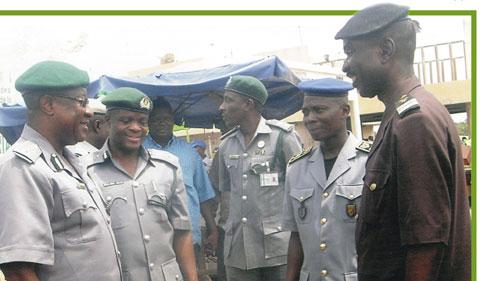
Comptroller General of Nigerian Custom Service (NCS) Alhaji Abdullahi Dikko, Comptroller Gabriel Aliu, Chief Superintendent Ibrahim Turaki and Cheff du bureau of Benin Republic Customs Seme Command, Col Kpodehou Yves at a recent function at Seme.
By UDEME CLEMENT
The Port Harcourt Area 11 Command, Onne Port , Nigeria Customs Service is one trade centre that most oil and gas companies cannot do without. Strategically located at Onne, the Command has become vital for trade facilitation within Nigeria and West African sub-region, as Onne assumes the status of largest growing dedicated oil and gas free zone in the world.
The zone is designed to act as a distribution hub for the West African sub-region for general and container shipping services. Experts described Onne as one of the largest oil and gas free zone service centres in the world. When Sunday Vanguard visited the Command, it was observed that its operations differ from other Commands at the border points in the country, because the Command handles conventional imports as well as oil and gas imports.
The Command deals mostly with oil and gas multi-nationals, as about 90 per cent of National Integrated Power Projects (NIPP) equipment are brought in through Onne. The Customs Area Controller (CAC) of the Command, Comptroller Magaji Mohammed, who was former CAC Oyo-Osun Command, DC Administration in Onne and Acting Comptroller, Customs Intelligence Unit (CIU), speaks on the four years of reform embarked upon by the Comptroller General of Customs Dikko Inde, the revenue profile of his Command and how the reform will enhance economic growth and development.
The Service has experienced series of reforms in the last four years. Could you tell us how these reforms impacted on your operations within the oil and gas free zone like Onne and the economy at large?
The on-going reform in the Service has rejuvenated every aspect of Customs operations. It has impacted positively not only in our Command but in various Commands across the country. The evidence can be seen in areas like revenue generation, anti-smuggling campaign to prevent economic sabotage and increased productivity through trade facilitation in the last four years. For example, the half year 2013 record of revenue collection in our Command shows tremendous improvement over the previous years.
Can you give us statistics of your revenue profile in 2013 in naira and kobo?
The revenue analysis from January to June this year shows that the Command realised huge revenue generation of over N37.9billion, out of which N24billion went into Federation account, while N13.8 billion went into non-federation account. Also, the Command recorded 13 seizures, which includes 13 containers, total CIF value is N62,474,870.45, total duty payable is N20, 588,794.48, total Duty Paid Value (DPV) is N89,290,965.33 and 11 number of defendants. The highlights of the seizures include motor spare parts, plastic boxes, plastic plates, red-wine, slippers, steel doors, tiles, pirated books, television cable wire, glass tables, plasma hangers, DVD players and boxes for conveyance of musical instruments.
Aside from revenue and anti-smuggling, how has the reform impacted in other areas of the economy?
Looking at the Service holistically you will see numerous achievements recorded through the reform initiated by the CGC in the last four years, especially trade facilitation in line with international standard. Look at Information Communication Technology (ICT) for instance. In line with the global trend of facilitating trade, the CGC introduced the modernisation programme based on ICT, which entails migration to Single Window.
Can you explain what you mean by Single Window?
Single Window in Customs operations, provides e-services to all stakeholders involved in clearance of goods out of the sea ports, airports and land borders. It also enhances efficient cargo clearance to facilitate trade in the country. Within ICT is the introduction of an e-trade platform known as Nigeria Integrated Customs Information System (NICIS). Also, we have what is called the Nigeria hub, a platform where importers, exporters and other stakeholders can access relevant information from a central point for trade purposes. These are some of the outstanding achievements recorded within the last four years.
Aside from Nigeria’s economy, other countries within the West African sub-region are beneficiaries of Customs reform. A typical example is in capacity building programmes. In order to meet the present global challenges, the CGC organised various training programmes within and outside the country, which covers all ranks in the Service.
Apart from other Customs Colleges that are well equipped in the country, the Command and Staff College at Gwagwalada in Abuja , has been upgraded and approved by World Customs Organisation (WCO) to serve as a regional training centre for West and Central Africa . This is a great achievement for Nigeria made possible through Customs reform.
Also, within the present CGC’s tenure, the Service has achieved great deal of infrastructure development in terms of adequate office accommodation, installation of computers and software, provision of operational vehicles and other work tools needed to enhance efficiency and increased productivity to stimulate economic growth and development, now and in the long-run.
Customs also acquired two fast moving ocean going vessels and a modern aircraft to curb smuggling. Due to the positive restructuring of the Service, Dikko was adjudged to be the best CGC and was given an award as the “Best African Public Servant of the year”, by African Leadership Magazine in London. He has instilled discipline in the Service, such that, there is high sense of discipline in Customs now than what obtained years back.
What will you consider challenges in the last four years?
The major challenge for some Commands at the border points in the country are the porous borders, which makes policing the borders difficult, but we are doing our best to curtail smuggling of offensive goods into our country. A recent example is the interception of 56,750 rounds of live ammunition by Customs in Oyo/Osun Command, which attracted commendations from Nigerians and people out side the country. The current Customs management has succeeded in bringing back the good image of the Service in the eyes of all Nigerians and the world generally.
Disclaimer
Comments expressed here do not reflect the opinions of Vanguard newspapers or any employee thereof.