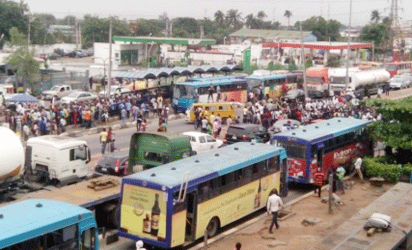
File photo: students protesting ASUU strike in Lagos
By Denrele Animasaun
“Education costs money, but then so does ignorance.” — Sir Claus Moser
A couple of days ago, I was watching Al jazeera, where the presenter, had mentioned a special feature exchanging information about the current situation that Nigerian university students who are facing prolong the Nigerian’s Academic Staff Union of Universities (ASUU) strike.
Reading the messages left by numerous students, is quite shocking and it saddens me to the core. One student listed his day to day activities as sleep, breakfast, sleep, do nothing, lunch and sleep some more. Well, what else can they do? There is an obvious feeling of hopelessness and they say: idleness is the devil’s workshop.
Without a doubt, this prolonged strike is affecting these young people and their immediate family. One very clear message from the number of comments I read on AJstream is the resentment, despondence and frustration felt by these young people. Nigeria cannot afford to dice with the education of our young people.
No quibbles, education should be a priority not an option, how do we expect to compete in the world market, if our young people cannot get a decent, consistent and thorough education? They will vote with their feet and go elsewhere. No wonder there is a proliferation of private universities in Nigeria. Problem with that is that only the rich can afford to go to these inflated establishments. So, the gulf between the classes will continue to widen and impact seriously on the future of Nigeria and in all area of economics and development.It is going to create more unrest, fuel more resentment and about time the government stop pontificating and invest in our public universities.

File photo: students protesting ASUU strike in Lagos
This strike has been going long enough, since July as the negotiation between the union and the government stalls, the level of uncertainty is bordering on negligence and criminality. In all 60 public university staff have downed tools and closed our seats of learning. It is unfathomable that in the last fifteen years, three years is far too long to deprive young people of their academic and personal lives.
The impasse is not isolated to these young people, it affects families who have practically invested financially. Their lives also are put on hold; the community is robbed of young men and women and the country well, a lot of money and manpower is lost. Billions of Naira is haemorrhaging due to the delay, it is a very big problem in the full scheme of things and I don’t think that the powers that be fully grasps the dire implications of their inertia.
Last year, in the UK there was a deluge of snow storm and it prevented workers, students and commuters getting to and from work and schools. The delay cost was rounded in billions and that was days not months. It is bad enough when the condition of our universities has been described as “on life support to (and) critical”.
The education of our young people should be a priority not an option. With about 1.25m students are enrolled in Nigerian public universities, Nigeria allocation to education is far lower than its neighbouring and least populous nations. Nigeria’s annual average budgetary education expenditure during the last two decades was 5.8%, whereas Niger spent 28%; Côte d’Ivoire 30%; Burkina Faso 16.8%; Liberia 11.9%; Gambia 14.2%; Ghana 30% ; South Africa, 19.3% of its annual budget on education, while Egypt committed 11.1% on average and Kenya 23%.So it is lunacy when you pay peanuts and expects gold nuggets.
The government response to the impasse is that they have increased the allocation to education from $ 2.6 to $2.8 but not by much to the union’s frustration.
In neighbouring Ghana they are investing 30% in education, so no wonder Nigerian students are going to Ghana to study.
In a country where over 62.6% of its citizens live below the poverty line of $1 a day, according to the World Bank, many cannot afford to pay the inflated fees levied by the private universities so they are therefore out of reach for a university education.
Those in government should know they would not have had an education if the public universities in their day, was not available or accessible to many.
How soon they forget, many would not hold high office and now they deny that opportunity to ordinary Nigerians.
Hope Spring Eternal
The story of the stowaway was not big news over here but it did pique my interest. A 13 year old, hid in the wheel well of Arik Air from Benin Airport to Murtala Muhammed Airport in Lagos. Good news the boy did not die but, what ensured after was disgraceful. The young boy was beaten and rough handled by the airport security.
This boy deserves better and not the treatment he received after his misadventure. We need to re- examine and understands what makes a 13 year old to go through these dangerous lengths to escape his life. If the news is true I hear that, he has now attracted some well-wishers willing to provide him with quality education and nurture his ambition. Hope springs eternal.
Peter Obe…
“Earth does not belong to us; we belong to earth.Take only memories, leave nothing but footprints.” ¯ Chief Seattle
A good photographer, when I was growing up is often liken to Peter Obe, It was a compliment that I still used till this day. The real Peter Obe sadly passed away this week. He was the original and inspired many. Way before high tech gadgetry, he would drive all hours of the day and night and through his lens he covered many salient moments in Nigeria’s history. He was Ace to those who knew him at Daily times and never misses those poignant moments. To many of us growing up, he was the definitive Peter Obe and his pictures was that exactly that: the hallmark of excellence. He truly deserves the many accolades I have read and many will follow. Peter Obe, a true master in photo journalism.
Who Is A Thief?
When someone steals another’s clothes, we call them a thief. Should we not give the same name to one who could clothe the naked and does not? The bread in your cupboard belongs to the hungry; the coat unused in your closet belongs to the one who needs it; the shoes rotting in your closet belong to the one who has no shoes; the money which you hoard up belongs to the poor.”
¯ Basil the Great
Disclaimer
Comments expressed here do not reflect the opinions of Vanguard newspapers or any employee thereof.