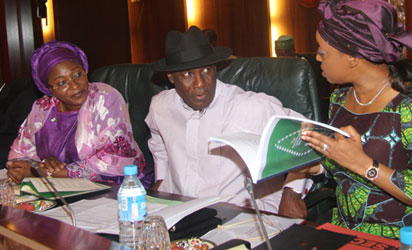
Petroleum Resources Minister, Mrs. Deziani Alison-Madueke (r) showing a copy of the authentic Petroleum Industry Bill to the Niger Delta Minister, Elder Godsday Orubebe and the Minister of State Niger DeltaDevelopment, Hajia Zainab Kuchi while the Sports Minister, Mr. Bolaji Abdullahi watched the weekly meeting of the Federal Executive Council at the State House, Abuja. Photo by Abayomi Adeshida
By ABIYE MEMBERE
REGIONALLY and globally, the petroleum market is becoming increasingly unkind to Nigeria. At the national level, of course, we have problems too – bunkering, or theft, as well as a lack of transparency both create commercial difficulties for companies operating in the Niger Delta and off the country’s southern coast.
These domestic issues are threatening our competitiveness, and we’re working to deal with them. The Petroleum Industry Bill – a mammoth piece of sector reform that’s being considered by the National Assembly promises several solutions to these and other problems.

Mrs. Deziani Alison-Madueke (r) showing a copy of the authentic Petroleum Industry Bill to Elder Godsday Orubebe and Hajia Zainab Kuchi while Mr. Bolaji Abdullahi watched the weekly meeting of the Federal Executive Council at the State House, Abuja. Photo by Abayomi Adeshida
The separate class of problems, at the regional and international levels, is related to these domestic concerns. As regional and global competition become stiffer, issues like transparency and bunkering become more important, as they reduce Nigeria’s competitiveness. The reasons to pass the PIB, in other words, are gathering and growing every day.
At the regional level, we’re facing stiffer competition. Across sub-Saharan Africa, other countries are discovering oil and working harder to bring it to the market. New discoveries range from Sudan to the Democratic Republic of the Congo; closer to home, Angola continues to supply large volumes of oil to the Asian market (it is by far our closest competitor in sub-Saharan Africa in terms of production volume). Meanwhile, Ghana has also brought on stream its own, large reserves during the past three years.
As these countries begin to expand their output, seeking to gain the foreign currency inflows that come from oil and gas sales, competition will increase, creating pressure on our own market offer. Nearby competitors will work to demonstrate to international oil companies – IOCs – that they, too, can play host to large multinationals. Ghana may demonstrate too, that other West African countries can also do transparency and competition properly – potentially leading IOCs westwards away from Nigeria and into other well-regulated oil blocs off the Ghanaian coast.
This regional challenge is the most immediate test for us. The PIB offers a clear set of solutions: the dissolution of confidentiality clauses so that companies and the public are aware of the true market value of oil blocks under auction. It is a regulatory system that emphasises production volume instead of profit, and smaller oil blocs with “drill or drop” provisions to ensure that companies that are eager to extract won’t lose out to companies seeking to buy and hold their blocks idle.
Global developments
But the regional pressure is not the only force affecting us from beyond our borders. There is also another change affecting oil producers worldwide, namely the growing power of consumers over suppliers. During much of the post-colonial period, oil producers have had the upper hand over oil consumers: the establishment of the Organisation of Petroleum Exporting Countries, OPEC in 1961 allowed suppliers to coordinate their sales to strengthen their bargaining position collectively; and the inescapable need for oil in America, Europe, and other fast-growing oil-consuming states means that even as prices rise, demand has stayed steady. Even the oil shock of 1973, and the modern environmental movement, did not lessen the West’s thirst for oil.
Today, though, the balance of power is tilting in favour of the consumer. It’s changing due to shifts in supply and demand.
As regards supply, there are now more oil producers internationally: states are now extracting at a pace never seen before, and shale-based extraction is now possible due to advances in technology, meaning that new supplies are now expected to come online in Europe and North America during the coming decade.
As regards demand, the financial crisis of 2008 continues to exert its negative influence upon global oil needs. Europe’s recovery is sluggish or yet-to-be-seen. America’s consumption has been affected, albeit to a lesser degree. And new fears about a slow-down in the Chinese economy threaten to reduce that country’s industrial demand for oil, gas and oil-based products there over the coming years.
The Chinese problem is particularly acute for Nigeria: because China consumes much of Angola’s gas, a reduction in Chinese demand would leave Angola seeking new markets for its output. If Nigeria finds itself competing locally with both a rising Ghana and a re-orienting Angola, it may discover that its oil blocs sell for far less than they do today.
Naturally, these are not forces we can control from Abuja, or from anywhere else. They are part of the global turmoil that has wracked Europe and America since 2008, and that has largely passed Nigeria by. We should not be surprised to find ourselves impacted by the downwind of this financial and economic hurricane.
Feasible programme
But we should be surprised if, over the coming year, legislators do not understand what must be done to brace ourselves against the concomitant drop in demand. It is vital that, while the market is still favourable to us, we work rapidly to make the Nigerian supplies attractive to outsiders.
The PIB is the indispensible response. Certainly, it cannot be the only response: continuing to handle security is vital, too. But the PIB offers the best and most feasible programme for reforming Nigeria’s petroleum sector. And it appears, from recent news that this is being understood: the Congress for Progressive Change (CPC) supports the bill, and the Senate has accorded it a high priority during its latest session, which began on June 25.
If this bill were to be rejected, Nigeria would have reason to be seriously concerned for the future of its oil industry. If it passes, we will be in a position to continue winning business even as the international environment becomes more cut-throat. We will always need to continue improving regulation and responding to new, unforeseen challenges – but this is normal in any country. Passing the PIB is the only feasible foundation for the industry’s future. I remain hopeful that the legislators will agree.
Disclaimer
Comments expressed here do not reflect the opinions of Vanguard newspapers or any employee thereof.