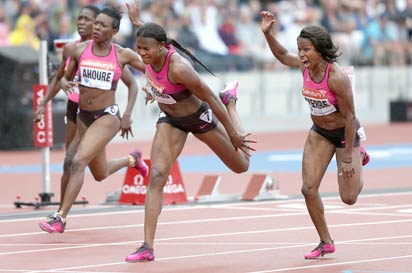
Blessing Okagbare of Nigeria (2-r) stretches to cross the line in the womens 100 metres event during the London Anniversary Games International Association of Athletics Federations (IAAF) Diamond League International Athletics Championships at the Olympic Stadium in London yesterday.
Blessing Okagbare’s exploits at the recently concluded International Association of Athletic Federations (IAAF) championship in Moscow, Russia, was widely hailed by sports enthusiasts and stakeholders.
Blessing won silver and bronze medals in long jump and 200 metres respectively, thus ending Nigeria’s 14-year-old medal drought in the IAAF championships.
Nigeria last won a medal in 1999 when Gloria Alozie won silver in the women’s 100 metres hurdles, while Francis Obikwelu got the bronze in the men’s 200 metres at Seville, Spain.
Some stakeholders described Okagbare as indeed a `Blessing’ to Nigeria as her performance placed Nigeria 24th on the overall medal table.
Chief Nicodemus Omenka, a former Commissioner for Youth and Sports in Ebonyi, said that Okagbare’s recent feat had returned Nigeria to its glorious days in athletics.
“She has returned us to the days of Innocent Egbunike, Chidi Imoh, the Ezinwa brothers, Mary Onyali, Chioma Ajunwa, Christy Opara-Thompson, Falilat Ogunkoya, among others.
“These were the days that the nation was sure of medals in major international competitions which was climaxed with Ajunwa’s historic gold medal at the Atlanta ‘96 Olympic Games,’’ he said.
Dominic Ukwuome, Athletics Chief Coach of the Ebonyi Sports Council, said that Okagbare’s performances had eclipsed the sad tales of London 2012 Olympic Games, and other recent competitions.
Some analysts have argued that Okagbare succeeded where her male counterparts failed, and had entered the annals of Nigerian athletics as one of the females who did the nation proud at the international competition.
They listed others to include Chioma Ajunwa, the first Nigerian to win an Olympic gold medal (long jump at the 1996 Atlanta Games), and the first African woman to win an Olympic gold medal in a field event.
Mary Onyali also won the gold medal in 100 metres in the 1994 Commonwealth Games in Canada. She was the first Nigerian woman to compete in five Olympics, clinching 12 medals from various competitions with eight gold medals.
Falilat Ogunkoya was Nigeria’s 400 metres queen and still holds the African record of 49.10 sec in the 400 metres event.
Fatima Yusuf won a gold medal each in the 400 metres event at the 1990 World Junior Championship, and at the 1991 All African Games. She participated in the 1996 and 2000 Olympics, winning silver and bronze respectively.
In football, Mercy Akide starred for Nigeria in three FIFA Women’s World Cups, two Olympic football events, and won three African titles with the Super Falcons.
She was named African Women’s Footballer of the Year’’ in 2002 by CAF, and was appointed an ambassador for women’s football in 2005 by FIFA.
Another football heroine is Perpetua Nkwocha, who played in three African Women’s Football Championship.
Linda Ogugua and Mfon Udoka were known for their feats in basketball. They participated in the 2004 Summer Olympics. Udoka was first in rebounding and second in scoring points.
The Monu sisters (Ngozi and Uche) set the pace in swimming, an event that is not common among Nigerians.
Ngozi participated in the 2000 and 2008 Summer Olympics setting the fastest time by any Nigerian in the 50 metres freestyle event.
It is the views of most stakeholders that Nigerian women were capable of bringing more laurels to the country if given more encouragement.
Victor Orji, President of the Federation of Public Service Games (FEPSGA), said that female athletes needed more attention from the government and the society.
“So far, they have fared well with the limited resources they have; it is just that the support they got was not enough compared to what their male counterparts receive.
Mrs Dilichukwu Onyedinma, Chairperson of the Nigeria Women Football League (NWFL) corroborated when she said that women footballers should enjoy as much as their male counterparts.
“Women’s football in Nigeria should be enjoying what the men are enjoying because the senior women’s national team, the Super Falcons, qualified for the World Cup the same year it had its first international outing.
“But it took the senior male national team, the Super Eagles, 40 years to qualify for the World Cup.
“Also, the Super Falcons have won the African Women Championship six times, while the Super Eagles won the African Cup of Nations three times.
“So, we should be given the attention we deserve and not what we are experiencing,’’ she said.
Ebenezer Morakinyo, first Vice President of the Nigeria Volleyball Federation (NVBF), argued that that the problem with women’s participation in sports is the failure of the nation to appreciate women’s achievement.
“Their contributions cannot be over-emphasised as they do not only participate, but they have also succeeded in sports administration.
“But the problem we have in this country is that we do not sing praises of our women when they win laurels for us at both individual and team sports.
“I think people should be able to do a kind of comparative study to know how well the women and men contributed in sports development in this country.
“The study should not only be in sports administration, but also in participation and winning laurels; I will not be surprised if the women have an edge over the men,’’ he said.
More women should be encouraged to show more interest in sports as female athletes had done the nation proud in international competitions. It is on record that Nigeria’s first Olympic gold medal was won by a female athlete. (NANFeatures)
By Bushrah Yusuf, News Agency of Nigeria
Disclaimer
Comments expressed here do not reflect the opinions of Vanguard newspapers or any employee thereof.