Labour warming up for industrial action
By Salihu Moh. Lukman
The national minimum wage is in the news again. This time, the issue is whether or not to have it retained on the exclusive list or to have it on the concurrent list. The NLC and the TUC have threatened a strike if it is placed on the concurrent list. Labour Vanguard opens a forum for this discussion for proponents and opponents of the new move. Informed contributions on this issue are welcome.
ONCE again the issue of minimum wage is reverberating in the
Nigerian media following the consideration by the National Assembly to move it from the exclusive list to the concurrent list in the 1999 Nigerian Constitution. By that proposal of the National Assembly, Part I, item 34 of Second Schedule will be amended to move the sentence “prescribing a national minimum wage for the Federation or any part thereof” to Part II.
The NLC has registered its opposition to this proposal arguing that the “removal will unnecessarily expose Nigerian workers, especially those in the low-income bracket with grave implications for security, productivity and national well-being, as most state governments if given the latitude, will pay wages as low as one thousand Naira per month in spite of the relative enormous resources available to them.” This was contained in a statement by the NLC President, Comrade Abdulwaheed Omar.

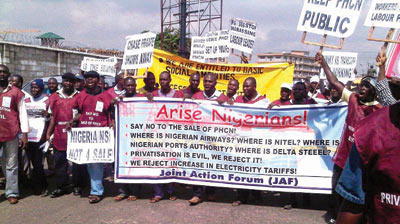
*File photo: Cross section of pensioners defying the downpour during a peaceful protest against non-payment of their entitlements at the Federal Secretariat, Abuja. Photo by Abayomi Adeshida
While the position of the NLC is very understandable, it is however founded on a very weak and erroneous premise. In the first place there is the implicit assumption that there is relatively “enormous resources available” to all governments and perhaps all employers in the country. Related to that is the apparent conclusion that the “enormous resources” are equitably distributed to all employers across the country, be it public or private.
It needs to be emphasised that minimum wage law is applicable to all employers – private and public. Partly because the process leading to passage of the 2010 Minimum Wage Act was dictated by the capacity of the Federal Government to pay N18,000 should not cover the reality that many employers, including some state governments have been unable to implement the N18,000 minimum wage. This much was acknowledged in the statement by Comrade Omar. This highlights the existence of a problem which may also translate into wiping out some small employers out of business with the consequence of all workers employed by such employers thrown back to the labour market.
There is certainly both conceptual and empirical problem with respect to the framework for minimum wage legislation in Nigeria. While it may be advantageous today for Nigerian trade unions based on some faulty notion of statutory awards that would threatened employment as well as almost proved impossible for unions to enforce, it could be debated that in the long run it may be a disadvantage.
Imagine a scenario whereby either price of Nigerian crude in the international market crashed or the market become smaller. If the argument for “enormous resources” is informed by current revenue from oil as determinant for minimum wage and not workers output or production levels, the NLC position with respect to minimum wage is to say the least injurious to Nigerian workers.
The point is, it is wrong to hinge argument for current statutory framework for minimum wage in Nigeria based on a pedestrian belief that there is relatively “enormous resources”. Relative to what? This is the common perception in the country today, which has impacted negatively on productivity and has virtually reduced most Nigerians to rent-seeking behaviours. The dignity of labour and the human person is commonly sacrificed on the alter cheap search for free money. Contractual responsibilities have been reduced to nothing.
It is important to emphasise that relatively “enormous resources” is a perception that is easily justifiable with reference to perhaps current levels of revenue from crude oil and not necessarily taking into account work indices, especially issues of workers output and its contribution to national wealth. Against the background that today, Nigeria earns more than N8 trn annually largely from crude oil, the temptation to conclude that our governments at all levels enjoy relatively “enormous resources” is appealing.
No doubt, with reference to our recent past as a nation whereby the total annual revenue of government was in the region of N2 trn, current levels of N8 trn is relatively “enormous”. The critical reality however is that this increase in revenue is not shared proportionately. On account of what can we regard states like Ebonyi and Nasarawa as enjoying “enormous resources” with less than N4 billion monthly from the Federation Account, while states like Akwa Ibom and Rivers receive more than N20 billion monthly. Perhaps with reference to a personnel cost of approximately N500 million for Ebonyi and Nasarawa, the argument for “enormous resources” may be sustained.
This financial profile is almost re-enforced by IGR profile of these states. Based on CBN 2010 Report, Akwa Ibom is reported with more than N1 billion monthly IGR and Rivers close to N5 billion monthly. Contrastingly, Nasarawa and Ebonyi were reported with less than N200 million monthly IGR. Now what will be the logic of equating the pay of workers in Akwa Ibom and Rivers with that of Nasarawa and Ebonyi?
With monthly personnel cost of approximately N500 million and monthly IGR of under N200 million, a situation where FAAC receipt crashed can be better imagined.
Organisational indolence
How then can anyone be making a case for wages based on such a loose foundation? In many cases, one is tempted to argue that NLC argument as presented by Comrade Omar is driven by large dose of intellectual and organisational indolence. Given that Nigerian trade unions are almost completely absent today in all our national policy debates, they have lost rational reasoning and relied more on grandstanding and brinksmanship as a strategy, which has reduced NLC’s, and of course trade unions’ pre-occupation in the country to dominantly that of organising strikes.
Nigerians today hardly hear of NLC and trade unions activities except when strikes are declared.
Logically and historically, this will not be defensible. NLC and Nigerian trade unions have been vibrant centres of first and foremost intellectual contestation which get reflected and manifest in the way union leaders relate with governments.
Disclaimer
Comments expressed here do not reflect the opinions of Vanguard newspapers or any employee thereof.