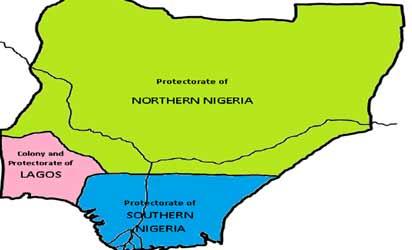
Map of Nigeria
By Adisa Adeleye
Every week and every day, many Nigerians will like to discuss about the good fortunes or otherwise, of their country which bears the title of Nigeria since 1914. Even if the word, ‘Nigeria’, to some, is merely a ‘geographical expression’, the country is still geographically, a reality.
The love of the country called Nigeria is so great that enthusiasm for greatness is so high, especially during international competitions in sports where every gold medal is desired for Nigeria.
When a Nigerian wins a gold medal, it is a win for Nigeria, when the individual fails to win, his state of origin or tribe takes the blame. However, it has taken us a long time to realize that success is a function of absolute patience after a long period of training and preparation.

Map of Nigeria
Nigeria is a young country of less than one hundred years old and has been subjected to colonial rule until 1960. Between the advent of freedom in 1960 and the return of democracy in 1999, the country’s leaders had been politically remiss and economically amiss. The intervening period had allowed those countries which started the race of development with Nigeria in the 1960s to fare far better.
Although comparison might be odious, it might be refreshing to acknowledge the economic miracles of Indonesia, Malaysia and Singapore over the past fifty years, under strong and purposeful leadership. Indonesia (population of about 250 million) could boast today of per capital income of $3,000; with more than sixty per cent of the population having access to safe drinking water.
Malaysia has a low rate of about four per cent of people living below poverty line, while unemployment rate was about 3 per cent in 2011; foreign exchange reserves stood at $129.6billion and GDP growth rate was about 5.2%; per capital income was calculated at $2,981 and about 87 per cent of the population have access to drinkable water.
Singapore is a typical example of phenomenal economic growth in the world. From a figure or $395 per capital income in 1960, that country has been able to raise her per capital income to $43,865 by 2011. Also, the whole population has access to clean drinking water.
(I am grateful to the Governor of the Central Bank, Mallam Sanusi Lamido Sanusi for the compilation of these figures through series of his lectures). Compared with the three countries mentioned, Nigeria could only exhibit not too impressive figures of $1,500 per capital income, more than 70% of the people living below the poverty line and less than 40 per cent of the population having access to good drinking water. Although with a 6.28% GPD growth rate in 2012, Nigeria’s current unemployment rate is about 40 per cent. Hence, the call for jobs and more jobs for the people.
In fact, as I have noted before in this column, by 1965, Singapore depended mainly on entrepot trade and provision of services for British Military bases, it had no natural resources. Today, Singapore has been able to transform herself into a prosperous country by embracing development strategies along these phases – import substitution; export drive; industrial reconstruction and diversification.
I mentioned also that the present day Nigeria could be said to have gone through all these stages of development, but haphazardly, and without due regard for assessing the rate of success at each stage. Perhaps, it is now time to return to the starting point and sort out the real growth motivators from the welter of conflicting economic policies.
Perhaps what is not properly understood by some analysts is that Indonesia, Malaysia and Singapore grew under a relatively long period of political and economic stability (under a form of dictatorship). Each leader was given enough time to pursue his pro-growth, pro-employment and pro-poverty eradication policies. The people also, were patient enough to reap the joy of patience.
Even in Britain, ‘Thatcherism’ as a concept had eleven uninterrupted years to germinate, while Tony Blair and Gordon Brown spent ten to thirteen years to preach the gospel of ‘New Labour’. China, the new world economic power took some time to prepare, while the people suffered a lot of deprivations and loss of personal freedom, while waiting.
The pertinent question is; can or will Nigerians give President Ebele Jonathan enough time (patience) to translate his Transformation Agenda into economic prosperity and political stability? Or, can the President sell his policy to the people to exert sacrifice and patience from them?
At the moment, there is a bit of confusion about what the President and his ruling party (PDP) think on the process of reconstruction and what the opposition feel is the right way. However, many analysts believe that the problems of Nigeria – Power, Security, Poverty and Mass Employment – are beyond the capability of the present ruling party; even if the government is trying cleverly to cover the mediocrity of its officials.
President Jonathan can save the nation by casting his net beyond the shallow waters of party politics. He could initiate a policy of common sense economics and sensible politics.
I think there are many ways of making the Federal Government the true friend of Nigerians in solving many of their problems. Though the Constitution talks about one Minister to represent each state, it does not specify that the person should be a member of the ruling party at the centre.
If the President could go out of his way to nominate members from the opposition states with the approval of the government of those states, he would be making things easy for himself and of his administration.
Many people believe that political considerations have affected the adoption of many progressive policies of the Federal Government in most of the states that are not properly represented in the Federal Cabinet.
State of Emergency
There is no doubt that every peace loving Nigerian will support the declaration of state of emergency in Adamawa, Borno and Yobe States. Though the action by the President seems belated, there is hope that it is a necessary move to stop the drift towards anarchy in the country.
With the offer of amnesty still on, members of Boko Haram Sect and other agents of destruction should embrace peace for the survival of the country. It should be realized that the security of the country is a challenge to all Nigerians at any time.
Disclaimer
Comments expressed here do not reflect the opinions of Vanguard newspapers or any employee thereof.