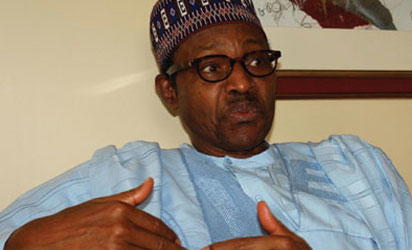
Muhammadu Buhari
By Bisi Lawrence
It is unfortunate that a former Head of State and perennial presidential candidate, like retired Maj. General Muhammadu Buhari, could expose himself to indefensible criticisms through his unguarded statements about this nation. How can he habitually paint a poor picture of the country which he would wish to rule as a democratic leader in future, when he falls short of restraining himself within the bounds of reasonable and acceptable address about the leadership of the day?
Of course, everybody — political opponents, aspiring politicians, foreign commentators and even those who cannot estimate the worth of followership in a democracy but feel free to pontificate on leadership — have adopted the theme of poor leadership as the easy answer to any question about the problem with Nigeria.
It is all our leaders’ fault, and even those who are identified as leaders, or imagine themselves to be entitled to that classification, agree that it is the most painful fact of our national existence that we are not blessed with good leaders, or good leadership — I wonder if the two characterizations are always interchangeable.
But be that as it may, we can align leadership with governance or government which, in a democratic setting, speaks about policies and institutions and direction. So in holding “government” absolutely accountable for a particular aspect of governance, like security, too narrow a view may have been assumed in such a presentation.
We cannot hold ourselves qualified to expatiate on Buhari’ s thoughts but his latest unwary pronouncement has evoked the umbrage one had to suppress about earlier gaffes in the same game of attempting to slam his ill-considered opinions down other people’s throats. On this occasion, Dr, Doyin Okupe, the presidency’s or president’s trumpet was (as ever) at hand to recall that we were all stunned when Buhari declared, while seeking to be the president of this nation, that the country would be made “ungovernable” if he did not succeed.
It should be pointed out, however, for the sake of accuracy, that he did not state the he would make that happen, but the statement has been construed, fairly or unfairly on several occasions, to mean just that. It is also worthy of note that he does not seem concerned about any (mis)interpretation that could have been given to it. The heart-rending events that have since erupted in the killing of so many innocent souls in the North should have made him appreciate the need for such clarification.
It would also seem trite for a man in Buhari’ s position to compare the instance of insecurity in the North with the criminal activities in the Delta. The difference did, in fact, order the contrasting means of handling both of them.
The militants of the Delta did not hold their problems intractable, but submitted to discussions which led to some form of settlement. The terrorists in the North operate in the shadows behind a veil of anonymity, creating fear and keeping meaningful discussions at arm’s length. What is more, many of the operatives are not indigenes of the land but patent mercenaries intent on a heinous mission.
The former Military Head of State is no less entitled to seek any elective office in the land than any other Nigerian, and should feel really concerned about the insecurity that now encloses this country from various directions.
He can make worthwhile contributions to the search for solutions to the problems from which they arise. Since he believes that the issue of the Boko Haram, specifically, is being ill-managed, he is duty-bound to proffer suggestions for an end to this deadly phenomenon. But, like many Northerners, he does not seem to see beyond the proposition of “dialogue”, which has now been expanded to “Amnesty”.
But a positive stand by the leading Muslims in this nation today against massacres and general mayhem by the Boko Haram seems more likely to effect a settlement that statements that tend to give comfort to the terrorists. Wordy statements in condemnation of the terrorist acts and loose declarations of sympathy for the wanton destruction of innocent lives do not go far enough.
There is too much of arm-folding after that. Every Muslim in Nigeria should now rise up with one mighty voice and say, “ENOUGH!”
The Koran is against the use of violence to impose any form of religion on a community or an individual. How then can followers of the faith fold their arms and watch the name of their religion linked with these dastardly actions?
How can they join in the contrived excuses of poverty, deprivation and lack of opportunity for this open onslaught of massive brigandage on their homeland? If we may point it out once again, the marauders and murderers are mostly imported mercenaries anyway. Should Nigeria have gone to educate the youths of Niger; or Chad? ENOUGH!!!
The militants of the Delta were themselves faceless for quite a while. But the distinction is always made that they “came out of the closet”, or of the creeks rather, in due season. While, on the face of it, we assert a further distinction of their targets, being less indiscriminate than those of the Boko Haram, thus making them more discerning; and, furthermore, even if the issues they raise appear to be submissive to straightforward negotiations, there is yet a point of similarity between the Boko Haram and the Movement for the Emancipation of Niger Delta (MEND): it is this fact that those who are nearest to them openly withhold the call to cessation of the deviltry unleashed by these groups, howbeit, for different reasons.
MEND has announced that it is going back into the trenches or creeks rather, to resume its activities of mayhem in the country. The militant’s group’s complaint is against the submission of a letter alleged forged by the Nigerian and South African governments to secure the conviction of its erstwhile(?) leader, Henry Okah in South Africa.
The real grouse, of course, is the conviction of Henry Okah, not necessarily the manner, legal or not, of it. The announcement was made some 48 hours ago, and the action was to have started last night. Of the variety of reactions it has incited, not many have come from the civil society, the professional bodies, the ethnic bodies, the religious organizations, et al, admonishing the MEND members to sheathe their swords and seek for “dialogue” (again?) Or, right away, throw in the “amnesty” card.
Only the security forces have stated flatly that fire would be unleashed to meet fire. But the true reaction, the effective reaction, should have been a massive outcry from the people of the Delta, with one mighty voice declaring, NOT AGAIN!
The fatalities that would accompany the operations would be from among the Delta indigenes. The economic loss would be that of the Nigerian people. The unrest would be of national proportions. There are other ways of negotiating about these issues in a peaceable manner, and they have been tried before with appreciable success in the Delta area. But all one can sense mostly is an air of expectancy like in a theatre audience waiting for the curtain to rise. And yet we know that the stage would run red and the curtain would drip with blood before it dropped, if that doleful drama were to be played out.
It is not so much the government as the people, the men and women who are the real stakeholders and who, ironically, would launch a public rally in protest against the government over an issue which they oppose at the drop of a pin. Why won’t the people of the Niger Delta rise up and cry out aloud, “NOT AGAIN!!!”
Why would Nigerians not now take back their country by starring violence in the face and screaming, “ENOUGH IS ENOUGH?”
Not many people made much of the instance of the AC wriggling out of that acronym and in effect metamorphosing into the ACN. A new political party made up of some parties ganging (sorry, coming) together to form a brand new one may feel somewhat finicky about its name, but the case of the APC was carried on for too long. Even though it was clear to many people that there was an admixture of mischief in the well-claimed entitlement of some people to form their own party and register it accordingly; the more mature group would have displayed the position of a, well-established entity by quietly conceding the acronym. Other choices were easily available.
But they chose to heat up the polity, though one wonders how that could have been to their benefit. Beckoning them was the wide-open advantage of the majority party— the majority party, the dislodgement of which is their raison d’etre — offering its soft underside, to wit its disrupted innards, for easy disembowelment.
That rupture by itself that is, the rupture within the majority party, had turned on the heat in no uncertain manner at the top hierarchy. Policy pronouncements of divergent import were rolled out from all directions. There would be primaries for all, stated one, there would be a short-circuited internal democratic dispensation, stated another. And so it went on and on, and is still going on and on, while a paradox of the two-party system is being played out. Only one voice has been raised to douse the empty passions from all sides—that of the man who showed us the beauty of the system himself, former President Ibrahim Babangida. In the midst of the inane hubbub, he suddenly announced that he might join the opposition. That seemed to quell the tumult somewhat. It was his way of saying, “Come on! That’s ENOUGH!”
Time out!
Disclaimer
Comments expressed here do not reflect the opinions of Vanguard newspapers or any employee thereof.