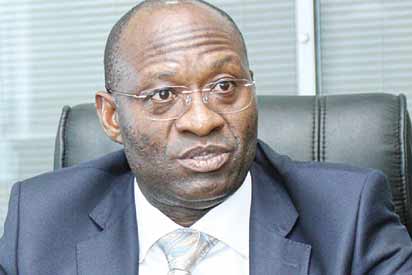
Mr Ifie Sekibo
BY PETER EGWUATU
The Managing Director/CEO, Heritage Bank, Mr. Ifie Sekibo, in an interview with selected media last week, highlighted the bank’s vision and target in the banking industry. He also spoke on how the bank came into existence after recapitalising the defunct, Societe Generale Bank of Nigeria (SGBN) to the tune of N12 billion to operate as a regional bank. Excerpt:
What is the history of Heritage Bank, vision and your target?
The history of the bank is public knowledge. Heritage Bank is like any other bank. Societe Generale Bank of Nigeria, SGBN, as we all known had some challenges with capitalisation as a result of the capital review by the Central Bank of Nigeria (CBN) in 2006/2007. Before then, they have had some challenges with clearing and so on. We came in as core investor when all attempt to capitalise the bank failed. We made a bid like every other person to see if we can recapitalise it and on that basis, we were able to win that bid. We had negotiation with the legacy investor or former investor of the bank and came up with an agreement.
We recapitalised to the tune of N12 billion, take up all liabilities and assets of the bank and found some form of accommodation for depositors whose money has been trapped for 10 years. In a nutshell, that is the bank transiting from SGBN to Heritage Bank. Our vision is simple and clear; today, we might look quite new in the market, but our idea of what this bank should be is clear from day one. We want to be a bank that people will believe and know that generation banking is the way to go. When we say generation banking, we are basically saying it is not enough to amass wealth and when you die, you write a Will and somebody carries the Will and walk away.
They fight over your Will or whatever, lawyer spends some part of the Will money and we don’t know what is up. We want a situation where your life is a continuum of what legacy you left behind. At the end of the day, the true wealth we have is our name. So, we are trying to see if we can re-focus our clients to begin to think of it in that line; to say if I have to leave a name, what kind of name will I leave behind? That name should be the legacy. If it is the wealth I left behind, what is that wealth? It does not have to be cash, it could be industry, that wealth could be an art gallery, that wealth could be a big factory, that wealth could be an invention, but I have to leave it for those people I work for and bear my children, my family, which is why we call it generation banking.

Mr Ifie Sekibo
Our objective to achieve that is to be about the best knowledge driven organisation technologically. And above all, being able to show the customer that in truth, service is what will make it possible. We don’t say we know what the customer wants, we can’t claim. We can’t serve what we think is best for him, rather we would like the customer to tell us what he or she wants us to do for him or her. We would serve the customer better when they tell us what they want.
Given the competition in the banking industry, how will you break through?
It is not impossible for us to break through. We have to get a customer to begin to believe in themselves; that if you say you can do water, then we as a bank will want to know whether you will be able to do it. If you have what it takes to do that, then we as a bank will help you with other things that would assist you make the water. Some time people think money is the main thing to get business right; money is not the main thing to get business right. The partners have to put other things right. Most banks would be ready to help you if you are prepaid to do things right. If you tell a bank that you have partners that have enough skills to do the business, then better.
You need people that will help you market the product, accountant or cashier, engineers etc. Another thing is ownership structure; you should not allow your relation to do everything in the business. What is lacking in the Nigeria banking state seems to be that we are not willing to own up. We want to be everything such as managing director, chairman, accountant and so on. Many at times, one person, who wants to be do everything and in fact do not qualify to have access to banks’ credit. So, if you put appropriate structure in place, it will work.
In fact, your family can be board members with other skilled people working together, pay yourself salary and discipline yourself. The Dangote that we are seeing today did not start big, but started somewhere because he disciplined himself. The people he brought in to assist him were not blood brothers. It will pay us if we do business by sharing responsibility. Our children will enjoy, our grandchildren will enjoy and the entire country will enjoy if the business grows.
What is the bank’s unique selling point in terms of niche?
I don’t want to tie myself as a niche banker. I want to take people from ordinary banking to real banking. If I can achieve that in five years, it is okay. There are a lot of value and opportunities in the Small and Medium Scale Enterprises (SMEs). Most banks don’t have the skill to mentor this scale of business. Money is not the first thing to get business right; there are things that must be put in place first before money. So, we intend to work with the SMEs and nurture them so that as they grow, we also grow with them. We would like to see the SMEs grow and become household name like the Dangote, Femi Otedola etc.
When we created International Energy Insurance (IEI) Company, there was no known energy insurance company in this country. People thought it won’t be possible. We took engineers who are petroleum engineers and taught them insurance and grew that market size .It looked impossible, but it worked out. There are ordinary people like us who can strive to be better off tomorrow; that is one niche. We might be small today, but if we have 20 people like us growing gradually, then tomorrow, we will grow to become big companies and that is what we are saying, that we are ready to work with enterprises that are ready to grow with us.
What is the ownership structure of the bank like?
Heritage Bank is owned by many people, but before we came in, it was owned by 19 people. Our shareholding structure is 80 percent core investor, nine percent legacy bank, that is, the former core investor and 11 percent depositors who converted their deposit to owning stakes in the bank.
Do you have any plan to expand beyond the three branches you started with?
Heritage Bank is expected to grow by 13 more branches by June 2013 from three branches it started with. We are targeting to have 16 branches by June and from there, we will grow further. Although, having many branches is not the ultimate because we are going to use technology to drive our business. There is mobile money, Automated Teller Machine (ATM) and online banking transaction, all driven by technology.
We will deploy adequate technology as point of presence matters a lot. We would show point of presence rather than building many branches. If you can transact your business seamlessly without difficulty, it is better. You can get a loan from the comfort of your home by asking for it. If I want N10 loan as a small business to start a trade of pure water, should I go and do documentation for trading and go and bring my grandfather’s land because I want to take small loan? No, there are other alternate channels of delivery.

Mr Ifie Sekibo
How do you intend to play in the SMEs sector?
The SME is a sector we believe can grow this economy and it has been a philosophy that we believe in; philosophy of possibility, philosophy of tenacity, philosophy of hardworking and so on. For instance, as a journalist, if you need a recorder to do your work efficiently and you come to us a bank to assists you get it. We should be able to help you get it. We would start by asking you why you need it and how you intend to use it do your job. So, you get value for using tape recorder.
Our job is to help people actualise their dream in life by supporting them not only financially but in other ways. Though it could take you five, 10 years to get exactly where you want to be, but you have to start somewhere. So, our job is to assist entrepreneurs grow and by so doing, the entrepreneur will trust us as a partner. If we are able to do this, then we would have done our job as a bank.
Your background is in insurance sector, how equipped are you to work in the banking sector?
No, my background is not in insurance, but I happened to work in the sector in the past. I am an accountant by training. May be, that is when the financial industry noticed me, when I came to limelight in International Energy Insurance, IEI, as an insurance company. They saw IEI when I grew the company within three and five years. I am an investment banker. I was not the Managing Director (MD) of IE1; I was the Group MD of the whole Group of IEI. I had an MD of IEI Insurance Limited. There was an MD of IEI Assets Limited, there was an IEI Pension Limited, there was an MD of the PMC, the mortgage bank, I was just the Group MD.
The reason I was able to play that part was because of my financial background. I had no training in insurance, but I saw a big opportunity of buying global Assurance at that time in 2004. I said to my people that with N15 million to buy 70 percent stake, it was very cheap. How can such a big business with such a big stake be this cheap, yet people are not seeing the opportunity. So, in two years, we were able to restructure the company, a company that has no office, the office building that has no windows and doors but only chairs and tables. So, we looked at ourselves and believed in ourselves that we can push it forward. We hired professionals, and in fact, we were assisted by Linkage Assurance which gave us money for leasing, I don’t hide it. Trade Bank gave us initial money to pay our staff.
What are the modalities for account verification and for customers to collect their money?
On the modality for account validation, savings account holders are expected to come with means of identification such as driver’s licence, passport or National Identity card, as well as their cash withdrawal forms and deposit slips. For current and corporate accounts, account holders are expected to present their cheque books or cheque stumps.
The process is simple, hassle-free and technology-driven to ensure that customers that turn up do not have to wait endlessly. We just call up the customer’s number from our server base at the head office. Once this appears, the customer’s picture is taken and stored and the form is passed on to the validation officer through the control officer for the account to be verified, including the balance in such account. Once this is done, the customer is referred to the cashiers who instantly write cheques for those that want their account balance paid.
Did you make any effort to retain majority of the customers of the defunct SGBN?
Yes we did. The aim of the revalidation exercise was to possibly pay all customers of SGBN who came to participate in exercise through issuance of cheques to them at the validation centres immediately their accounts were successfully validated from day one of the exercise. Like I said, the exercise was in two parts, namely verification of accounts and instant issuance of payment cheques for those who prefer to collect the balances in their accounts. Owners of successfully validated accounts also have the option of retaining such with the new Heritage Bank.
So, we hired four banks thinking that people will turn up in large number, we had instructed the banks to please pay people that will come to collect their money, not because we don’t have cash but because we had not taken off then. But to our surprise, not much people turned up to pick their money and many of the people who turned up refused to collect their cheques. We issued less than 10 cheques. Most people declined to collect their cheques saying they are not going anywhere and that showed the confidence they have in us.
There was a man that said he wants to be an ambassador of the bank. When he came in, we gave him the cheque and he left and later on, he came back saying we should take our cheque that he never believed this will happen and instructed us to bank the money for him. We ended up where 95 percent or more said they are not collecting their cheques. There are some old people we identified and we went to them to give them their money but they refused, but we advised them that because of their age, we will look for a closer bank near them to bank the money for them.
Disclaimer
Comments expressed here do not reflect the opinions of Vanguard newspapers or any employee thereof.