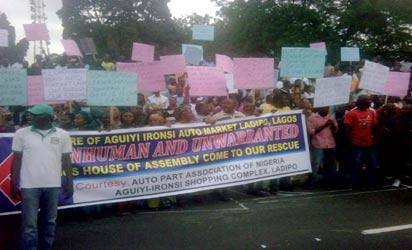
*Ladipo Market traders protesting against the closure of the market
By Ocehereome Nnanna
It has become an annual routine for the Lagos State Government, LASG, to close the Ladipo Auto Spare-parts Market, Mushin, citing poor sanitation.
Each time you drive past the Guardian Newspapers premises along the Oshodi – Apapa Expressway and you see hundreds of young men loitering around the fringes of the famous market, you will know that the two sides are at it again.
The traders say they are not guilty as charged. Some even table the hollow alibi that auto spare-parts are naturally oily or greasy. Therefore, the market in which they are sold must appear “dirty”.
I don’t buy that. I have visited some European countries, especially Germany where some of these parts are sourced from. They are always well organised and neat. I wonder why the traders, most of whom are importers who travel to Europe, Asia and America to pick and choose their commodities will not emulate best practices in advanced societies?
Even if the goods are greasy and dirty “by nature” what about the habit of dumping refuse in the canal, which was one of the grounds on which Governor Babatunde Fashola ordered the latest closure of the market? What about trading along the road, thus causing difficulty in movement for traders and by-passers alike? What about trading along the canal itself?
One thing I have noticed is that Nigerian traders are generally cavalier about issues of environmental hygiene. They are also particularly prone to lawlessness. And it is not just noticeable in Lagos alone. Nor is it peculiar with any particular tribe. I will give examples.
It is a well known fact that certain linguistic groups in Nigeria are associated mainly with some lines or items of trade or provision of specialised services. For instance, up to 80 per cent of the traders in the Ladipo Auto Spare-parts Market are Igbos. Yoruba-speaking people and others take up the rest and provide services that the spare-parts dealers cannot do without.
In the East, particularly Onitsha Bridgehead, the site of frequent altercations between traders and the Anambra State Government, ANSG, the major items of trade are poultry and foodstuff. Again, about 60 per cent of the traders there are Hausa-speaking Northerners, with the local Igbo population providing complementary items of trade.
Just as the LASG is engaged in endless battles with the Igbo traders at the Ladipo market, the ANSG is also ranged against the Northerners, who have stiffly resisted efforts to relocate to a new site to give way to beautification of the NigerBridge – Zik Mausoleum corridor. They claim, rather provocatively, that the “market” was given to them by the Federal Ministry of Works, perhaps their booties of the civil war?!
In Aba, the situation is not much different. In fact, the Aba traders became so lawless that some of them brought trucks with loads of sand to fill the Big Gutter, the giant drainage built by the colonial masters to drain the flat city of rain or running water.
After filling the portion they chose for themselves they would simply build sheds and start trading or renting to traders! Once it rains, water will have nowhere to go. Since the government of Ochendo Theodore Orji began demolishing the structures to restore the drainage, there has been no dirty name under the sun he has not been called.
Having made the point about dirty and lawless proclivities of market traders, I want to still blame government, especially the LASG, for not taking the bull by the horn to end the annual routine of Ladipo Market closures.
It is the duty of government to provide markets, facilities and services and dictate regulations for their use, while it is the responsibility of traders to use the facilities lawfully and pay taxes and rents to government. Corruption of government officials is chiefly responsible for trade on roads and along the canals. This has been going on for decades, and each time government closes the market it pretends not to know that these traders pay through the nose for the illegal spaces they occupy.
The LASG, over the years and through the various regimes, has evolved strategies for solving problems to ease the tension between them and traders. Traders were simply allocated land far away from their makeshift markets and allowed to buy and develop sheds and malls in accordance with government regulations.
That was how Alaba International Market, Trade Fair Complex and others sprang up, and are largely owned by the traders. But with regard to the Tejuosho Market, the LASG opted to retrieve it from the traders and is on the verge of completing it into a world class market for allocation to traders who can afford.
Why is it that the Ladipo Market has not been paid similar attention? The traders recently revealed they have been losing not less than N100 million everyday since the closure. This means they have the means to build a first class market if challenged to do so by government, just as their Alaba, Balogun and Trade Fair counterparts were able to do. So, what is still keeping the goat tied to its tether?
There is this growing feeling that the LASG under Bola Tinubu and Fashola have not always been as friendly towards non-indigene Lagos residents as they should be. Those who say this point to the way Okada riders, slum dwellers and low-level traders have been banged about without “human feelings”. They also allege that this is being done because most of the people in these categories, being non-indigenes, are being subtly “encouraged” to leave Lagos.
I don’t believe that. I believe in modernisation. If you want to live in Lagos you must join the modernisation train or it will leave without you. But government must work more closely with market and trade associations, carry them along and give everybody a sense of belonging. The tendency to raid and harass must be toned down. We are all in this thing together, like it or not.
Disclaimer
Comments expressed here do not reflect the opinions of Vanguard newspapers or any employee thereof.