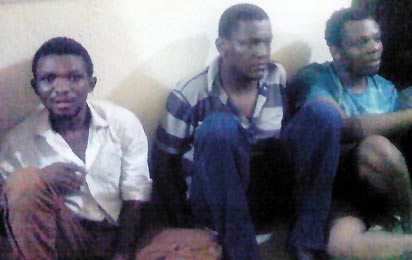
*Suspected kidnappers with Nonso, first right.
By Ochereome Nnanna
BEING from Abia State, I come from the Niger Delta. At least, that is what the legislation that established the Niger Delta Development Commission (NDDC) says, though those from the “True Niger Delta” (Rivers, Delta, Bayelsa and, to a lesser extent, Akwa Ibom) would laugh at those of us from Abia, Imo, Edo and OndoStates with the question: “How many oil wells do you have?”
In those earlier days when kidnapping was popularised within the “True Niger Delta” both as a tool for criminality and agitation for “resource control”, a colleague of mine here in Vanguard came to work one Friday in full “Niger Delta” regalia, bowler hat and all. As he approached me, I jibed:
“Old boy, the way you are dressed today it seems you want to kidnap me?”
He looked at me from head to toe and answered: “But you have no kidnap value!” Slowly but surely, kidnapping as a crime spread from “True Niger Delta” to all parts of the South East and South-South. In my native AbiaState, a vicious cell of this crime developed around Aba and surrounding villages. One felon, Obioma Nwankwo, better known as Osisikankwu (the tree that’s mightier than the palm tree) mounted a reign of terror and even succeeded in forcing banks, markets and businesses to close down and people to flee the legendary commercial town.
In fact, Osisikankwu was already transforming into a political figure, as he started making demands for political and economic concessions to his Ngwa people as one of his conditions to lift the siege.
That was when the Governor, Theodore Orji, went for broke. He brought in the Joint Military Task Force (JTF), the same force that had all but broken the backbone of the militants in the Niger Delta, to smoke out Osisikankwu and crush his well-oiled network of kidnappers. For some time, the body snatchers kept away from AbiaState, even though some relocated to villages (including my village, Abiriba) and continued to wreak havoc.
In those (will I say “good” old days) kidnappers had their eyes out for the politically highly placed or connected individuals, including their relations. They also carefully chose those they felt were “wealthy”.
Sometimes they even sent spies to big events, such as special church services, weddings, fundraising ceremonies, burials and any celebration that drew in those eager to show off their material accomplishments and report back. It became a case of “the rich also cry”. The rich from the South East and South-South either stayed away in the safety of Lagos and Abuja, or they came home only with the full compliment of armed mobile police escorts which they paid through the nose to acquire.
After a respite, kidnapping has not only returned in full force, it is in fact now a national fad, even though Edo and Delta remain the flaming flashpoints of this high crime. Last week Friday, I woke up as usual at 5.00am and started consulting my ipad for news. I came across a chilling story leading page six of Vanguard: “Kidnappers abduct five Lagos-bound passengers along Benin – Shagamu road”.
According to the story, armed kidnappers blocked the express road with a lorry and the first bus that came up bore people from Warri going to Lagos. They abducted five of the passengers and released the driver and a passenger to go and break the news of the crime. Then they got in touch with the families of their victims and started making silly ransom demands.
Kidnapping no longer targets the rich
You know the import of this. Kidnapping is no longer targeted at the rich. Most people who travel by public bus fall into that class formerly regarded as having “no kidnap value”, but times have changed! If they can do this to mini bus travellers what will they do to people travelling home in their Sport Utility Vehicles (SUVs)? So, beware.
Kidnap-for-ransom has gone out of hand. It is about time we as a community threatened by a few (though ever-increasing) hoodlums put all hands on deck and defeat it. What happened in Abia three years ago is proof that when there is a will there is always a way out of any problem.
Arunma Oteh should step aside
FOR the first time in the history of this nation, a federal budget was passed by the two arms of the National Assembly and forwarded to the President of the country with one agency of government – the Securities and Exchange Commission (SEC) – given zero allocation in the 2013 Budget.
This was due to the personal vendetta against Ms. Arunma Oteh, the Director General of the SEC, whose brushes with members led to the disgrace of Hon. Herman Hembe and some members of the Ad Hoc Committee of the House of Reps on the Capital Market over alleged bribe demands.
When that Committee was reconstituted with Hon. Ibrahim El Sudi as Chairman, it recommended that Oteh should be removed because she was “not qualified”.
Following President Jonathan’s refusal to abide by the resolution the House decided it would never have anything to do with SEC so long as Oteh remained its DG.
It was because of this and a few other reasons that the budget was delayed on the President’s desk for two whole months before he reluctantly signed it into law last week Tuesday.
I am asking Oteh to voluntarily step down because the SEC is bigger than any individual.
The House of Reps is willing to wreck the economy and a crucial federal institution regulating a capital market that trades with trillions of Naira worth of funds belonging to Nigerians and foreign investors. It is a path of honour for Oteh to quit rather than give them the pleasure of forcing the President to sack her. It is the civilised and honourable thing to do.
The President can also break the deadlock by giving her another job which does not require any encounter with the witch-hunting federal lawmakers.
Disclaimer
Comments expressed here do not reflect the opinions of Vanguard newspapers or any employee thereof.