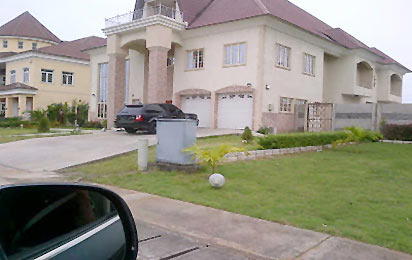
*Don Jazzy never bought this mansion
By Jude Njoku
…Assessment should base on sound valuations – Experts
“If we as a country are serious about eradicating poverty and its side effects, we must consider redistribution of wealth through such medium as property taxation as has been done successfully in most advanced countries”.
This submission which was made by a frontline estate surveyor and valuer, Mr. Mondiu Adebayo Belo at a workshop put together by the Lagos State Branch of the Nigerian Institution of Estate Surveyors and Valuers NIESV, a few years ago, still holds today.
Against this backdrop, many state government who are desirous of shoring up their internally generated revenue, IGR, have introduced various forms of property taxation. Lagos, the acclaimed centre of excellence and trail blazer, enacted the contentious Land Use Act in 2001.
The Land Use Charge came into being as a result of the government’s desire to harmonise four different previously existing land charges into one charge. The old charges included tenement rate, developmental charges, ground rent and neighborhood improvement charges.
Buoyed by the success recorded by Lagos in the implementation of this property-based tax, Edo State on December 7 this year, signed a carbon copy of the Lagos land Use Charge into law. Governor Comrade Adams Oshiomhole said the legislation will not apply to rural people across the state and people who occupy family houses.

*Don Jazzy never bought this mansion
“Even though the rural people are exempted but those who are rich occupying in excess of one hundred by one hundred land will pay the tax,” he noted. According to him, the idea is to encourage those who use much land to pay something to the government to assist in the provision of amenities, such as schools, health facilities and to find resources to support tertiary institutions, water as well as carry development to the villages and hamlet.
While assuring that this is a pro-development law, Comrade Oshiomhole maintained that the government is determined to tax the rich and the very rich to enable government provide for the poorest of the poor.
“Every rich man should know that it is in their interest that the poor are catered for. The task at hand is not only to consolidate on the gains recorded in our first tenure but to take Edo State to the next level. We cannot rely entirely on the revenue from Abuja, we have to look inward,” he said, adding that “property tax is a reality and the law is not targeted at everybody. Though everybody needs to use the land but some people use more land than others. We are not apologetic about taxing the rich”
The Edo State Land Use Charge Act is coming on the heels of a plea by Lagos-based estate surveyors and valuers on the Babatunde Fashola-led administration to review and harmonise contentious areas in the State’s land use legislation to make it more acceptable to the citizens.
The surveyors alleged that council officers still issue tenement rate notices to areas already billed for land use charges, while other irregularities which are inimical to the growth of the housing industry still exist.
According to them the high taxes for well maintained properties is a punishment to the owner. They also sought to know who is responsible for ground charges between landlords and tenants.
Some estate surveyors are of the opinion that Lagos has more than enough taxes on property. The tax on properties in Lagos include capital gains tax, land use charge, withholding tax, probate tax, consent tax, stamp duty, registration fee, ratification fees, regularization fees and development charges.
“These are not just too many but the methods of their assessment are questionable. For example, the land use charge is an annual tax but it is levied on capital value. An annual tax should be based on annual value. Capital gains tax is based on the sale price instead of gains as the name implies. What is consent fee? This is a tax known in Nigeria, Taxes are payable on income. On what income is one paying consent fees? The seller would have paid capital gains tax, which is the appropriate tax on income or profit of the property seller,” he said at a recent workshop organised by FIACI Nigeria..
According to him, the various taxes has made the acquisition of property very expensive thereby reducing supply of housing and raising sale prices and rents.
Property taxes should not be based on assumptions, mere conclusion of property value by individuals, old records and non-professional opinions among other means but it should be based on property values obtained from registered estate surveyors and valuers certificate of valuation.
Disclaimer
Comments expressed here do not reflect the opinions of Vanguard newspapers or any employee thereof.