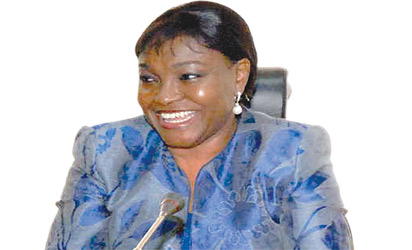
*Mrs Funke Osibodu
By Omoh Gabriel, Business Editor
Last week, Mrs Funke Osibodu who was drafted by the CBN Governor, Sanusi Lamido Sanusi, in August 2009 to rescue Union Bank completed her assignment. She had a valedictory interactive session with the media where she outlined the spirited efforts put up by her team of rescuers to bring the bank back to life. Today she said the bank is not just big, strong, but more reliable than before.
Excerpts
You said you are going on leave and after a while, you will return to Union Bank. Please can you be explicit and give us details on why you are coming back?
I didn’t say after a while I would be returning to Union Bank. I said I would be leaving to proceed on leave and I have my accumulated leave till end of December. So, technically, I am still a staff of Union Bank till the end of December. I was only talking about the transition with the new Chief Executive Officer that we have been working silently together and he would take over officially on Thursday. When I leave, if there are things that are unfinished, I would come in and sort them out. So, I am not returning to Union Bank, I will just be performing my duty as a staff of Union Bank till the end of December.
As the last person standing, what have been your experiences so far in trying to bring back Union Bank?
Union Bank is the last man standing, not me. Union Bank has been a very interesting institution to work for and it is an institution with a very rich heritage in terms of relationships and people. I believe I have stayed this long because it is a huge institution and achieving the goal which was set when the governor asked us to come was basically to stabilise the institution.
I have played my part in moving it to a greater height. In fact, I give kudos to the outgoing board because from day one, they came to a decision that Union Bank will stand on its two feet again and we would do our best to see to it. So, from that perspective, we looked for investors that would ensure our going forward and that some of those things that happened in the past would not surface again.
As you all know, we now have core investors called Union Global Partners Limited and what is unique about them is that they are foreign investors who brought very strong corporate governance and international exposure to the bank. As some of you know, externally, they have been making their own press announcement that they have invested in Union Bank.
So, when you bring foreigners into this kind of environment, their time frame is not necessarily as fast. And secondly, the methodology we use is different from others such that it required careful process of regulatory approval.

*Mrs Funke Osibodu
Why was there delay in recapitalising the bank?
While we wanted it faster, we couldn’t get it faster but we are close. Again, to ensure that there is smooth transition, I had to stay and be part of the new board which started in February and see that there is a new executive so that when I leave, someone will still be around.
As you know, three out of four former executives – Ibrahim, Kunle and Phillip – are part of the process to see that the transition is successful. Two new executives will join us; one of them would not be joining us until sometime next year which will make it a complete team plus the new chief executive. So, it was planned so that the change in mantle will be smooth.
On my own side, what have kept me going are different things. Some are positive and some not very positive. When I read the newspapers, the negative speculations give me the energy to say ‘I would stay and prove them otherwise. The positive ones when we were celebrated for what we have done so far and from the people themselves.’
If you could remember, at some point when we needed shareholders to agree to our scheme document, we needed staff and shareholders to work together, that was one point where I saw the real strength of Union Bank. Our staff, pensioners and shareholders all worked together to see that Union Bank retained that last man standing. So, as the last man standing, generally, it has been so many things in bits and pieces that have ensured that we are successful.
What was wrong when you took over and how are the performance indicators now that you are leaving
When I came in, there were three things that were wrong. These were corporate governance, negative capital and liquidity crises. Within the first three months, we got over our liquidity situation. On our liquidity ratio that was negative, I am leaving the bank with liquidity ratio of over 80 per cent; it is around 90 per cent positive.
The statutory minimum requirement of liquidity, ratio-wise, is 25 per cent. We are leaving the bank above the statutory minimum. In other words, we are now swimming in money and immediate portion of it came from the new capital that came in and the loans we sold to AMCON.
When it comes to negative capital, I think at our peak level, our shareholders’ fund was negative, somewhere around 300 or 400, that is about N378 billion negative. At that point, even the shareholders had technically lost all their money.
Today, we have positive capital of N190 billion. So, we have moved from negative of N378 billion to N190 billion positive. That is over N570 billion positive to change that. That is something that took quite a lot of work by all of us.
On the corporate governance side, you remember the corporate governance issues were that everybody was doing his own thing and there were so many things we had done wrong. I think the example I can use is that now we are 95. At that time, we were 92 or 93 years old.
When you go to an old woman’s house, you are bound to find a lot of cobwebs because she will not throw so many things away easily. It is when the children come and say ‘Grandma, why are you still keeping this?’ And she will say ‘leave it there,’ and they will forcefully take it and throw it away. Our own job was to go and clean out several of those cobwebs. I believe we have done a reasonable job. There are many things we have cleared up. Remember, I used to say we have un-reconciled accounts of over N3 trillion.
what is the size of accounts you have reconciled so far?
Today, our un-reconciled accounts are in the hundreds of millions and not billions any more. We have an army of over 150 people that work day and night cleaning it up. So, that is part of the cobwebs we were cleaning up. We had bad loans which we sold to AMCON; we wrote off some, we negotiated some and we now have a unit called Portfolio Management.
Their job is to manage those bad loans and resolve them. It means that our loan portfolio reduced from over N700 billion to around N200 billion now. All the things clustering us have gone. It is now for us to build on it. Some people used to say that Union Bank is for old people.
A young man would say that is the bank of my father or my grandfather. ‘They took me there those days.’ We have good news for you; we have an army of at least 1,000 young people recruited within the last three years. So, we have new blood that has taken over Union Bank.
What will you say about the Union Bank you are leaving behind?
The way we have described the new Union Bank is that there are two of us necessary for the future of Union Bank – the older people like us with experience and the younger people who we call energy – So, imagine the new Union Bank with energy and experience. While the experience tells you what to do, the energy works on it very fast.
So, several things have changed. You will see it in our customer care. I have seen several customers expressing amazement after visiting our staff. When a customer comes in, we try our best to be fast in attending to him. You have seen some of our branches; some of them are very run down, but we have a new face of the branches. We have launched at least 75 out of over 300 branches. These changes are what I call the foundation to move to the next stage.
What are your projections for Union Bank in the next one year:
When we came in, some of our customers went to the branches to withdraw and our staff were trying to pacify them, to convince them not to, but I told them that they need not do that, they should let them take their money. Then they will see that even though you were sacking, you are still big and strong.
They did and within a short while, they returned and throughout the three years, (and this is very important because it tells you the strength of Union Bank), our savings account continued to grow. Our current account also continues to grow and these two are very strong mark of confidence and, it is largely from our retail network both at the rural and all other small branch networks because they are all in small pieces everywhere.
So, that rural side if you call it rural, I call it retail and there is nowhere that is rural anyway because there is nowhere you cannot reach with technology today. So those locations became a bedrock for savings/deposits, they are what I call low cost deposits that continue to be our confidence and you would hear from those customers that this is my bank ‘I am going nowhere and nothing will happen to it.’
So in that area, we did not have any issue in terms of our performance. On technology, again, to some of us that were here at the early stage, while we had computers, most people could not use computers; it was largely on the secretariat side because they were not educated to use it.
They didn’t need to use it. You give it to the secretary and the secretary does the typing. Today, when it comes to banking, using technology is everything whether it is telephone banking, internet banking, cashless banking and the latest, POS cashless process. We are now number one in terms of active POS. I never dreamt that we will get there to be number one in terms of active POS. In other words, customers are using our machines. They will only use your machines when you have educated them well.
You have enough machines around and you are making sure that those machines work and the customers use them. We are the first on that list; we are not the first in terms of total volume because we are still smaller than several banks, but we were the first in terms of activity and that is technology. For the mobile banking and internet banking, again, we did not need to buy anything new.
We had them, we just needed to open them up and get our customers to start using, and get our staff to appreciate and start using it. So, whether it is credit and debit alert, whether you want to transfer money from one account to the other using your phone, whether it is going online using your computer to move money, we do all that.
We used to have a very low number of cards that we had issued to our customers; now that is a thing of the past and before someone was telling me when they ask for a card, at best if it is very fast, it will take you about two or three months to get it, and sometimes you pray it does not take you six months.
Today, the maximum it will take you is ten days. We are working on turning around to make it 48 hours but from where we were coming from, we are very fast. We still have a long way to go in terms of making it 48 hours but, even cheque books use to take forever, now there is a turn around.
I ask for cheque book, I get it by afternoon or latest by the next day. So, a lot has happened on that technology side which we are on top of. Even, we have the technology, we have not opened it to the public where you can use your naira card as some banks do abroad; we have it.
Can you still say that Union Bank is big, strong and reliable?
We will be starting it very shortly before the end of the year and we have had it for a while. So what am highlighting to you is that that big, that strong, that reliable, is back. The first office I went to somewhere in Abuja when I resumed, I was just walking in and somebody said ‘big, strong reliable’ and I looked at the person and I said ‘this was the security man at the gate, how did this man know that I was in Union Bank, is my face that public?’
He saw the way I looked at him and he just pointed at this big, strong reliable on my lapel, that is how strong our brand is. You will see it in some of our television adverts. So, that is why our latest advert says ‘we’ve just only begun.’ Our only just begun means that we are starting a new phase, we are no longer an old institution, we are a young and vibrant institution and you should watch out.
When you go into projection till the end of the year, we have published our June result and I think it surpassed everybody’s expectations. September will soon be out. We are putting finishing touches and the trend is still the same and I expect December to be the same.
For next year, I expect that trend to continue, because from next year we will not be here; we will no longer be having the saying that we were trying to make a change. We have made the change. It is now building on the change and doing the business and that is easier. It is easier to build than to lay the foundation because foundation holds the erector and nobody will see it until the pillars are out now. So, it is easy to see the building the workers will go into.
What is the current shareholding structure of Union Bank?
On the shareholding structure, what we have currently is that UGPL (Union Global Partners Limited), own 65 percent; AMCON still retain 20 percent shareholding and existing shareholders have 15 percent. The bank was commended that it retained the largest shareholding structure for existing shareholders in the intervened banks.
In some of the intervened banks, some lost it completely and it became a different bank. So, part of our focus on the re-capitalisation process was actually to negotiate the best deal for existing shareholders. UGPL came with $500 million to acquire 65 percent of the bank and in that process; we still managed to maintain 15 percent for existing shareholders.
The UGPL shareholders is made up of foreign groups mainly, the Standard Chartered Group through Standard Chartered Private Equity, we also have Corsel Capital, which is a major private equity capital which is based in US and UK. We also have African Development Corporation, which is a German private equity firm that owns banks in East Africa also one of the major investors in the bank.
Then, we also have FMO which is the Dutch Development Financial Institution. They are also a major stakeholder and then we also have Akia Capital which is the Belgian Group. They are also one major stakeholder and of course, African Capital Alliance, which we all know also invests in lots of companies in Nigeria.
The last but not the least is the Micha Changa Group, which is also one of the largest private fund management companies in New Zealand and also in South East Asia. It is this party that is UGPL that owns 65 percent of the bank.
Existing shareholder would have gotten more but
It is a pity, you know we had a right issue which we have to let go because it was not successful and even, we made the case to SEC that existing shareholders that attempted to invest the minimum to see whether we could get acceptance, but it was against the rule so we have to cancel the offer, otherwise if those who took up the Right Issue were accepted, the existing shareholders would have had more than 15% and that on one side.
On the other question that will lead to the performance based assessment, it is a staff process, it goes back to what I mentioned earlier in terms of the new culture.
The new culture is everybody has what is expected of him or her in terms of goals and expectations. And those goals and expectations on a quarterly basis do the performance review; performance review that start from the supervisor, getting to even the ranking panels, to eventually get to Exco members and in that performance review process there are those who are excellent performers and there are those who are not which we called marginal or poor performers.
Of cause, depending on the usual process for this you will get your compensation, benchmarked. But in addition you get your commission benchmark and those who are not up to it they also know because we have a process that every quarter you get your information, and so you will know that you are not doing well and there is a time frame if you are not doing well and you don’t shake up, you are better off leaving the institution. It is an ongoing process, it is a process that must come.
Disclaimer
Comments expressed here do not reflect the opinions of Vanguard newspapers or any employee thereof.