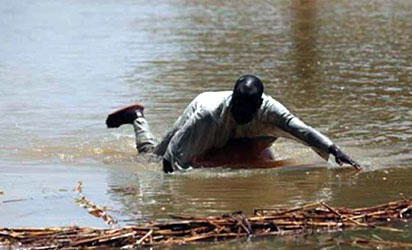
*Swimming to safety
Lakemfa contributed this piece at the International Roundtable on Energy Emergency and Energy Transition organised by the Cornell Global Labour Institute, Cornell University, and the Rosa Luxemberg Foundation, New York. October 10 – 12, 2012. The first part was published yesterday.
ADDITIONALLY, the people suffer oil spills which are usually not cleaned and gas flaring which further depletes the ozone layer. In the oil producing areas, many farmlands are destroyed by oil exploitation; the waters are polluted thereby destroying fishing which is a major preoccupation of the people.
When the people protested in the mid 1990s, nine environmental activists including the writer, Ken Saro-Wiwa, were hanged. When the people began an armed protest, oil production was drastically reduced and some local and foreign oil workers were abducted with some losing their lives.

Swimming to safety
With the frequent abduction of oil workers which are affiliated to it and the general insecurity the armed rebellion engendered, the NLC organised an all-inclusive national summit on the issue. Shortly afterwards, the Government agreed to implement an amnesty programme which brought the insurgency to an end.
Transnational oil corporations
But while many armed militants have been rehabilitated, the oil producing areas remain a study in neglect.Nigeria is a country where the transnational oil corporations like Shell and AGIP are lords and kings, and the political elites are basically parasitic.
The energy shortages and environmental costs: Nigeria is notorious for power failure; some factories rely entirely on the power they generate privately. Consequently, the cost of production in the country is extremely high; energy costs add 40 per cent more to production costs in the country.
While some factories have collapsed under the weight of high energy cost, some, to survive, relocated to other African countries like Ghana which has a more reliable power supply. Under the President Olusegun Obasanjo administration (1999-2007) $16 Billion was expended to improve power supply but there was actually a decrease in the supply.
More funds have been off loaded on the power sector with claims that the country is near a relatively high 4,000MW. This is for a country of 167 million people and is not even enough power to run Lagos alone. Compare this with South Africa with 50 million people producing 40,000MW and working to increase this output.
Power shortage
With power shortage, many Nigerians depend on power generators; one in every four household in the urban centres run generators which pollute the air. In some cases, entire families have been wiped out by generator fumes.
Living up to the future: The effects of climate change, misuse of nature, refusal to adapt and slowness to change has boxed Nigerians into a very tight corner. So we have the Lake Chad drying up, the Sahara Desert racing southwards, the sea seizing lands in the south, floods sweeping away farms, lands polluted by unrestrained and irresponsible oil exploitation, air pollution due to gas flaring and unrestrained carbon dioxide emission, and lack of practical steps to stem the disaster.
Whatever the case or excuses, we in Nigeria have to accept that the times have changed and we can no longer live or do things in the old way. The environment has to be preserved because we inherited it from our ancestors and our survival as a people and a nation depend on it. Most importantly, we must preserve the environment because we inherited it as a trust for the future generations who own it.
But the rich are the Polluters-In-Chief, they are also the class in government, and so, have to be compelled to change the country’s direction. The challenge of development is the provision of the basic necessities of life to the citizens in a sustainable manner.
What is clear to me is that this has to be state-led, but people driven; state-led not only because the state has the concentrated power to implement development programme in a sustainable manner, but it alone, has the capacity to call all – Nigerians and non-Nigerians, corporate and non-corporate bodies, – to order.
Besides, there is no part of the world, whether in the developed or developing countries, where the state did not play the vanguard or leading role in societal development.
So the fable of the private sector leading the development of Nigeria has to give way to the truth. As a matter of fact, civil society must compelled the political class (the executive and legislature) and the bureaucratic elites in the civil service to adhere to the preachment of Adam Smith that any advice, policy, plans, etc, coming from the private sector for societal development … ought always to be listened to with great precaution, and ought never to be adopted till after having been long and carefully examined, not only with the most scrupulous, but with the most suspicious attention.
It comes from an order of men, whose interest is never exactly the same with the public, who have generally an interest to deceive and even to oppress the public and, who accordingly have, upon many occasions, both deceived and oppressed it.[1] (Emphasis added.)
So the advocacy for a safe environment and sustainable life cannot be divorced from the political question. The required shift in focus and policy would involve a commitment to be environmental friendly and clean up all acts of pollution by oil companies, a stop to gas flaring and the strict monitoring of the transnational oil companies and their Nigerian allies.
The railways and trams which were the means of mass transit in early 20th Century Nigeria must be rebuilt and reintroduced to replace the second hand commercial motor cycles, cars and trucks which are also one of the major pollutants of the environment.
Increase in electricity
Electricity has to be significantly increased to reduce, and eventually stop the use of generators in households, factories and offices. Basic petroleum products like kerosene have to be available and affordable to stop the poor and even some in the vanishing middle class, from continuing or resorting to the use of firewood which is the primary cause of deforestation.
The ruling elite who led the country down this unsustainable, corrupt and disastrous path will not willingly agree to these basic steps; it is only the conscientization and empowerment of the people that can propel the country towards this sustainable development.
Labour unions, student organizations and generally groups in the civil society, whether in the formal and informal economy, need to play major roles in this new direction. In this, they require the cooperation and support of the parliament.
The time to act is NOW!
Disclaimer
Comments expressed here do not reflect the opinions of Vanguard newspapers or any employee thereof.