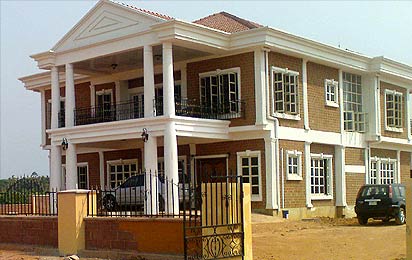
•A residential property in Lekki, Lagos
By Kingsley Adegboye
Housing is one of the three basic needs of man. After food and clothing, the next basic human need is housing. In civilised climes, provision of housing is seen as a fundamental social responsibility of the government to its citizenry.
However, records show that Nigeria has a housing deficit of about 17million. How far this frightening gap can be closed or how well the authorities have facilitated the citizenry in achieving these basic needs still remains a paradox.
Availability and affordability of houses have therefore remained a thorny challenge. It is evident that every Nigerian family wants a comfortable accommodation; at least a roof over its head, potable water with convenient means of disposal of both solid and liquid wastes. This, however, has been a mirage for an average Nigerian family.
Since Nigeria’s independence 52 years ago, pundits believe that the only successful housing policy that attempted to provide a near affordable housing for Nigerians was the Second Republic administration of President Shehu Shagari that came up with the then Shagari Low Cost Houses.
It is interesting to note that there was an ecstatic slogan on the eve of this millennium tagged “Housing for All Before Year 2000”. But the year 2000 flipped past and the slogan, not crafted as a vision and backed by any concrete plan, came and passed as a mirage.
“Just like the Federal Government failed in this regard, state governments also have not fared better as no state government has achieved any housing policy in recent history. The Federal Capital Territory, FCT, is most culpable as it has failed to meet the housing demands of the ever increasing influx of people into FCT on daily basis.
Lamenting this sad development, built environment professionals who spoke to Vanguard Homes & Property blamed the government for its insensitivity towards the provision of housing which is a fundamental right of the people. They therefore called on the government to stop paying lip service to the all important issue of housing and do something concrete without further delay to reduce the huge housing deficit.

•A residential property in Lekki, Lagos
Mr. Sola Fatoki, an estate surveyor and valuer and chairman, Lagos State Branch of the Nigerian Institution of Estate Surveyors and Valuers, NIESV, lamented that after 52 years of Nigeria’s independence, “we are still hearing the report that Nigeria has a housing shortfall of 17 million”.
“This has already confirmed that there is a failure in our housing delivery. So, the government needs to do a lot to reduce this gap. We as estate surveyors and valuers, have been telling the government that there are simply five ways to increase housing stock in Nigeria.
“These include one, there must be adequate land policy, where land will be available to the generality of the people. This was the essence of the Land Use Decree. But over the years, you discover that the Land Use Act has not been able to achieve the purpose for which it was enacted. What this means is that the Act is due for review. And this is what we have been clamouring for, because state governors have turned the Act into a money making venture.
“The original intention of the Land Use Act is to make land available for everybody irrespective of where he or she lives in Nigeria. But as it is, to acquire land in Nigeria today, one has to pay through his nose. So, if we have adequate land administration in place which will make land available to the people, if we have effective mortgage system where prospective home owners can take mortgage loans, then people can begin to think that home ownership in Nigeria is realisable.
“It is only in Nigeria people gather millions of Naira to build houses. In advanced nations, most home owners built their houses with mortgage loans. So, we need effective mortgage system in the country to make home ownership easy”, Fatoki stated.
Another factor that can facilitate home ownership in Nigeria, according to the Lagos NIESV chairman is the availability of building materials. While the costs of building materials is generally high, some of them are imported. He called for a price control mechanism to ensure that prices of building materials are affordable, adding that if this is done, home ownership will become easy for prospective home owners in Nigeria.
Fatoki called for the use of locally made building materials churned out after rigorous research work by the various building materials research institutes and bodies in the country. He enjoined the Government to take the lead for others to follow.
“If the government can start to build houses using locally made materials, and people are seeing them, then Nigerians will be encouraged to make use of locally sourced building materials.
The Lagos NIESV boss also stressed the need for infrastructure development in the country. “For instance, cement is very expensive because of high cost of production,” he stated.
According to him, if there is steady power supply for cement manufacturers to produce cement, the cost of the product will not be as high as it is now; and low price of cement will reduce cost of home ownership. Fatoki who decried the poor state of roads infrastructure in the country, observed if the roads are in good shape, people can live in far-flung places and come to work in the city centre without much hassles.
In his own reaction an Ex-Officio member of the Nigerian Institute of Building, NIOB, Mr. Adesina Aladeloba said the Government and built environment professionals have a lot of work to do to close the housing shortfall put at 17 million units.
Disclaimer
Comments expressed here do not reflect the opinions of Vanguard newspapers or any employee thereof.