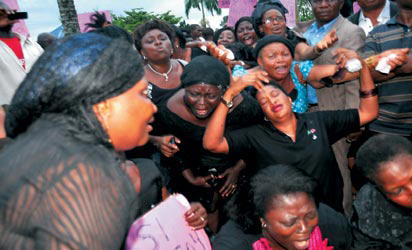
* Protesters: our fate uncertain
In less than one month, Nigeria will forgo Bakassi Peninsula to Cameroon unless Nigeria raises an appeal against the verdict of the Hague based International Court of Justice which awarded the sovereignty of Bakassi peninsula to the Central African country using the 1913 Anglo-German treaty as the basis of its decision.
This is the first part of the Vanguard Media series on rethinking the judgment of ICJ and options before the Federal Government where the executive seems to be alone in conceding Bakassi.
In the first of our series on why the Federal Government should revisit the ICJ judgment, a senior research fellow at the Nigerian Institute of International Affairs, NIIA, Lagos, Mallam Abdullahi U. Maiyaki, provides fresh insights on options before President Goodluck Jonathan.
HIGHLIGHTS: THE recent call credited to the Nigerian Bar Association, NBA, to the Federal Government of Nigeria to apply to the International Court of Justice, ICJ, for the revision of its judgment of October 10, 2002 which ceded the disputed Bakassi Peninsula to Cameroun was not only timely, courageous but equally strategic. The said call was contained in the NBA Communiqué issued on Friday, August 30, 2012 after the Association’s 52nd Annual General Conference held in Abuja where it asserted that there are fresh facts for the ICJ to revisit its judgment and thus requested the Federal Government of Nigeria to legitimately apply. (Source: Bakassi: Apply For Revision of ICJ Judgment NBA Tells FG, The Leadership Weekend Newspaper Sept. 1, 2012 P.8)
HIGHLIGHT 2: After all, Article 61 (Sub-Section 1 & 5) of the Statute of the ICJ had provided this facility where it stated that:
Article 61 (1): An application for revision of a Judgment may be made only when it is based upon the discovery of some fact of which a nature as to be a decisive factor, which the judgment was given, unknown to the Court and also to the party claiming revision, always provided that such ignorance was not due to negligence…. Article 61(5) No application for revision may be made after the lapse of ten years from the date of the judgment (i.e. October 10, 2002 – October 10, 2012 in the Bakassi Case)
Basically, the foregoing provisions of the State of the Court requires a critical re-examination, review and analysis of the entire litigation strategies, proceedings and indeed the Summary of the Court Judgment, particularly in context of the separate Declaration of some Judges, who are members of the Court as at October 10, 2002.
Window to explore
Collectively, Nigeria may find a window to explore to its advantage in her quest for revision of the contentious Judgment on the Bakassi Peninsula which was ceded to Cameroun.
HIGHLIGHT 3: During the proceeding, it was speculated that Nigeria was requested to produce any scientific evidence of ownership of the disputed Bakassi Peninsula earlier than the 1884 Treaty of Protection between the Old Calabar Chiefs and Britain, to which I understand, the Nigerian agents at the Court presented substantial titles thus gladly the discovery of yet another crucial documented evidence would certainly enhance Nigeria’s prospects before the ICJ.
This new document satisfies the Court’s requirements as contained on Article 49 of the Court Statute which states that: “The Court may, even before the hearing begins, call upon the agents to produce any document or to supply any explanations. Formal note shall be taken for any refusal”
Prof. Walter Ofonagoro asserted recently that he has in his possession year 1822 documents which vested ownership of the Bakassi Peninsula to the Old Calabar Chiefs by extension to Nigeria. He disclosed this while speaking to Nigerian public on a topic: “Nigeria, Cameroun and the Bakassi Question: The Unfulfilled UN Mandate” organized by the Nigerian Institute of International Affairs, NIIA, held on Thursday, August 23, 2012 in Lagos. This is a fresh fact unknown to Nigerians and the Court before the Judgment of October 10, 2002, which gives credence and impetus to our agitation.
Highlight 4: Similarly, Article 52 of the Statute of Court provided another window to Nigeria to explore in her quest for the revision of the ICJ ruling of October 10, 2002 which ceded Bakassi to Cameroun. The provision stated:-

* Protesters: our fate uncertain
Article 57(2): If the Judgment does not represent in whole or in part the unanimous opinion of the Judges, any Judge shall be entitled to deliver a separate opinion.
Critically reviewing and analyzing the separate/dissenting opinions of some of the Judges of the Court as provided by the Article 57 of Statute of the ICJ cited above, their separate declarations against the Court’s ruling as presented in the Summary of the Court’s Judgment of October 10, 2002 is quite revealing and indeed exposing the erroneous basis upon which judgment was passed. Irrespective of the numerical strength of the voting which favours the Cameroun, the intellectual exposition, the analytical skills on the strength of law, International Jurisprudence and conventional wisdom, suggest either there was an organized conspiracy to derail justice against a party in the case or just a mischievous plot to overlooked the place of intellectualism on the case by the Court.
These separate/dissenting opinions of members of the court who adjudicated over the case raised credibility questions on their intellectual status, sound sense of judgment, neutrality and courage of the Judges who voted in favour of the judgment. These dissenting/separate opinions if adopted could have added colours, class and credence to the International Court of Justice verdict and, indeed the United Nations in passing the contentious Judgment of October 10, 2002.
Highlight 5: After all, Article 38 (Sub-Section a-d) of the Statute of the Court has provided another window to Nigeria to explore in reinforcing the legal status of these intellectual expositions of some of the Judges who expressed their reservations to the court’s judgment over the Bakassi Peninsula which ceded the Island erroneously to the Cameroun on October 10, 2002.
Reservations to court’s judgment
The Article 38 (1) Sub-Section a-d states: “The Court, whose functions is to decide in accordance with International law such disputes as are submitted to it, shall apply:
(a) International Conventions whether general or particular, establishing rules expressly recognized by the contesting states;
(b) International customs, as evidence of a general practice as law;
(c) The general principle of law recognized by civilized nations;
(d) Subject to the provision of Article 59, judicial decisions and the teachings of the most highly qualified publicists of the various nations, as subsidiary means for the determination of rules of law.”
These separate/dissenting opinions of some of the Court Judges to the October 10, 2002 verdict over the Bakassi Peninsula coupled with the interpretation of the term “Treaty of Protection of 1884 between the Old Calabar Chiefs and Britain” by renowned International Jurists and Scholars articulated in this paper would show how the ICJ violated its own Statute of Article 38 (1) Sub-Section a-d which presents a sound legal basis for the Court to revisit the said contentious Judgment of October 10, 2002 which ceded the Bakassi Peninsula to Cameroun. Moreso, Nigeria still has a legal basis to request the ICJ to revisit the contentious judgment it passed on October 10, 2002 by invoking Article 66(a) of the Vienna Convention on the Law of Treaties of 1969 which states: “any one of the parties to a dispute concerning the application or interpretation of Article 53 or 64 may, by a written application, submit it to the International Court of Justice for a decision unless the parties by common consent agree to submit the dispute for arbitration”
Highlight 6: Diplomatic option open to Nigeria: Furthermore. Nigeria still has a window to explore diplomatic option before the United Nations until the expiration of the ten year grace in the said judgment which ends on October 10, 2012. Article 66 (b) of the said Vienna Convention on the Law of Treaties of 1969 States: anyone of the parties to a dispute concerning the application or the interpretation of any of the other articles in Part V of the present Convention (i.e. Invalidity, Termination and Suspension of the operation of Treaties) may set in motion the procedure specified in the Annex to the Convention by submitting a request to that effect to the Secretary-General of the United Nations.
Consequently, the above provision of the Vienna Convention on the Law of Treaties has opened yet another window to Nigeria, while still utilizing the legal instruments cited above and many others being projected by other stakeholders across country for consideration by the Nigerian Government. Moreso, these available diplomatic options open to Nigeria within the United Nations when explored could equally provide a face saving diplomatic channel for the world body to revisit this contentious verdict of the ICJ. Also, the precarious security threat such insensitivity may pose within the Gulf of Guinea Region of Africa in particular and global peace in general imply that, a request by Nigeria to the Court to revisit the ICJ ruling of October 10, 2002 becomes inevitable.
The controversial green-tree agreement of year 2006: The on-going national controversy over the legitimacy of the Green-Tree Agreement of year 2006 is not unexpected. However, there are existing International Instruments which legitimizes such an exercise. The question as to whether the said Agreement needed be ratified by the Nigeria Legislature or as to whether President Obasanjo had powers to single handedly enter into a Treaty or Agreement without ratification of the Nigerian Parliaments are equally provided in the Vienna Convention on Law of Treaties for Nigeria to explore.
Article 7 of the Vienna Convention on the Law of Treaties states the procedures/personalities that have the capacity to conclude treaties/agreements as understood in International Law.
(Article 7(1) states: A person is considered as representing a State for the purpose of adopting or authenticating the text of a treaty or for the purpose of expressing the consent of the State to be bound by a treaty if :
(a) he produces appropriate full power or ;
(b) it appears from the paragraph 2 of the Statute or from other circumstances that their intentions was to consider that person as representing the State for such purposes and to dispense with.
Article 7 (2) states: In virtue of their functions and without having to produce full powers, the following are considered representing their State:
(a) Heads of State, Heads of Government and Ministers of Foreign Affairs for the purpose of performing all acts relating to the conclusion of a treaty;
(b) head of Diplomatic Missions, for the purpose of adopting the text of a treaty between the accrediting State and the State to which they are accredited;
(c) representatives accredited by States to an International Conference or to an International organization or one of its organs, for the purpose of adopting the text of a treaty in that Conference, organization or organ.
Disclaimer
Comments expressed here do not reflect the opinions of Vanguard newspapers or any employee thereof.