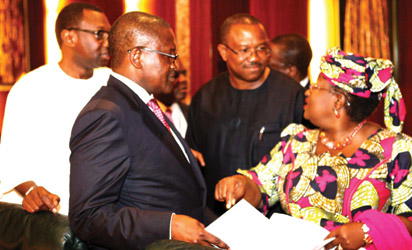
Economic Management Team Meeting presided over by President Goodluck Jonathan Tuesday At The State House In Abuja. From right, Finance Minister, Mrs. Ngozi Okonjo-Iweala, Gov. Peter Obi of Anambra State, President, Dangote Group of Companies, Alhaji Aliko Dangote and Mr. Femi Otedola, Managing Director of Forte Oil. Photos–State House.
By Clara Nwachukwu, Emma Ujah & Victor Ahuma-Young
They’re lying — FG
SOME oil marketing and trading companies, OM&TCs have insisted that they have not been paid despite the Ministry of Finance publication of subsidy claims that have been verified and paid.
But the Debt Management Office, DMO, told Vanguard exclusively that the marketers were lying and were being paid from an Escrow Account worth about $7billion, which is derived from the Excess Crude Account, ECA.
The agency, which insisted that government was not broke, also said there was no way marketers could claim that its Sovereign Debt Notes, SDNs, are not backed by cash, since marketers were being paid from a dedicated account. It added that “whatever delays that cropped up must have been procedural in terms of documentation and payment processes.”

Economic Management Team Meeting presided over by President Goodluck Jonathan Tuesday At The State House In Abuja. From right, Finance Minister, Mrs. Ngozi Okonjo-Iweala, Gov. Peter Obi of Anambra State, President, Dangote Group of Companies, Alhaji Aliko Dangote and Mr. Femi Otedola, Managing Director of Forte Oil. Photos–State House.
The Ministry of Finance, yesterday, called the marketers’ bluff and published the names of marketers whom they claimed to have paid amidst controversies over widespread scam involving the subsidy regime in Nigeria.
But some of the independent marketers, who spoke in confidence said, “We don’t know why government is deliberately misinforming the public, but the truth of the matter is that we have not been paid. Despite their publications, the Minister of State for Finance, Dr Yerima Ngama, deliberately instructed the DMO not to pay some of us whose claims have been verified and approved for payments. We don’t know what his reasons are.”
As the drama of who owes whom between the Federal Government and the OM&TCs continues, fuel stock level, particularly of petrol and kerosene, which are under subsidised by government, continue to deplete, notwithstanding the assurances by the Department of Petroleum Resources, DPR, that “the stock level is not low enough to cause panic.” The Nigerian National Petroleum Corporation, NNPC, also insisted on its claim of 33 days sufficiency reserves at 35million litres per day.
But among all the marketers contacted by Vanguard in separate telephone interviews as at the time of filing this report, only NIPCO Plc could confirm that “We received our payments last Thursday,” unlike Integrated Oil, which revealed that, “As we speak, we have not been paid. We don’t know why government is saying that we have been paid.”
Fuel stock depletes
As the drama unfolds, the Chairman of Major Marketers Association of Nigeria, MOMAN, Mr Wale Tinubu, reiterated that, “All marketers (MOMAN) have stopped importing products until further notice. We are owed over N200bn, and we cannot afford to continue to import, as the banks say what is paid is not enough to sustain their continued support.”
Tinubu, the Group Managing Director, Oando Group, who could not however confirm whether his company has been paid as published by the Finance Ministry, noted that the burden of fuel importation was now solely that of the NNPC’s.
One of the independents also revealed, “I have not been able to import any product in the last three months, because we are being owed more than N10billion, which belongs to the banks. The banks are not willing to lend us money anymore, and we continue to incur all manner of charges. In my company, we have over N30million overhead costs and as it is, we may be forced to start retrenching workers.”
Another major marketer reacting to the Ministry of Finance publication further argued, “The Sovereign Debt Notes that government is giving will go into a bottom less pit in the banks because we are being owed so much and because of the rising interest charges, the SDN’s are just being swallowed up.”
Confirming Tinubu’s claim of no imports by the majors, a top management of DPR told Vanguard that, “Most Major marketers are not importing as much as they used to because of some challenges they are facing.”
Nonetheless, he noted that apart from some independents importing new cargoes in the Lagos area, vessels were also being discharged in Warri, Port Harcourt, and Calabar depots to meet national fuel demand.
But without being economical with words, some members of MOMAN said, “In deed and in truth, the fuel stock level is very low. Only NNPC/PPMC has brought in fuel at the Apapa depot, which it will share among the majors and NIPCO.”
Available fuel stock
According to DPR, the regulator of Nigeria’s oil industry, there are at least 67million litres of petrol currently being discharged in Lagos. “As we speak, we have some cargoes coming in from the independents depots. These cargoesof at least 19 illion litres each are currently discharging at Ascon, Dee Jones, and Swift. Techno Oil finished its discharging two days ago,” our source told Vanguard.
NIPCO, one of the independents that have throughput arrangement with the NNPC, also confirmed that it “received 20 million litres from the NNPC and we have pushed out about 10 million litres.” The company happily added that it was bringing in its first set of cargoes after receiving its subsidy payments within the next seven days, which will cushion some of the shortages in supply.
The majors also confirmed that they were depending on the NNPC stock, saying, “Currently at Apapa Jetty, NNPC is discharging 18 metric tonnes, MT, to be shared among the six majors and NIPCO. NNPC is also bringing in additional 33,000MT or 44million litres to be loaded out at between 8000MT and 7,500MT daily. But this means that the 33,000MT will just be four days stock because one MT is equivalent of 1,341 litres.”
NNPC also said that in addition to its 33 days sufficiency, it also has another three vessels waiting to discharge at its Apapa Jetty, and as such, there is no scarcity nd warned consumers to desist from panic buying.
NUPENG dissociates self from strike
The Nigeria Union of Petroleum and Natural Gas Workers, NUPENG, said there were no petroleum products to load at the fuel depots, even as the price of petrol went up to N110 a litre in Awka, Anambra State.
Dissociating members from the fuel scarcity currently being experienced in parts of the country, especially Abuja and Lagos, NUPENG insisted that members were working but had no products to lift in some depots.
NUPENG in a statement by its Acting General Secretary, Comrade Isaac Aberare, challenged the Federal Government to explain the reason for the shortage of products to Nigerians, after it boasted a few days ago that it had stock that would last for 45 days.
The statement said “NUPENG is therefore not responsible for the growing queues in filling stations as it is being speculated. The Union is not on strike and the Petroleum Tanker Drivers are ever ready to lift products. NUPENG members are working but have no products to lift in some depots, which are empty, as a result of the non-refusal of some oil marketers to import fuel due to non-payment of their claims.”
“Nigerian National Petroleum Corporation, NNPC, alone cannot meet the huge demands of fuel importation in the country, coupled with the vandalisation of the corporation’s supply pipelines in Arepo village in Ogun state which pumps fuel from Lagos to Mosimi depot in Ogun state. NUPENG union calls on the federal government to quickly intervene on the lingering issues so that the shortages of petroleum products will not spread to other parts of the country.”
The union advised the Federal Government to put appropriate security arrangements in place to nib the activities of vandals of pipelines in the bud and called on the “Minister of finance, Dr. Ngozi Okonjo-Iweala to release money to verified claims by marketers so that they can import fuel and make their jetties and depots active again to meet the shortfall.”
NUPENG implored the “government to quickly repair the vandalised pipelines in Arepo, so that fuel supply can resume to Lagos, Ibadan and Ilorin axis.”
Other areas
Already there have been visible fuel queues in Abuja since Monday with long where long queues of vehicles waiting to buy fuel at various filling stations.
Black Market operators are cashing on the scarcity and are selling a 10 litres of petrol for N3,000 against the normal price of N970.
One of the young parallel market operators, Akeem Muson, said he travelled to Keffi in neighbouring Nasarawa State to buy fuel for sale when he noticed the queues on Monday night.
The Deputy Supervisor, Total Fuel Station Area 3, Mr Moses Audu, blamed the scarcity on inadequate supply of the product to Abuja.
He said his station ran out of stock after the last supply of product on Monday. “We are not getting regular supply in Abuja; we only had one yesterday and we have sold all. Unlike before we do have regular fuel supplies but since yesterday, we only had a supply of one truck which we discharged and sold to customers until about 10 a.m. today (Tuesday) when we ran out of stock. In an attempt to find out from the tanker drivers, they also told us that even the depot in Lagos had only 12 trucks to distribute nationwide but I believe before the end of today, we may get another supply.”
At Conoil, Area 1, Mr Atai Obaka, a dealer, also claimed there was a shortage of supply from Lagos to Abuja, adding that most marketers were not importing petroleum.
“The marketers are not importing because most banks are not ready to give us loan as they are not sure of getting back their money. Right now, I have 240,000 litres of petroleum to be discharged and more is still expected to be transported down to Abuja but I don’t know if we can get more. I feel government should rescue the situation by compelling the bankers to give loans to importers,” Obaka said.
At the NNPC Mega Station, Central Area, Mr Stephen Yohana, said he did not know why there should be fuel scarcity after NUPENG had met with the Federal Government and agreed that there would be supplies of the product nationwide.
According to him, “For me, I think it’s out of panic that most stations hoard the product; as for us, we have 300,000 litres underground and four trucks standing to be discharged. We are selling at the normal price to customers.”
Mr Andrew Obande, a bus driver who plies the Wuse Market route, said passenger fare was still normal but might be increased if the scarcity continues.
Fuel price hits N110 per litre in Awka
Similarly, the price of petrol has gone up to N110 a litre in Awka, Anambra StateNAN check on Tuesday showed that many petrol stations in Awka were selling the product for N110 per litre.
Some marketers told, the News Agency of Nigeria, NAN, that the price hike was a reflection of the scarcity of the product in the area.
Mr Emmanuel Orakpo , Managing Director, Orasonic Oil, said that N110 was the lowest possible price they could sell a litre of petrol.
He attributed the rise in price to problems of loading the product at the depots.
“There is problem with fuel supply generally. Loading cost has gone up considerably to about N104 per litre and this may also not be unconnected with the turnaround maintenance at the Warri and Port Harcourt depots,” he said.
Another marketer, Mr Benjamin Abimaje, a manager at Femas Oil, said the hike in price had affected their business, adding that sales had dropped drastically.
He urged the Federal Government to fix the problem of product supply in order to avert the looming energy crisis.
“Our businesses are badly affected. With the way things are going, there may be a serious scarcity looming,“ he said.
Mr Charles Jideani , the Secretary, Petroleum Dealers in Anambra, told NAN that the problem with fuel supply and pricing was beyond the control of petroleum marketers.
He said that the marketers were trying to ensure that consumers “do not face any hardship“.
Jideani called on the Federal Government to address the major factors affecting fuel supply in the country.
“Putting the refineries and deports in good condition is a good starting point,“ he said.
Disclaimer
Comments expressed here do not reflect the opinions of Vanguard newspapers or any employee thereof.