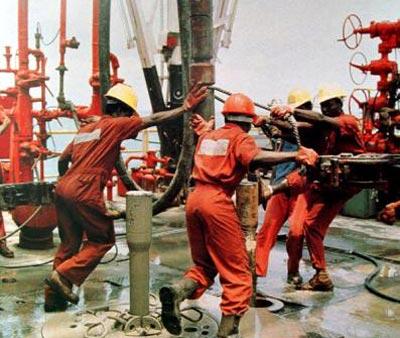
*Oil rig
Last week, energy journalists, under the auspices of the Nigerian Association of Energy Correspondents, NAEC, held a conference with the theme: “Energy Industry Regulation: Prospects and Challenges to the Economy.”
A number of resource persons spoke on various topics relating to the theme of the conference, at the end of which a number of questions were raised, as captured by KUNLE KALEJAYE, VICTOR IGIRI AND ADA ONUNALI. Excerpts:
A lot of non experts are in the oil industry. What are the measures taken by the Federal Government to tackle this problem?
Executive Secretary, Nigerian Content Management Monitoring Board, NCDMB, Mr. Ernest Nwapa
The Ministry of Interior Controls the administration of expatriate quota, and they develop laws in respect to that. The law requires that before companies operate, it must have received instructions from the Ministry of Interior. Presently we are capturing expatriates workers and they will issue with expatriate permits, which will prevent non experts from working in the oil industry. Letters have been sent to various companies and they will be captured with biometrics.
As a board, we believe that Nigerians can do things, things that we do so that we can bring jobs back to the country, we need to recognize the need to facilitate job creation where Nigerians can work, where Nigerians can innovate by themselves.
The people in the industry now understand that it is a way of life to do business in the country. We have made it clear that the government is serious about this issue and we have reserved that Nigerians can own assets in the oil and gas industry, both E&P assets and assets in marine vessels, fabricated yards, construction equipment.
We have started a revolution that is really backed by the industry and the federal government and to make sure that we don’t import everything that we use in this country. We want to start manufacturing components. Today Shell is regarded as a company that is trying to use a local chemical producer to produce a very useful chemical in the country and we believe that these successes will lead to more employment.
We are actually going for productive employment: employment that can drive innovation, employment that can drive knowledge, drive sustainability and drive independence that is economic independence of the country.
Managing Director, Integrated Oil and Gas Ltd, Capt. Emmanuel Iheanacho
I want to thank Engr. Ernest Nwapa for his beautiful contributions and the work that the NCDMB is doing. But I think there is still more for them to do.
There is need for them to sit down and work out modalities as to how to move the petroleum industry forward.
For instance like Engr. Nwapa said, you can issue the License of Operation to an expatriate IOC but the person cannot work without the Nigerian Content Permit.
Once the expatriate quota has been issued along with other necessary documents to work with, they are absolutely permitted to work. The Ministry of Interior will work closely with the NCDMB, but I also want to urge them to bring out modalities to ensure that these issues are well addressed.
But we have realized that some expatriates will come directly to the Ministry of Interior with their documents, but the onus now lies with Ministry to tell the expatriate to go NCDMB and do the necessary verification after that, then they can come to us (Ministry of Interior) then every other procedure will follow.
What is the state of the Nigerian Content Fund, and has stakeholders started assessing it?
Nwapa: We are happy that the thing is taking this form. Before, we were saying that Nigerian banks cannot fund some of these things, but, because it has formed the indices that Nigerians must know, Nigerian banks are being approached even with funds from outside the country, there is need to channel these funds to Nigeria
And that is why we are seeing some marine vessel exhibition, upgrade of fabrication yards, establishment of training facilities in all aspect of this industry and people are being funded. The problem now is the cost of the funds and that is where the Nigerian Content Development Act can come in, the policy puts up a robust fund.
We will be looking for ways the fund will cushion the effect that we have been shouting about. So in order to make it effective, we have set up a benchmark that will define how it will essentially make things work out in the industry. However, the fund will help keep the interest rate at a very good competitive level.
The Nigerian Content Fund was 0% as at year 2000. Today, it has increased greatly because fund arrangers are brought into it in order to enhance its efficiency. We have enjoined Nigerian Chamber of Shipping and other organizations to be in charge of the fund.
Group Executive Director, Corporate Services, Nigerian National Petroleum Corporation, NNPC, Dr. Timothy Okon
Oil marketers deserve a return on investment for themselves because they have invested in the downstream sector of the petroleum industry. And we have to create an atmosphere for continuous financing of investors business in the country.
When you go to the bank to borrow money, the bank will ask you how they are going to have their money back. The simple truth whether in Africa or elsewhere once money is lent out there must be a way of recovering that money back so that both parties do not lose out of the transaction.
Regulation is important but we are regulating the wrong thing, you cannot regulate price. When the prices are regulated, it creates this distortion of what is the actual consumption in the market because marketers form an economic system and this system is when they come together and raise money, those who have to give them that money will expect them to return the money after the marketers must have done business with the money and made profit.
But when someone else regulates the price of the products, it creates an uncertainty and a risk that the oil marketers will continue to experience.
The government can guarantee that there is going to be an open market price that will ensure return of investment to oil marketers.
The moral aspect that government should not go and guarantee that they will pay oil marketers and at the end of the day they refuse to pay
We should not allow institutions or government drag you to a debt that will collapse the economy that is why I said we cannot sustain the subsidy program.
When the prices of petroleum products are not controlled, the problem will have solved.
Remember I said that our economy is the second largest in Africa and a lot of ,investors are looking at that but the control of the petroleum price is keeping them away from the markets because they are asking themselves; how do I make my profit? The truth is that PMS consumption in the country will continue to increase and investors are looking at that but the price is controlled by the federal government they will run away.
Let us not continue to shoot ourselves on the leg.
Based on the Engineering Service Agreement that has been on; there is still vandalization of oil pipelines. So what is the essence of this agreement?
Ihenacho
The Engineering Service Agreement was established before the Nigerian Content Act. The problem is that foreigners have been made to watch over the vessels. If Nigerians are made to watch over these vessels, these foreigners are reckless. If Nigerians are made to watch over these vessels, they would not be as reckless as these foreigners because they have experience of how these vessels should be maintained.
There was a report on Nigerian ship clearance, where some ship belonging to foreign ship owners that were not cleared and this trend is unacceptable and it is very critical point that needs to be taken into account because the specifications of ships is subject to the convention that of the marine time organization in Nigeria. Our certificate has to be internationally acceptable and that is an issue that we have been battling with and it has really affected the acceptability of Nigerian certification.
What have been the Board’s key challenges?
Nwapa: The key challenges that we had came from stakeholders in the sector, because, they felt that this was another government policy that will not work. But, tactfully, we have demonstrated that we can really do something and by our actions that government is very serious about the efficiency of the board.
Another key challenge is to ensure that the Nigerian content policy is well implemented. However, the implementation is costing us more money. In some countries, they take a decision that they are going to do something like industrializing their country and they are determined to do it at all cost without back up and they do it.
If we take a decision that we will start building marine vessels repair yards, no matter what it cost us, because, as an oil producing country, there are certain things we must have in this country.
Take a look at Angola, if they take a decision that they are going to manufacture some certain things in their country, they manufacture it and it meets the standard or requirement. So it takes a lot to even get the quality of things that we need in Nigeria to meet the standard of the oil and gas industry.
So, the moment that you get that quality, you will put it in the market and make sure that it is standardized and patronized. Then, we will start pricing the cost price and that is the strategy. This are some of the things that we kind of being challenged with, how do we convince the stakeholders that there is a limited amount of money, hence we need to be prudent with the cost. But, the first thing is to get a place where our people can work.
However, our people cannot all work in the ministry or in the oil companies; they have to work in other related fields in the oil and gas industry.
Disclaimer
Comments expressed here do not reflect the opinions of Vanguard newspapers or any employee thereof.