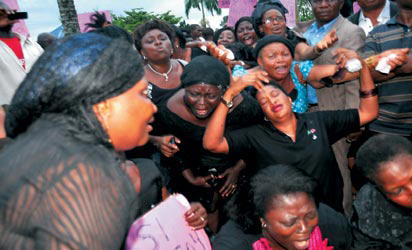
* Protesters: our fate uncertain
By Ochereome Nnanna
DAY after day and sad event after sad event, it is becoming clear to many of our minority brothers that by joining in bringing down the Igbo the (North, along with the West) and their international business and political partners were merely given an unfettered right of way into the South East and South South to plunder and exploit.
There are many who still do not quite see it this way but it is hoped that the situation does not continue to degenerate to the point where they become convinced through intensified painful means. There is no need for anybody to be revanchist or gleeful about the loss of Bakassi.
My people, the Abiriba, have been sea-faring (some choose to say “smuggling”) between Calabar, Douala, Fernando Po, Equatorial Guinea, Bonny and Port Harcourt for centuries. That environment did a lot to shape our commercial culture, which has now become associated with the entire Igbo race since the war ended. It is not the Efiks and Ibibios alone that will suffer the immediate consequences of this ugly turn of events. Sure enough, the crayfish trade will continue, but it will now be under the laws of Cameroun, unless we can find a way to wrest some political solution out of this imbroglio.
Political solution
Gowon’s view of the Bakassi Peninsula as something that could be pawned or hocked to win the civil war showed the limited regard that he and his sponsors and supporters paid to certain parts of the country, especially where we call the South East and South South today. If Cameroun takes full charge over Bakassi, apart from the hundreds of thousands of Nigerians who would automatically become third class citizens of Cameroun (second class being the Anglophone Cameroun and first class the Francophone), strategically Cameroun will be in a position to “breathe down the neck” of Nigeria.
Our strategic interests in the zone include not just the oil reserves that are associated with the Peninsula. Bakassi overlooks our Calabar Export Processing Zone and oil wells in the eastern Niger Delta, including the gas pipeline network in nearby Bonny. They are vulnerable to short- and medium-range missile attack. It has been argued that Cameroun and their French masters will not dare to target the oil facilities that belong to fellow Western countries. But then, can you really predict how far an enemy is willing to go if he wants to cripple an otherwise giant African nation now or in the future?
We have allowed Cameroun to come close to our soft-underbelly. This is an aspect that has escaped strategic considerations of our military generals and “civil war heroes”. There are two major options before Nigeria in the aftermath of the World Court ruling. Should Nigeria obey and vacate Bakassi or should she disregard it and fight if necessary? My answer is that Nigeria, as a signatory to the UN Charter, should not be seen to brazenly disregard the ruling on one of the UN’s important bodies set up for arbitration. One day, we will need the World Court.
Economic attachments
We should pursue political solutions. We must let the international system know the importance of what the court describes as “affectivities” to us. These “affectivities” relate to our long historical, cultural and economic attachment to the Peninsula. We can put pressure on both the international system and Cameroun to settle amicably with us. We must let the international system and Cameroun know that our people in Bakassi and the strategic safety of the gulf of Calabar are more important to us than the oil associated with the Peninsula. Cameroun should see reason and voluntarily cede the Peninsula in the interest of African brotherhood and good neighbourlines.
We should subtly let Cameroun realise that it is neither in their interest nor ours to refuse a political settlement as we are not contemplating abandoning our people living in the Bakassi Peninsula to their fate.
An addendum
TEN years after this article was published here is an addendum. One of the consequences of giving up Bakassi to Cameroun is that Cross River State has lost its oil wells and been deleted as a state in the Niger Delta. It has ceased to be a littoral state! They are no longer “people of the sea” (ndi mba miri, as Igbos would say). What a calamity!
We must reclaim Bakassi Peninsula. After all, our Constitution does not recognise the cession. Bakassi is still a part of Nigeria. Let’s keep it. Or at least, allow the people of Bakassi to determine their future, as Western Cameroun did when they left Nigeria and Adamawa Province of Cameroun did when they joined Nigeria, by plebiscite in 1961. There should be a referendum to give the people the choice of coming back to Nigeria, staying in Cameroun or going solo as a separate republic as East Timor did when it pulled out of Indonesia in 1999 through a UN-sponsored referendum.
The effort should not be left to Bakassi people or the Efiks or Cross River State alone. It has to be embraced as a regional struggle belonging to the old Eastern Region, now South East and South-South. The people who own the land must lead the struggle. The North and West came together to pawn off Bakassi over 40 years ago. Olusegun Obasanjo was pursuing an elusive personal glory (Nobel Peace Prize) ten years ago when he ignored larger national interests to give away a territory that General Sani Abacha had patriotically fought to keep in Nigeria.
The East must close ranks and persuade Nigeria to bring back Bakassi. Thank God an easterner is the President of Nigeria. Surely, this is a rare opportunity, with the ten year window about to elapse in October this year. If tomorrow Nigeria breaks up, only the regional East will be the loser over Bakassi. The North and West will feel nothing.
Disclaimer
Comments expressed here do not reflect the opinions of Vanguard newspapers or any employee thereof.