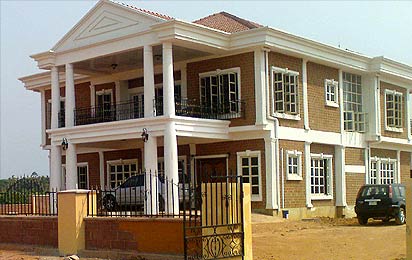
•A residential property in Lekki, Lagos
By Jude Njoku
The Federal government recently approved a new national housing policy that will ensure the construction of one million houses annually.
Rising from the Federal Executive Council meeting chaired by Vice President Namadi Sambo, in the absence of President Goodluck Jonathan who was then attending the RIO+20 summit, in Rio de Janeiro, the Information Minister, Mr. Labaran Maku and his Housing & Urban Development counterpart, Ms Amal Pepple, said the new policy replaces the 1991 Housing Policy, as well as the Urban Development Policy initiated in 1997.
The Information Minister noted that “for almost two decades, Nigeria has been struggling to bring up a new policy to facilitate the growth of housing provision in the country.
The proposal to build a minimum of one million houses annually is not a new policy after all. The Vision 20 2020 Committee in 2010, actually came up with that proposal but the target has never been achieved.
Against this backdrop, fears are rife that the new policy thrust might just be another tall dream that would not be realized. This fear is premised on the fact that the enabling environment that would make the realization of the target easy to come by, has not been put in place.
Built environment experts posit that although the target appears a tall dream, it is realisable if the necessary foundations are laid. President of the Nigerian Institution of Estate Surveyors and Valuers, NIESV, Mr Emeka Eleh stated that even though the land professionals support the policy, the government must create the enabling environment to actualise it. “The question is, what is on ground to ensure the realization of that target?, he asked.
Noting that the policy proposal is still at its embryonic stage, Mr. Eleh stated that “Implementation is key and in implementing, let the public be told how the government will go about it”.
“For us as an Institution, we must say that ensuring private sector participation is very key to achieving the target. The private sector must remain the engine of growth for that kind of target to be achieved.
Things to be done before the target can be realized
Continuing, the NIESV President called for a review of the mortgage sector, strengthening of the Federal Housing Authority, FHA and Government’s direct intervention in housing. His words: “One major issue is the mortgage sector that needs to be revamped. Mortgage is very key to housing delivery all over the world.
The idea of full payment for a house is an impossible event; buying a house for even N5 million or N10 million and you are required to put down the whole amount is difficult for anybody to achieve and that is not one of the things that develop the economy. So, one key area is to develop the mortgage sector and make it possible for that sector to play its own role in national development.
Secondly, Government should intervene in the housing sector by way of reducing the interest rate. You know that housing is a long-term venture and capital intensive, so the same way government is intervening in other sectors, (Government has intervened in the agriculture and aviation sectors), it should also intervene in the housing sector to lower the interest rate, so that people can borrow at a rate that is reasonable. The idea of borrowing at double digit interest rate to finance housing is too high.
Again is the cost of building materials. We have been told that we are now self-sufficient in cement production based on the number of plants that are now operational. But at what price? At N1,700 per 50 kg bag of cement, the price remains very high because cement is a major component of building material. What do we do ? If you look at the bulk of housing deficit in this country, the bulk of it is low-income. Government should open up the suburbs so that people can live there and come to work in the city centres”.
Social housing and its implementation
Mr. Eleh lauded the social housing policy of the government but advised that its implementation should be at the local government level.:” It is a policy that we believe in and key into it because even though we believe that the private sector should be the engine of growth in the housing sector, we also believe that there are those who may not be catered for because they cannot afford the housing in the commercial market. We believe that social housing is appropriate because the aim of every government must be to house all its citizens. Until everybody has proper shelter, nobody is safe.
We advise that these policies can work better at the local government level because they are closer to the people. We also call on the Federal government to reequip or strengthen the Federal Housing Authority, FHA. Recall that the FHA was meant to be a social housing development platform for the government.
That was how Festac was built. We want to encourage them to strengthen FHA and such agencies at the state level so that they can play their roles which is to develop houses and sell at subsidized rates,” he said. Another issue raised by the NIESV President is the provision of infrastructure, which he noted, constitutes a substantial chunk of the cost of housing delivery.”
Subsidy can come in different forms; it can come in form of lands for development, it can come in the form of direct assistance, it can even in the form of government lending assistance to infrastructural development, because we keep saying that the major component of cost that we don’t talk about is infrastructural cost.
Disclaimer
Comments expressed here do not reflect the opinions of Vanguard newspapers or any employee thereof.