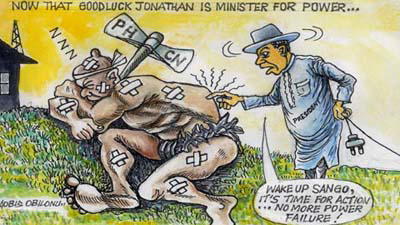
The percentage difference between the Contributory Pension Scheme (CPS) under Pension Reform Act 2004 and the Defined Benefit Scheme (DBS) run from superannuation fund in calculated monetary terminal benefits of Power Holding Company of Nigeria (PHCN) workers among other related issues, have caused serious labour upheaval in the power sector.
In a nutshell, the Federal Government and electricity workers are in disagreement over employees terminal benefits subsequent to the privatisation of PHCN whereby it has been unbundled into several successor companies.

While the workers are insisting that they should benefit from the previous superannuation fund scheme existing at PHCN before the coming of the Pension Reform Act 2004, the Federal Government is saying that it won’t revert to the old pension scheme.
The workers are rejecting the sale of PHCN to private sector investors in a privatisation exercise perceived as not satisfactory, not sufficiently transparent enough and not equitable, unless their severance benefits and other entitlements are fully paid. They are also insisting that PHCN assets are worth over N1.5 trillion, but which government had valued at N200 billion, probably to sell such a national, monumental, money-spinning business heritage at a give-away price to some priviledged interests, friends and cronies of government leaders – people in political power.
As at the moment, workers’ unions in the electricity industry are still negotiating with government, especially concerning issues of severance payment, gratuity and pensions.
Electricity workers had been on edge recently, going through perilous times, when they got to know of government’s intention and decision to privatise the company, as only way of enhancing power efficiency and to check incessant failure and blackout that had become the stock-in-trade of this essential pubic utility.
Previously known as Electricity Corporation of Nigeria (ECN), then later changed to National Electric Power Authority (NEPA) and finally became Power Holding Company of Nigeria (PHCN).
Every change of name only helped to worsen its performance as the Nigerian people were having more power failures, interrupted electricity supply and frequent blackout or darkness than light. Sometimes, there could be no electricity in several places for over six months while bills are still being sent to the so-called consumers who have become completely helpless. To own a generator or power plant, no matter how small, even for a one-room apartment, is the beginning of “electricity wisdom” in Nigeria.
No business can thrive in the country without operating generators almost round the clock. This prevalent state of poor, inadequate, ineffective and inefficient power system made people to derisively refer to NEPA as “Never Expect Power Always” or PHCN as “Power Withholding Company of Nigeria.” It was as bad as that.
Inspite of this power debacle, the privatisation effort was received with mixed reactions by PHCN staff already used to lethargy, inefficiency and corruption that have afflicted the power system.
PHCN workers went on strike on 18th July, 2012 over the appointment of Manitoba Hydro International of Canada to manage Nigeria’s electricity transmission system under one of the major successor companies – Transmission Company of Nigeria (TCN). Soldiers were sent to protect the corporate headquarters of PHCN, Abuja, as protesting workers besieged the complex, alleging PHCN has been privatised, handed over to Manitoba Hydro International who will retrench the entire workforce without payment of severance benefits.
But the industrial action was suspended on 24th July, as a result of the successful signing of management contract to run TCN for three years. The Federal Government, represented by the Director-General, Bureau of Public Enterprises, (BPE), Ms. Bolanle Onagoruwa, and Manitoba Hydro International, signed a $23.7 million US dollars) equivalent of N3.6 billion, management deal.
Power minister, Prof. Barth Nnaji tried to douse the tension over payment of retirement/severance benefits of PHCN personnel.
He was quoted as saying: “We would like to make it crystal clear that all employees will receive their legitimate entitlements on time. Indeed adequate funds have been provided for this purpose.”
The Minister added: “Contrary to the allegation by some trade unionists in the power sector, there are no sufficient funds in the PHCN pension scheme to settle the retirement benefits of the 50,000 PHCN workforce.”
He stated that up to July 1, 2004, when the Pension Reform Act came into force, the PHCN operated a non-contributory scheme. As much as N88 billion is required to pay the retirement entitlements of the 50,000 staff members as of June 30, 2004, but only N3 billion is available in the PHCN Pension Scheme account. This scheme is administered jointly by the PHCN management and the three trade unions in the power sector.
He explained that because PHCN staff should not be made to suffer any hardship, the Federal Government has offered to provide the shortfall of N85 billion to the PHCN pension scheme account.
According to Nnaji, this offer has since been conveyed to PHCN workers representatives and leaders of the three trade unions in the power sector in the ongoing negotiations with Federal Government on the payment of benefits to PHCN employees in the wake of the privatisation of PHCN assets.
He listed what were described as “some of the far-reaching steps” taken by government to improve the welfare of workers. These included payment of N57 billion monetised benefits; conversion of about 10,000 casual workers to permanent staff with retroactive effect; and a 50% salary increase across the board with even a N9 billion grant to enable PHCN start paying the new wage bill. Not so much impressed, Mr. Bede Opara, President of the Senior Staff Association of Electricity and Allied Company noted that the Federal Government ought to have addressed all pending issues before the privatisation exercise.
According to Saturday Vanguard investigation, the contributory pension scheme is mandatory for every staff in public service and also workers in private sector organisations. Under the scheme, employers are expected to deduct 7.5% to be remitted into a retirement savings account which the employee should open with any Pension Fund Administrator (PFA) of his or her choice. This makes a total of 15% to be paid into the employee’s retirement savings account. The scheme is regulated by the National Pension Commission (PENCOM).
However, both the employer and employee may opt to contribute to the retirement savings account about the minimum of 15% and employers opt to bear more than half of the mandatory minimum of 15%.
In respect of gratuity and pensions, our checks showed Federal Government proposed that a percentage of the two will be paid as severance because gratuity has been merged with pensions in the Pension Reform Act of 2004. But the unions argued that gratuity is exclusive of pension.
They said while gratuity is a single bulk payment at the end of service which is not captured in the Pension Reform Act 2004, pension is however paid for life to the retired staff. Therefore, workers want 25% of salary calculated in determining their severance payment instead of that of Pension Reform Act which is 15%.
Disclaimer
Comments expressed here do not reflect the opinions of Vanguard newspapers or any employee thereof.