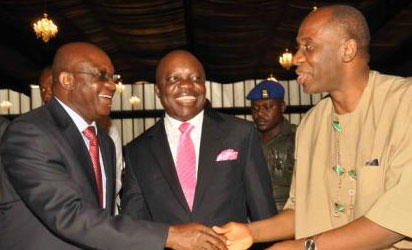
Senate President David Mark; Gov. Emmanuel Uduagha of Delta State and Gov. Hon. Rotemi Amechi of River State during the Retreat on the Review of the 1999 Constitution Held in Asaba Delta State.
By Emmanuel Aziken, Political Editor
The size and responsibilities of the Federal government came under attack yesterday just as the Senate at the commencement of a strategic retreat on the review of the Constitution put devolution of powers from the federal level at the top of its agenda.

Senate President David Mark; Gov. Emmanuel Uduagha of Delta State and Gov. Hon. Rotemi Amechi of River State during the Retreat on the Review of the 1999 Constitution Held in Asaba Delta State.
The move came as the Senate put a July 2013 deadline for the conclusion of the ongoing efforts to review the constitution. Among other issues of concern in the ongoing review exercise as listed by the Senate yesterday are the creation of more states, recognition of the six geo-political zones, role for traditional rulers in the constitution, the place of local governments in the federal arrangement and the establishment of State Police.
Chairman of the Nigerian Governors’ Forum and governor of Rivers State, Mr. Chibuke Amaechi presented the views of the governors at the retreat of the Senate Committee on Constitution Review, SCCR in Asaba, Delta State yesterday, just as Governor Emmanuel Uduaghan charged advocates of a Sovereign National Conference to use the opportunity of the constitution review to channel their desired changes through the National Assembly.
The President of the Senate, Senator David Mark who declared the retreat open on his part expressed strong reservations at the lack of democratic franchise in local government administration describing the present situation as wholly unacceptable.
The three day retreat is facilitated by the United Nations Development Programme, UNDP through its Democratic Governance for Development Project, DGDP.
The chairman of the Senate Committee on the Review of the Constitution, SCRC, Senator Ike Ekweremadu while welcoming stakeholders to the retreat had given a July, 2013 deadline for the conclusion of the review.
He, however, was not clear on whether that would be the deadline for the end of the exercise as concerning the Senate or for the conclusion of the constitution alteration exercise which also involves the House of Representatives and State Houses of Assembly.
Listing the sixteen areas he said would be of interest to the SCRC, Senator Ekweremadu, who is also the Deputy President of the Senate said:
“SCCR has critically revisited the Report of the last Committee to sift matters requiring immediate attention. We have in addition articulated other critical national issues based on unfolding realities.”
He listed the sixteen areas to include:
Devolution of Powers, Creation of more States, Recognition of the Six Geo-political Zones in the Constitution, Role for Traditional Rulers, The place of Local Government in our Federal arrangement, Extracting of the Land Use Act, NYSC Act and Code of Conduct from the constitution.
Other concerns listed include Fiscal Federalism, Immunity Clause, Nigerian Police, residency provisions, mayoral status for Abuja, term and tenure of executive office holders, rotation of offices among others.
Governor Amaechi in his own verbal address said:
“There are very germane issues that we want to raise. Why are the states suffering from financial crisis? Why are we having less money than others? Why can’t we have the money that we want to develop, people are calling us all sorts of bad names because they know that we have responsibilities to provide schools, education, we have responsibility for health and virtually everything?
“We want to have the money to provide all these things and if we don’t have the money, the country cannot hold us responsible for our inability to provide all that. Why should the federal government be handling education? Why? Who are they training? Why should they be building primary schools, secondary schools, then you don’t have any reason asking the states to build those ones. We want the federal government to reduce the responsibilities that they have as well as the resources that they have because I am first of all a Rivers citizen before I became a Nigerian,” he said.
Under the prevailing revenue formula, the Federal Government gets 52 per cent, States 26.72per cent while the 770 Local Government Areas get 20.60 per cent.
The governor also expressed concern on the arbitrariness in the operation of the constitution, asking why there are no stipulations against infringement.
“What are the consequences for those who refuse to implement the constitution? What do we do? Should we put it in the constitution that anybody who refuses to implement the law or the constitution should go for ten years imprisonment whether he has immunity or not?
“We want to know because a lot of laws have been put in place by the National Assembly, those laws are not being implemented. A lot of laws have been put in place by the State Assemblies, those laws are not being implemented”
Governor Uduaghan in his own address expressed concern that the present structre of the federation had stripped the states of the funds needed to govern them.
While calling for an abrogation of the Petroleum Act among others, he said:
“When we clamour for higher revenue allocation, it is targeted at the legitimate aspiration of the people. In this regard, the government and people of Delta State wish to urge that all obnoxious laws such as the Petroleum Act, Interpretation Act and of course the Land Use Act which among other enactments vest the resources of the Niger Delta on the federal government be declared unconstitutional and expunged.
“We believe that the alternative is to raise the percentage of revenue derivation from 13% to not less than 50%.”
Senator Mark in his own address declaring the retreat open flayed the situation where caretakers without democratic franchise have been imposed on the local governments by governors.
While noting that he shared some of the concerns raised by the governors through Governor Amaechi, Senator Mark said that constitution review alone would not lead the country out of the woods as he said that attitudinal changes would be the underling factor in the progress of the nation.
He said:
“I wish however to remind Nigerians that Constitution amendment alone, without attitudinal change on the part of every citizen, cannot guarantee democracy. Nor will constitutional amendment alone banish terrorism and insurgency, corruption, kidnapping, or the orgy of violence presently ravaging the sinews of our corporate existence.
“Constitution review should therefore not be seen as an end in itself. To run a democratic system successfully, the leaders and the led must show democratic impulses. It is the cultural basis of the democratic project.”
Disclaimer
Comments expressed here do not reflect the opinions of Vanguard newspapers or any employee thereof.