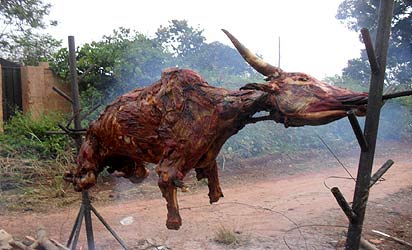
*Suya in the making
By DAVID EMEKA KALU
AS Ramadan approaches, David Emeka Kalu, a poet and freelance journalist in this humourous piece, “Slow Down Food, Lemme Catch Up Witcha!”, writes about discovering Lagos’s street delicacies and authentic local cuisine.
“My life looked good on paper – where, in fact, almost all of it was being lived.”
I felt I had just been defined, my amorphous existence sharply outlined, reading those words of Martin Amis’ amidst the manuscript-weighted, book-lined shelves of my writing room.
The consolidation of memory, the recalling of consciousness from the universe of my present novel. I went through that surrealistic process, realizing like one awakening from a coma the length of my disappearance from pubic affairs. Total absorption will do that to a writer. Morph you into a Rip van Winkle.
From being long subjected to the creative photosynthesis that bends the artist inwards towards the sun of his craft, at the price of exclusion from time’s passage through the terrain. Patting my manuscript, whispering promises of a quick return, I tore myself from the realm of heroic characters in fabricated cities, leapt forward before I could change my mind, and fell through the stars in a purple and yellow galaxy to Lagos lying just outside my door.
I felt I was still in free fall, tumbling through green and brown clouds, being driven through the highways of Lagos. Ah, but Saladin Chamcha survived his plummet from an airplane. Why not I, mine through Lagos with its dense population of wonders and people from all over the world?

*Suya in the making
I did not mention this daredevil fall was made by light of a gibbous moon in whose beams Lagos Island shimmered anachronistically.
Close circuit cameras
Driving past estates surrounded by high concrete walls, the kind fitted in bygone eras with battlements, now fitted with close circuit cameras, I wondered what those dwelling within were concealing from public glare.
Acclimatization tours in once-familiar now-strange locations instil all sorts of thirsts and hungers. Nostalgic thirsts and hungers. But my skin was thick; I was inured. In this, the city of FESTAC 77, the festival that celebrated the histories and cultures of Africa putting them on display for the world.
The city with a street named Queen’s Drive in honour of Queen Elizabeth and the drive she took here on her visit to hand over Nigeria for self-governance. The city of the assassination of Murtala Mohammed, a military Head of State many vow was possibly the best leader Nigeria ever had.
In Lagos with its port at Badagary called The Point of No Return from which over a million slaves were transported from Africa to Europe and to the United States – among them Uluadah Aquino and the ancestors of T. D. Jakes, my hunger was for a gastronomic meal.
What to eat?
I explored my choices: I could go to a restaurant. It seemed on this sojourn that I was relearning Lagos, its glittering night-time skyscape, the expanded freeways with their controversial tolls, the new kings of alimentation in its fast food restaurant structure. My last visit to Lagos seemed to have been in the late nineties.
A time when Mr Biggs held the monopoly on fast foods with outlets almost rivalling the Redeemed Christian Church in parishes. Tantalizers was but – in the words of one of Nigeria’s greatest poets – ‘a shrub amongst the poplars, thirsting for sunlight…’, then. And there were Sweet Sensation, Mama Cass and Big Mac – all similarly straining for light beneath Mr Bigg’s vast canopy.
Now sadly it appeared Mr Biggs had been eclipsed by more serious-minded fast food joints. Chicken Republic, Nandos and KFC were the Obas now. But I didn’t feel like a burger or chicken and chips. My ptyalin was effervescing for something more traditional.
I could have a dinner of sizzling suya bought fresh off the grill and served with sliced onions and juicy tomatoes. I could get this from any of the numerous aboki at every other street corner. If it were yet afternoon I could dine on boli, a meal of roasted ripe plantains served with peanuts. Driving past Eko Lé Meridien hotel I came across another type of fast food: instant noodles prepared by street side vendors in broad moonlight and served up with omelettes or sardines in melamine plates.
Roadside Noodles vendor
An image paused suddenly in the slide show of memory. An image from the Philippines captured on my last visit in the tour bus of my Google research. A road-side noodles vendor in a busy Manila street serving steaming noodles into a cup, smiling and bowing as he handed it to a customer. Roadside noodles vending had been big business in Asia for years, I discovered during that enquiry.
Ever since the seventies when Japan’s Nissin Food Products introduced the Cup Noodles, the next step forward from Momofuku Ando’s invention of instant noodles’ in 1958. From the car’s window beside Eko Lé Meridien hotel, watching as with the ease of jugglers the vendors tore open packs of Indomie and Chicki Chicken Noodles, soaked the contents in bowls of hot water, and returned almost before the motion was completed to turn the eggs frying on their stoves, I realized noodles vending had elbowed its way into the cramped roadside trades of Lagos’ metropolis and established itself sometime during my long disappearance.
Naturally, I was enticed.
Even as I watched, in between cooking the noodles the vendors scooped cocoa, sugar and milk in mugs, poured in measured lengths of piping hot water from soot-blackened kettles, stirred and handed the steaming cups to waiting customers.
The taxi driver parked. I got out, crossed the street and took up on a bench between a man in a suit and a youth clearly from a construction site.
“Aboki give me bread and egg,” the youth demanded.
“How many egg?”
“Two egg.”
“Do me two Indomie and two egg,” the suited man said.
I watched the noodles vendor break open two packets of Indomie noodles. While they soaked in hot water he cracked two eggs into a bowl. From another bowl he spooned pre-sliced onions and peppers into the eggs, sprinkled in salt, beat the eggs, poured them in the frying pan.
He reached for a loaf of bread, sliced it down the middle, turned the egg, returned to the soaking noodles, drained them in a sieve, spooned in onions and pepper, tore open the sachet of noodles flavouring, added this, turned back to the eggs on the stove, scooped them expertly unto the sliced bread, handed it in a plate to the construction worker, lifted the noodles in their bowl, poured them in the pan, stirring and raising the flame in the stove without breaking a sweat.
I gazed on like a man in a daze. The sheer art of it. The fluidity of movement. It was almost a dance, a culinary Terpsichore out here on this starry night this beautiful night of recognition and relearning. As when you are rejoined to a former love after an interval of years, appreciating familiar facial expressions, fascinated by new tics, this was a new surprise from Lagos, my unpredictable.
Disclaimer
Comments expressed here do not reflect the opinions of Vanguard newspapers or any employee thereof.