By Professor Mondy Selle Gold
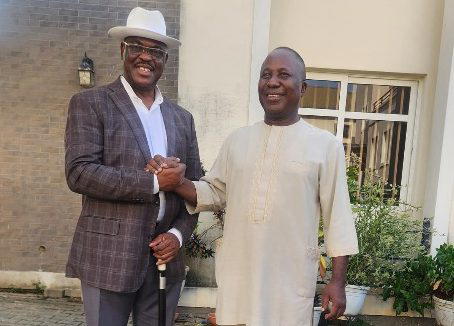
ABUJA — A photograph of Professor Mondy Selle Gold in a firm handshake with Honorable Professor Steve Azaiki, OON, PhD, DSC, has drawn attention to what observers are calling a moment of statesmanship and a broader conversation about leadership and nation-building in Nigeria.
Professor Gold, a governance expert and recipient of the Colorado State University Best Faculty Spotlight Award and the United States President’s Lifetime Achievement Award, described the encounter in Abuja as one that “transcends the immediacy of the moment and enters the realm of meaning, memory, and national reflection.” He noted that the image captures more than two individuals meeting, but rather “intellectual statesmanship in motion” and “the convergence of ideas, experience, and an unrelenting commitment to public service, institutional excellence, and nation-building.”
Professor Azaiki, a distinguished statesman, two-time Secretary to the Government of Bayelsa State, Executive Coordinator of the African Policy Research Consortium with presence across three continents, and Pro-Chancellor and Chairman of the Governing Council of Ritman University, was described by Professor Gold as the “quintessential scholar-statesman” whose career reflects more than three decades of service in public administration, policy formulation, and institutional leadership.
Set in Abuja, Nigeria’s administrative and political center, the photograph takes on added significance, according to Professor Gold, because the city is where “lofty aspirations confront the unforgiving realities of governance.” Quoting Winston Churchill’s line that “The price of greatness is responsibility” and Nelson Mandela’s admonition that “May your choices reflect your hopes, not your fears,” he argued that leadership should be judged not by rhetoric but by the strength of institutions built and the value delivered to citizens.
The reflection also turned to Bayelsa State. Professor Gold said the state’s complex challenges and development needs require leadership that “privileges structure over spectacle, policy depth over performative politics, and institutional continuity over transient political excitement.” He described governance as “the ultimate test of competence, character, and capacity” and said that leaders like Professor Azaiki, who are “intellectually prepared, administratively tested, policy-driven, and institutionally grounded,” could catalyze transformational reforms in the state.
While emphasizing the credentials and experience of Professor Azaiki, Professor Gold, a Fellow of the Chartered Institute of Leadership and Governance in the United States, stressed that leadership must remain anchored in democratic legitimacy. “The people remain the final arbiters of governance,” he said, adding that his comments recognize “differentiated capacity within the democratic marketplace of ideas and leadership possibilities” rather than an assertion of exclusion.
Drawing on proverbs, including “The best time to plant a tree was twenty years ago. The second-best time is now” and “to cross the river, one must feel the stones,” Professor Gold said nations are built not only during elections but through the deliberate recognition of individuals with intellectual depth, administrative competence, and moral courage.
He concluded that the handshake represents an invitation to reflect on the difference between ambition and ability, and between political noise and enduring statesmanship. “In the final analysis, the destiny of Bayelsa State, and indeed Nigeria, will not be determined by those who seek power most fervently, but by those most prepared to wield it with wisdom, humility, vision, and unwavering fidelity to the common good,” he stated.
Disclaimer
Comments expressed here do not reflect the opinions of Vanguard newspapers or any employee thereof.