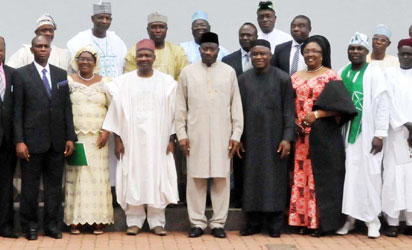
President Goodluck Jonathan (m), with Vice President Namadi Sambo, and Commissioners of the National Population Commission after their inauguration in Abuja on Tuesday (26/6/12). NAN Photo.
By Ishola Balogun, Moses Nosike & Ebun Sessou
Is Nigeria getting more crowded? Perhaps, President Jonathan feels the growing population is a challenge that must be checked.
The President at a function recently hinted that the government might consider legislation on birth control, triggering another national discourse on the intended policy.
With an annual exponential growth rate of 3.2 per cent, several individuals have helped to achieve the current population growth rate in the country. Remember Maasaba Bello, an Islamic Faith healer in Bida, Niger state with 86 wives and 185 children? The 88 year-old polygamist has solely increased Nigeria’s population more than anyone else, having the largest family in the world and hitting the world record leading Ziona Chana of India who has 39 wives and 95 children. There are other Nigerians who are closely behind Chana’s record.

President Goodluck Jonathan (m), with Vice President Namadi Sambo, and Commissioners of the National Population Commission after their inauguration in Abuja on Tuesday (26/6/12). NAN Photo.
A close look at your immediate environment will reveal unimaginable number of wives and children, most of whom groan under the painful yoke of poverty. Saka Oyesanmi, 64, who lives at Ayobo, Ipaja, Lagos has 13 children from his only one wife. His family of 15 currently lives in a one-room apartment. The same with a guard who has 11 children. Ironically, his boss who pays him monthly stipend has only two. Most of those with large number of children are being overwhelmed with poverty as they rarely provide the emotional and physiological needs of the children. The children most often than not become a societal burden, turning out to be miscreants and rascals.
The President at the swearing-in ceremony of the newly appointed Chairman and Commissioners of the National Population Commission recently, said Nigeria would not be the first country to make laws on birth control, adding that religious beliefs should not be used as a tool to frustrate the good policy. The president said “we have to plan and manage our population very well to make progress,” he stated.
However, earlier attempt made by the then military government of Gen Ibrahim Babangida in 1988, when Nigeria adopted a National Population Policy which sought to reduce population growth rate through voluntary fertility regulation, and to promote the health and welfare of mothers and children to improve the quality of life of all Nigerians.
The main thrust of that policy was the recommendation to young couples not to have more than four children per family (or per woman) and to attain a reduction of the population of women bearing more than four children by 80 per cent by the year 2000. But many believed that it was only an excercise in futility.
Even as the present government contemplates birth control, critics see the current attempt of Jonathan’s government to ensure that women have access to contraceptives and promote immorality. Catholic priests, Imams, mothers and other social commentators commented on the issue with divergent opinions. While some vehemently agreed with the policy thrust saying it will help to strengthen the socio-economic condition of Nigeria; others said it is unnecessary as it goes against the law of God. Again, some Nigerians declared that it is not practicable in the country.
The Assistant Parish Priest of Good Shepherd Catholic Church, Owode, Lagos, Rev. Fr. Mike Iroh said it is a welcome development. “The cannon law of the church emphasised procreation and education for children. But where we are today is a regeneration of poverty. A man with N15,000 salary should not go home and start procreating endlessly because that will amount to increasing the social burden of the church and the government. If it is well thought out and it tends to promote the education of the people, then it is a welcome development. I submit that instead of giving birth to children you cannot cater for, there should be population control.”
“This will help curb crime in the future. It depends on how focus and systematic we are about it. But another thing is that government policy should be people oriented but today it is not because governments have failed the people. They don’t have confidence in the government.”
He added that people should also make themselves arbiters of moral laws. “You see people doing abortion on daily basis and you see a wide use of contraceptives. The church has always been preaching dignity in the society. Another point is that if you are making provision on birth control, there should be provision for the childless where our system of adoption will work effectively without harassment and molestation,” he stressed.
Ustaz AbdulWaheed Olowo, an Arabic and Islamic teacher disagreed with Rev.Fr. Iloh saying it is at variance with the laws of God. He said: “Religiously, Islam cannot sanction such a law because it amounts to compromising the powers of Allah. Islam does not put a limitation on the number of children one should produce, so, we are supposed to give limitation in that regard.”
He stated that even if Nigeria’s population multiplies many times, she is fully capable of finding a solution. He added that the solution to economic downturn is production. “Government should concentrate on developing our industries so that we can take care of the massive unemployment and underproduction in the country. There is also strength in our numbers. We can improve economically by developing the human capital base from this growing population instead of thinking to check it.”
A Pastor and motivational speaker, Oluyide Fola Ukachi said: “These days nobody should have children they cannot take cater for. If it’s only one you can conveniently cater for, have one and stop. It’s not fair to keep having children expecting your relations to come and help with their education or to create burdens for other people to bear, and then turn around and accuse people of not helping you.”
Mrs Bukola Balogun, a businesswoman and a mother of two said “They not only want motherhood to be a conscious and controlled function but the government want parenthood to be something other than the consequences of recklessness and carelessness. Parenthood should be regarded as a fine instrument, a noble trust, a splendid assignment, and it can be so considered when it becomes a conscious responsibility in line with the dictates of God. The freedom of number which God gives should also come into play because He is the supreme being and He knows what we don’t know. He knows why He did not limit it. So, there should not be limitation.”
Rev. Isaac Afolayan, President, Presbyterian Church sstated: “They just say what they cannot achieve even in the next twenty years. This government should have improved on getting accurate data of all Nigerians. I don’t see it visible. Really speaking, it has no religious implication but the fact is that they will keep satisfying their interest and engage more in corruption so much that it will be difficult to check.”
Former Managing Director of News Agency of Nigeria, NAN, Bashorun Akin Osuntokun said “I’m not abreast of this issue, but I think it is still at the level of opinion yet to evolve into becoming a government policy. I support the notion of encouraging population control directed especially at those whose income level cannot support a large family but not as a mandatory policy.”
Adebayo Sokunbi, Operations Director, Kidney Consultants International said: “I don’t think such law is going to work because this is a part of the world where we love making children. How is Federal Government going to implement such law? I would advise that government focuses attention on other meaningful bills that would benefit the common man and the entire citizenry.
There are other things government can channel the availability of resources like medication, job creation, education that would promote the country socially and economically. Government should settle a lot of issues on ground before passing a bill on birth rate.”
Olukayode B.A Fabunmi, a lawyer and Nigeria Country Chair, IPFA insisted that for such law to determine how many children a family should have would not be a priority for now. There are other things government should look at now that are more challenging even though I have not seen the bill to look at it critically in order to know what government wants to achieve.
Again, it’s another thing to make law and a different thing to implement it. But on the whole, there are more challenging issues on ground that government should tackle first.
An expert in skills, science and technological development of youths in Nigeria, Mojisola Omole said: “It will not work because Nigeria is an entity with a culture where giving birth to many children are seen as God’s blessing and any attempt to curtail it is believed that your are depriving them God’s blessing. The CEO of Immersive Solutions Limited who stressed the bible injuction that ‘Your children will surround your table and that is one source of their joy in life’; noted that it’s an encroachment on human rights.
What government should do is to start encouraging, educating and enlightening people on the value of our children whether male or female.
She butressed her argument on geneder issues saying: “in some cultures where a woman has given birth to female children but has no male child she is not regarded, so keeps expecting and hoping to have a male child. In this regard, government should embark on awareness so that female children should be valued as male children. And more importantly, government should give more seats to the women so that value for the female will go high. So for them to make a law, I think it’s a violation of human rights. How will they implement it?, she querried.
Obiora Madu, Programme Director/CEO, Multimix Academy, “I think the people will support it because of one fact that we are not making use of our population for anything, unlike China. Government should not go in that direction now because there are several other issues begging for attention. Government needs to pay attention to hunger/poverty in the land while people are suffering in the midst of plenty. They should channell resources on infrastructure, power supply, education, skill acquisition, job creation. Government should rather concentrate its energy on tackling insecurity in the country. The country needs development that can create employment so that our youths will shun criminality.”
Disclaimer
Comments expressed here do not reflect the opinions of Vanguard newspapers or any employee thereof.