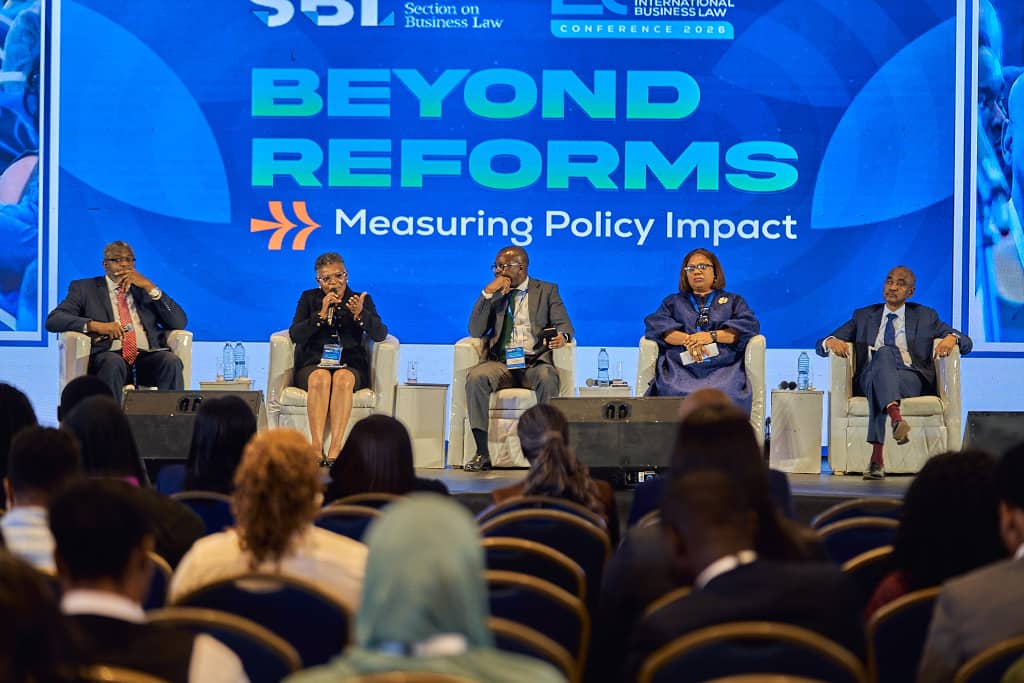
Nigeria’s economic, fiscal and judicial reforms came under scrutiny at the 20th Annual International Business Law Conference of the Nigerian Bar Association Section on Business Law (NBA-SBL), with stakeholders calling for measurable outcomes rather than policy declarations.
The conference, themed “Beyond Reforms: Measuring Policy Impact,” focused on evaluating how existing economic, legal and regulatory reforms are translating into measurable outcomes for businesses, investors and citizens.
Representing the Attorney-General of the Federation and Minister of Justice, Prince Lateef Fagbemi, SAN, Hussein Taiye Oloyode, SSA to the President on Arbitration and Drafting (Office of the HAGF/Minister of Justice), said Nigeria was experiencing one of its most ambitious reform periods since the return to democracy
He highlighted key reforms in foreign exchange management, taxation, energy, ease of doing business and public sector transparency.
Hussein said the unification of the foreign exchange market had improved transparency, reduced distortions and boosted investor confidence.
He stressed that the success of reforms would be measured by their ability to improve business conditions, attract investment, expand the tax base and drive economic growth.
According to him, the administration’s tax reform programme seeks to simplify tax administration, eliminate multiple taxation and create a predictable business environment.
He also pointed to increased domestic refining capacity, fresh foreign investment commitments and reforms aimed at strengthening energy security and job creation.
While acknowledging gains in external reserves, capital market performance and oil production, he said sustainable growth requires strong legal and institutional frameworks.
Hussein disclosed that the Ministry of Justice is implementing the National Policy on Justice 2024–2028 to improve access to justice and promote technology-driven legal processes.
He added that the government is reviewing Nigeria’s arbitration and Alternative Dispute Resolution (ADR) framework to align with international standards.
Warning against reforms without evaluation, he urged the NBA-SBL to develop objective benchmarks for assessing policy effectiveness.
Hon. Justice Mohammed Ambi-Usi Danjuma, Justice of the Court of Appeal, representing the Chief Justice of Nigeria and the President of the Court of Appeal, said the judiciary remains central to translating reforms into economic growth.
He noted that while Nigeria has extensive laws and regulations governing business and investment, the real question is whether they are achieving the desired outcomes.
Danjuma highlighted judicial reforms, including fast-track commercial dispute resolution procedures and expanded mediation and ADR mechanisms.
He, however, expressed concern that many lawyers still prefer conventional litigation, slowing the resolution of commercial disputes.
The appellate court justice called for stronger collaboration between judges and lawyers through training and knowledge-sharing initiatives.
On his part, NBA President, Mazi Afam Osigwe, SAN, urged policymakers, regulators and legal practitioners to focus on reforms that improve Nigeria’s competitiveness and attract investment. He stressed that “reforms should be assessed not by the volume of policy announcements but by their ability to deliver tangible benefits to businesses, institutions and citizens.”
He added that every reform initiative should contribute to economic growth and national competitiveness.
NBA-SBL Chair, Mrs Ozofu ‘Latunde Ogiemudia, also maintained that reforms should be judged by their impact on ordinary Nigerians rather than by policy announcements.
The conference attracted leading lawyers, judges, policymakers, regulators, investors and business executives, all united in the call for reforms that deliver measurable benefits to Nigerians and the economy.
Disclaimer
Comments expressed here do not reflect the opinions of Vanguard newspapers or any employee thereof.