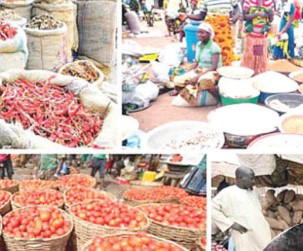
File image
By Cynthia Alo
There are strong indications that global food insecurity is set to worsen as the Food and Agriculture Organisation of the United Nations, FAO, revealed that 41 countries including 31 in Africa, urgently require external assistance for food due to escalating conflicts and severe weather shocks.This was disclosed in FAO’s latest report on Global Information and Early Warning System on Food and Agriculture (GIEWS) released on Friday. According to the report, conflict and insecurity remain the primary drivers of the most severe levels of acute food insecurity.
Concurrently, the latest FAO Food Price Index showed that the benchmark measure of world food commodity prices recorded a marginal 0.3 percent decline in June 2026 compared to May, though it remains 2.2 percent higher than last year. The decline was attributed to El Niño weather patterns and high input costs which continue to threaten agricultural production, particularly in East and West Africa.Commenting on the development, the Director of FAO’s Markets and Trade division, Boubaker Ben-Belhassen, stressed that individual commodity markets are responding differently to emerging economic drivers.He stated: “While the overall benchmark for international food commodity prices declined slightly in June, individual commodity markets continue to respond differently to evolving factors.
In an increasingly uncertain global environment, transparent markets, timely information, and predictable global trade remain essential to advance food security and strengthen the resilience of agrifood systems.”A further breakdown of the commodity indices showed that the FAO Cereal Price Index declined by 3.5 per cent from May, driven by lower international maize and wheat prices while global wheat prices fell by 4.4 per cent due to rapid harvest progress in the Black Sea region, a stronger US dollar, and softer energy markets amid expectations of reduced tensions around the Strait of Hormuz.The reported noted that world maize prices fell by 6.2 percent,reflecting prospects of ample supplies in exporting countries in South America and weaker ethanol demand.
Meanwhile,the FAO All Rice Price Index rose by 3.2 per cent in June which was driven by strengthening Asian demand for Indica rice, alongside elevated production, transport, and marketing costs.The report also recorded mixed prices for other critical food segments. The Vegetable Oil Price Index increased by 3.8 per cent from May, supported by stronger mandated biofuel demand. Similarly, the Meat Price Index grew by 0.5 per cent to hit a new record high, driven by tight domestic availability of poultry meat.On the downside, the Sugar Price Index dropped sharply by 5.7 per cent, driven by lower domestic ethanol prices in Brazil and the depreciation of the Brazilian real. The Dairy Price Index also dropped by 1.5 per cent, marking the eleventh consecutive monthly decline in international cheese prices due to excess global export supplies.On the production outlook, the FAO Cereal Supply and Demand Brief put global total cereal output for 2026 at 2,983 million tonnes.The report noted that while this remains the second-highest harvest in history, it sits 1.9 per cent below last year’s record high.According to the report, the global wheat output is expected to drop by 4.3 per cent to 806.5 million tonnes, severely impacted by El Niño conditions in major producing regions like Australia.” World rice production is now anticipated to dip by 1.8 percent from its all-time high in 2025/26.”FAO lowered its forecast for world cereal utilization in 2026/27 to 2,961 million tonnes, due to an expected reduction in global wheat utilization. FAO’s forecast of world cereal stocks at the close of seasons in 2027 now stands at 957.8 million tonnes, leaving the global cereal stock-to-use ratio largely unchanged in 2027 at 32.0 percent. FAO’s forecast for world trade in cereals in 2026/27 is little changed at 507.6 million tonnes,” the report stated.The report indicated that the situation remains difficult and uncertain for 39 Low-Income Food Deficit Countries (LIFDCs). Although their aggregate cereal output is forecast to increase by 1.4 per cent to 129 million tonnes in the 2026/2027 season, their total cereal import requirements are expected to rise by 2.0 per cent to nearly 48 million tonnes, putting further pressure on weak foreign reserves and worsening regional vulnerabilities.
Disclaimer
Comments expressed here do not reflect the opinions of Vanguard newspapers or any employee thereof.