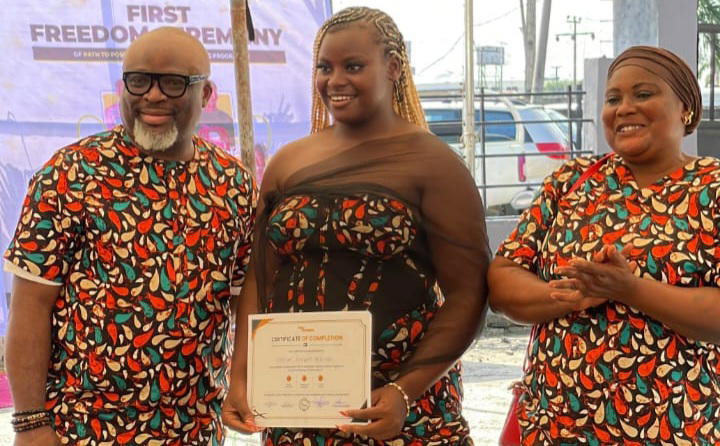
Anniversary: From left: Mr Tunji Ladle, Executive Director, Trinity Phoenix Charity Foundation, Ms Precious Nefisat, a beneficiaries of the Programme, and her mother, Mrs Haruna, during the Path to Possibilities 10th year anniversary in Lagos.
By Olayinka Ajayi
A community resource centre established to bridge educational inequality in Lagos has recorded nearly 96,000 visits in 10 years, providing thousands of children with free access to books, digital literacy, vocational training and life skills, even as its founders called on government, non-governmental organisations and private sector players to invest more in education and skills development.
The milestone was celebrated at the 10th Anniversary of the Path to Possibilities (P2P) Resource Centre and the First Freedom Ceremony of its Tailoring Training Programme, organised in partnership with Trinity Phoenix Charity Foundation.
The event also witnessed the graduation of five trainees, each of whom received a sewing machine and tailoring kit to help them begin earning a living immediately.
Speaking at the ceremony, Co-founder of Path to Possibilities, Titilolamo Bello, said while the resource centre opened its doors a decade ago, the journey of the charity began much earlier in 2009, inspired by her own childhood struggles after losing her father and watching her widowed mother raise five children with little support.
“I’m going to start by telling you something that might surprise you. And that is that this centre did not start in 2016.
“This centre actually started before that. The centre started with a story of struggle,” she said, recounting how relatives and friends helped her family remain in school.
Bello said those experiences, alongside the story of Resource Centre Manager Austin, who sold groundnuts at the age of 13 to pay his secondary school fees after losing his parents, shaped the vision behind the initiative.
“I tell you these two stories, mine and Austin’s, because I want you to understand that this centre was just not an experience. It came from lived experiences. It came from knowing what it feels like to want more for yourself and not have the means to get there.”
According to her, the founders had initially hoped to build a school but lacked the financial capacity. Instead, after consulting residents of Ikota on what they needed most, they established a community resource centre equipped with a library, computer laboratory, free internet and vocational training facilities.
Today, the centre welcomes about 200 visits weekly and has recorded nearly 96,000 visits since inception. Beyond providing books and computer education, it hosts career workshops, supports under-resourced schools with ICT training and recently introduced a tailoring programme to equip young people with employable skills.
Bello disclosed that keeping the centre running has become increasingly difficult due to prolonged electricity shortages, revealing that the facility had operated without public power supply for about five months and now depends heavily on generators while raising about N18 million to install a solar energy system.
She also lamented Nigeria’s worsening education crisis, noting that the country’s out-of-school population had risen from about 10.5 million when the organisation started to over 20 million today.
“I think that we are failing however. We are failing in the education system. There is an investment in education that we need to make,” she said, adding that vocational education should be recognised as an important pathway for young people unable to continue formal schooling.
The P2P co-founder urged governments to increase funding for education while calling on other non-governmental organisations, corporate organisations and established fashion designers to support community initiatives through funding, mentorship and apprenticeship opportunities for young graduates.
“In this country, we have amazing fashion designers. Some of these children can go to their shops. We have the numbers but we need to invest in the skill. And that skill investment will end up serving us well as well,” she said.
Also speaking, Trustee and Director of Path to Possibilities, Fumilayo Akanmu, said the charity has, since 2009, sponsored about 20 children through six years of secondary education, paying their tuition, uniforms, books and other educational expenses, while the resource centre has expanded access to learning for hundreds of children every week.
She noted that many children attending so-called private schools in low-income communities still lack access to quality facilities, making interventions such as the resource centre indispensable, but stressed that charities could not replace government responsibility.
“So, as a charity, that’s one of the things that we’re very aware of. It’s one of the areas that we’re really focused on trying to push the narrative, trying to engage with local and state government about the state of things in this community. If the state schools could be better supported, better funded, perhaps more of these children will be able to get into secondary school.”
One of the graduands, 18-year-old Jimoh Orilowo, who lives with a disability, described the tailoring programme as life-changing, saying that although sewing was difficult at first, he gradually mastered the skill with support from his trainer.
Expressing confidence after receiving his sewing machine, he said: “After this programme, if I have a machine, I’ll come and get my own shop. That’s my business.
“I want to tell them thank you very much. They also tried for me.”
For another graduate, 18-year-old Destiny Godwin, who was raised by a single mother, the sewing machine represents an opportunity to support herself while pursuing a university education.
“I’ll use the machine in school because I’ll go to university this year. I’ll sew for myself. When I sew for myself, my friends will see it and they’ll be amazed. So, I’ll sew for them and get money,” she said, expressing hope that the skills acquired would help her build a business and ease the financial burden on her family.
Disclaimer
Comments expressed here do not reflect the opinions of Vanguard newspapers or any employee thereof.