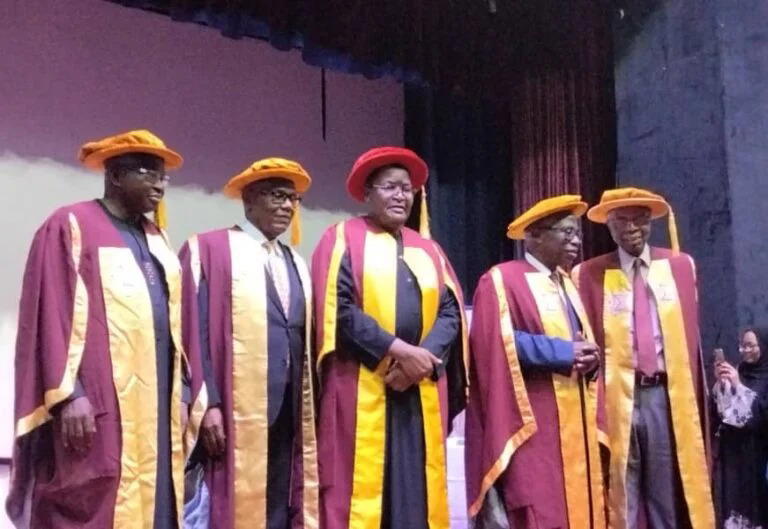
Danbatta in the middle after his investiture as the 14th President of NAE Thursday in Lagos.
Former Executive Vice-Chairman of the Nigerian Communications Commission (NCC), Prof. Umar Danbatta, has assumed office as the 14th President of the Nigerian Academy of Engineering (NAE), pledging to strengthen policy engagement and position engineering at the centre of Nigeria’s development agenda.
Danbatta made the commitment during his investiture ceremony in Lagos, where he also unveiled a four-point agenda focused on policy engagement, academia-industry collaboration, mentorship and strategic partnerships.
The event also featured the induction of 12 new fellows into the academy, the presentation of Lifetime Achievement Awards and the conferment of honorary fellowships.
In his acceptance speech, Danbatta said his administration would align its activities with the academy’s 2024–2028 Strategic Plan, which seeks to transform engineering education, promote industrialisation, strengthen infrastructure management and enhance technical skills development.
According to him, the academy will deepen engagement with both the executive and legislative arms of government to ensure that national policies are guided by sound engineering research, innovation and data-driven insights.
He stressed the need for engineering professionals to play a more active role in shaping public policy and addressing critical national challenges.
Danbatta also pledged to champion indigenous technological solutions to tackle issues such as inadequate power supply, broadband expansion, climate change and environmental sustainability.
He identified the gap between academia and industry as one of the major impediments to technological advancement in the country and promised to foster stronger partnerships that would equip graduates with practical, entrepreneurial and industry-relevant skills.
The new NAE president further pledged to prioritise mentorship and capacity building for young engineers through workshops, conferences, research grants and professional development programmes.
He said the academy would strengthen collaboration with institutions such as the Nigerian Society of Engineers (NSE), the Council for the Regulation of Engineering in Nigeria (COREN), the National Board for Technical Education (NBTE) and the National Universities Commission (NUC).
Danbatta added that efforts would also be made to expand partnerships with engineering institutions across Africa, Europe and the Americas to facilitate knowledge exchange and the adoption of global best practices.
He called on engineers across the country to move beyond advocacy and contribute practical solutions to Nigeria’s developmental challenges.
Earlier, the outgoing President of the academy, Prof. Rahamon Bello, said the institution had strengthened its role as a strategic adviser on engineering, technology and innovation policies during his tenure.
Bello noted that the academy continued to promote engineering research, capacity development and stakeholder engagement aimed at addressing national development priorities.
He urged members to support the new leadership in advancing the academy’s mandate and enhancing its relevance to national development.
Addressing the newly inducted fellows, Bello said their admission was in recognition of their professional achievements and contributions to the engineering profession.
“You are joining a community of thought leaders and nation-builders. Your expertise is needed now more than ever to support national development and advance the work of the academy,” he said.
Also speaking, the Vice-Chancellor of Bayero University Kano, Prof. Haruna Musa, called on the academy to play a greater role in addressing Nigeria’s development challenges through engineering-driven solutions.
He identified energy security, renewable energy development, transportation modernisation and technology-based security systems as critical sectors requiring urgent attention.
Musa expressed confidence that Danbatta’s leadership would deepen research, strengthen policy engagement and accelerate the adoption of home-grown technological innovations.
Speaking on behalf of the newly inducted fellows, Mrs. Aramide Adeyoye pledged the commitment of the new members to advancing engineering excellence and contributing to national development.
In his annual lecture, Prof. Emeritus Fola Lasisi called for increased investment in engineering education, research and innovation, describing engineering as a key driver of economic growth and industrial development.
The academy inducted 12 new fellows and honoured 10 distinguished members with Lifetime Achievement Awards in recognition of their contributions to engineering and national development.
Disclaimer
Comments expressed here do not reflect the opinions of Vanguard newspapers or any employee thereof.