By Adesina Wahab
Africa’s foremost industrialist, Aliko Dangote, has called on the Olusegun Obasanjo Leadership Institute (OOLI) to take the lead in providing high level leadership training for African presidents, prime ministers, governors, and senior policymakers, describing the Institute as the most strategically positioned centre for continental leadership renewal.
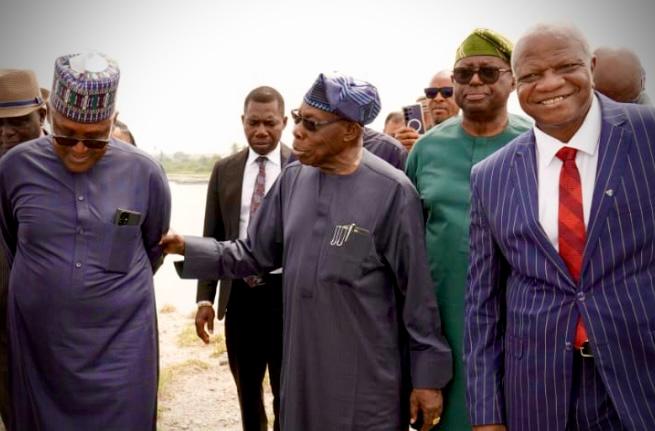
Dangote made the remarks during an exclusive engagement with the leadership of OOLI and the Olusegun Obasanjo Presidential Library (OOPL) during their visit to the Dangote Petroleum Refinery, where he offered a strong endorsement of the Institute’s mission and continental relevance.
“The Olusegun Obasanjo Leadership Institute is exactly what Africa needs at this critical time,” Dangote said. “With President Obasanjo and other outstanding African past presidents at its core, OOLI is uniquely placed to deliver experiential leadership workshops and bespoke training for African leaders who genuinely want to transform their nations.”
Obasanjo recounts the leadership moment that sparked Africa’s cement revolution
During the visit, former President Olusegun Obasanjo shared a previously undisclosed account of his early engagement with Dangote – an encounter that would later reshape Africa’s industrial landscape.
Obasanjo recalled inviting Dangote for a meeting while the businessman was still an importer of cement:
“Asking me to see you at 7 am when you are in Abuja and I am in Lagos is an impossibility,” Obasanjo said, recounting the exchange. “So, I asked him, ‘What time can you see me?’ He said, ‘9am.’ At that time, he was importing cement. I wanted somebody I could talk to.”
Obasanjo explained how he challenged Dangote on why he was importing cement instead of producing it locally, despite Nigeria’s abundant limestone deposits.
“He told me honestly, ‘It is more profitable for me to import and sell than to produce here.’ That was the truth. So I asked him, ‘What can I do to make you produce cement locally?’ I wanted to learn from him. I wanted to know what he required so that I could achieve what Nigeria needed.”
Dangote’s response became the turning point: “He said, ‘Make it unprofitable to import cement as it is.’ I asked how. He said, ‘Tie my ability to import cement to my commitment to produce cement.’ I said, ‘You can go.’ You are hearing this for the first time.”
Dangote: “Nigeria now produces more cement than Saudi Arabia”
Reflecting on the outcome of that pivotal conversation, Dangote highlighted the scale of transformation that followed: “Today, Nigeria produces more cement than Saudi Arabia. We are the largest producer of cement in Africa and the Middle East.”
He credited Obasanjo’s strategic leadership for catalysing the shift from trading to manufacturing—an intervention that now benefits more than ten African countries, including Nigeria, Ghana, Cameroon, Republic of Congo, Côte d’Ivoire, Ethiopia, Senegal, Sierra Leone, South Africa, Tanzania, and Zimbabwe
“Obasanjo’s leadership strategic mapping changed the trajectory of our business,” Dangote said. “That decision has benefitted multiple African economies. This is the kind of practical leadership OOLI can teach to presidents and policymakers.”
He expressed confidence that OOLI would bridge leadership gaps at continental level, particularly in governance, economic transformation, and regional cooperation.
OOLI responds: Raising leaders who deliver
Speaking on behalf of the Institute, Prof. Samuel Adedeji Daramola, Deputy Chief Executive of OOLI, representing the Director, General Martin Luther Agwai (rtd), expressed appreciation for Dangote’s endorsement and acknowledged the refinery’s monumental contribution to Africa’s industrial growth.
“We appreciate the enormous impact of the Dangote Petroleum Refinery and the entire conglomerate on Africa’s economy,” Prof. Daramola said. “OOLI’s mandate is clear: to raise leaders who deliver measurable results.”
He noted that OOLI has assembled a global faculty of distinguished facilitators, diplomats, academics, and practitioners, supported by a curriculum designed to strengthen leadership capacity across African nations.
“Our programmes are experiential, practical, and grounded in real world leadership challenges,” he added. “With the right curriculum and facilities, OOLI is ready to support presidents, prime ministers, governors, and senior officials committed to transformational leadership.”
A call to African leaders
Dangote urged African leaders—past and present—to embrace OOLI as a strategic partner in their leadership journey.
“If Africa is serious about changing its development story, then our leaders must embrace continuous learning,” he said. “OOLI offers the right platform—rooted in African experience, yet globally oriented—to make that happen.”
OOLI reaffirmed its commitment to becoming a continental hub for leadership excellence, focusing on governance, peacebuilding, economic transformation, and sustainable development.
Disclaimer
Comments expressed here do not reflect the opinions of Vanguard newspapers or any employee thereof.