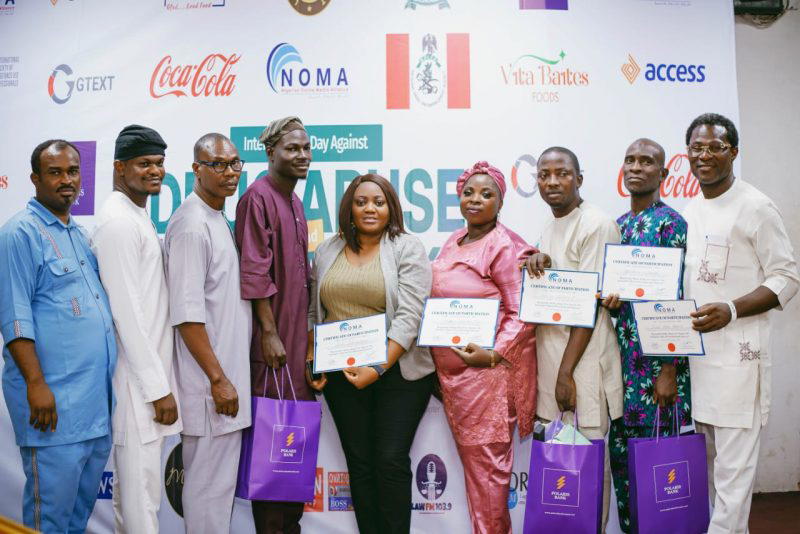
By Elizabeth Osayande & Ifunanya Ndigwe
To strengthen drug prevention across Nigeria, the Nigerian Online Media Alliance has partnered with the National Drug Law Enforcement Agency and public health experts to equip journalists with advocacy skills to fight substance abuse.
The programme, which was held at the Federal Neuro-Psychiatric Hospital in Yaba, Lagos, to mark the 2026 International Day Against Drug Abuse and Illicit Trafficking, provided a platform to train media practitioners on driving effective public awareness campaigns.
Speaking at the event, Chairman and Chief Executive Officer of the National Drug Law Enforcement Agency, Brigadier-General Mohamed Buba Marwa, warned that Africa faces a rapidly growing drug problem, and Nigeria remains at the centre of the challenge.
Marwa stated, “While global drug use is expected to rise moderately by 2030, Africa could witness an increase of up to 40 per cent. Our national drug use prevalence stands at 14.4 per cent, which is significantly higher than the global average of 5.6 per cent. We have made over 77,000 arrests and seized over 15 million kilograms of illicit substances, but law enforcement alone cannot solve this problem. Reducing demand is the ultimate solution, and this is where the media becomes indispensable to influence positive choices among young people.”
Chief Medical Director of the Federal Neuro-Psychiatric Hospital, Yaba, Dr Olugbenga Owoeye, described drug abuse as a public health challenge and noted that public education is critical due to the shortage of mental health professionals in the country.
Owoeye said, “Nigeria has continued to grapple with a high prevalence of substance abuse, making it imperative for all stakeholders to join forces. Prevention remains the most effective and cost-efficient strategy to handle this menace. Through international collaborations, we have already trained more than 1,200 substance use prevention and treatment professionals across Nigeria to help manage the situation.”
President of the International Society of Substance Use Prevention and Treatment Professionals Nigeria, Dr Olajumoke Koyejo, challenged misconceptions about addiction, calling for a more compassionate, science-based approach.
Koyejo explained, “Addiction is a chronic brain disease rather than a moral failure. Stigma remains one of the biggest barriers preventing people from seeking treatment. When addiction is viewed as a personal weakness or criminal behaviour, individuals become afraid to seek help, and families hide the problem. To support recovery, we have introduced the VIBECHECK platform, which is a digital screening tool designed to help individuals assess substance use risks and access professional help safely.”
Lagos State Commissioner for Youth and Social Development, Mobolaji Abubakre Ogunlende, expressed concern over how social media normalizes substance abuse among young people, noting that economic pressures and peer influence make youths more vulnerable.
Ogunlende noted, “Drug-related content continues to gain traction online, exposing young people to harmful lifestyles. To check this trend, the Lagos State Government has implemented initiatives, including the Lagos State Kick Against Drug Abuse programme, school sensitization campaigns, and digital mental health support platforms.”
Publisher of JKNewsMedia.com and Senior Investigative Journalist, Ms Joke Kujenya, delivered a goodwill message on behalf of media practitioners, emphasizing that journalists bear a massive responsibility to protect lives through safe reporting.
Kujenya noted, “Journalists are not the police, and we do not arrest traffickers, but we can make their hiding place smaller. Our role is to report facts, not to glamorize crime or scare people with rumours. We must ask the hard questions about why young people turn to drugs and who brings these substances into our streets. When we report consistently and humanely, law enforcement acts, communities organize, and policymakers move funds toward treatment. Drug abuse will not end with one headline, but it will not end without headlines.”
Chairperson of the Nigerian Online Media Alliance, Theresa Moses, described the event, held on June 25, as a strategic intervention to guide media practitioners away from sensationalism.
Moses said, “The stories we tell, the language we use, and the facts we verify all contribute to shaping public understanding and influencing behaviour. Responsible journalism can help strengthen public awareness, reduce stigma, and support national efforts aimed at creating a drug-free Nigeria.”
Lagos State Commissioner for Information and Strategy, Obafemi-Ajayi Ademuyiwa, added that responsible reporting requires protecting the dignity of individuals undergoing recovery, promising that the state government will continue to collaborate with the media on prevention-focused messaging.
Disclaimer
Comments expressed here do not reflect the opinions of Vanguard newspapers or any employee thereof.