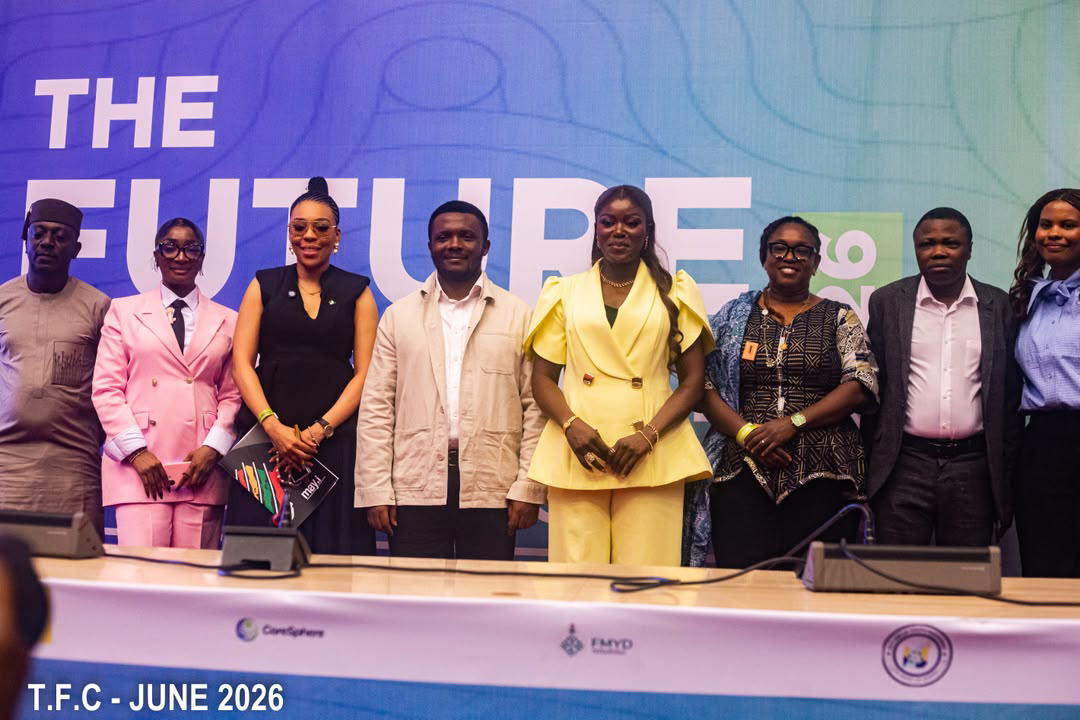
Calls for a more inclusive and action-driven energy transition took centre stage at The Future Conference (TFC) 2026, as stakeholders urged the Federal Government to enact legislation on energy justice while launching a clean cooking initiative aimed at improving the lives of vulnerable Nigerians.
Held at the Federal Ministry of Foreign Affairs in Abuja, the conference brought together more than 500 participants, including policymakers, energy regulators, development finance institutions, private sector executives, academics, civil society groups, and youth leaders under the theme, Green Transitions: The Future of Energy and Climate Change.
Organised by CoreSphere Nigeria Limited, the conference focused on moving Nigeria’s climate agenda beyond policy discussions to practical implementation, with participants agreeing that the country is prepared to accelerate its transition to cleaner and more inclusive energy systems.
Convener of the conference and Founder/Chief Executive Officer of CoreSphere Nigeria Limited, Ambassador Sonia Elohor Somuvie, challenged Nigerians, particularly young people, to complement online advocacy with active participation in policymaking and governance.
She noted that while social media campaigns have helped raise awareness on climate issues, meaningful change would only come through sustained engagement with legislative and institutional processes.
According to her, “Lasting change requires Nigerians to engage directly with policy processes and political institutions.”
One of the major outcomes of the conference was a collective resolution calling for a Bill on Just Inclusion in Nigeria’s Energy Transition Plan. The proposed legislation seeks to embed equity and inclusion for women, young people, and vulnerable communities within Nigeria’s energy transition framework.
CoreSphere announced plans to begin work on the proposed bill in partnership with the Abuja Youth Parliament, with the objective of translating the conference’s recommendations into legislative action.
Chairman of the conference, Senator Ned Munir Nwoko, reiterated the need for practical solutions capable of delivering measurable benefits to communities, while the keynote address, delivered on behalf of Hon. Terseer Ugbor of the House of Representatives, urged stakeholders to move beyond policy aspirations and focus on tangible outcomes.
Panel discussions featured representatives from the Nigerian Electricity Regulatory Commission (NERC), the Energy Commission of Nigeria, the Rural Electrification Agency (REA), the Nigeria Sovereign Investment Authority (NSIA), Binary Solar, AquaEarth Consulting, Nile University, the National Power Training Institute of Nigeria (NAPTIN), and the FCT Abuja Youth Parliament.
Discussions centred on regulatory reforms, financing mechanisms, renewable energy investments, off-grid electrification, youth entrepreneurship, women’s participation in clean energy manufacturing, and strategies for accelerating Nigeria’s transition to a low-carbon economy.
The conference also witnessed the official launch of the Clean Cooking Initiative, championed by Senator Ned Munir Nwoko and represented by Mr. Chukwuebuka Anyaduba.
The initiative aims to distribute 1,000 cooking gas cylinders to vulnerable households across Nigeria as part of efforts to reduce dependence on firewood and other harmful cooking fuels. Organisers disclosed that ₦5 million was raised during the conference to support the first phase of implementation, with distribution scheduled to commence later this year.
Participants described the launch as a practical demonstration of the conference’s commitment to translating policy conversations into projects capable of improving livelihoods while advancing Nigeria’s climate and energy goals.
As proceedings concluded, delegates agreed that the success of Nigeria’s green transition would depend not only on ambitious policies but also on inclusive legislation, sustained investment, and coordinated action across government, the private sector, development partners, and civil society.
With resolutions now set to evolve into legislative proposals and community-focused interventions, organisers said TFC 2026 has positioned itself as a platform for driving practical solutions to the country’s energy and climate challenges.
Disclaimer
Comments expressed here do not reflect the opinions of Vanguard newspapers or any employee thereof.