By Osa Mbonu-Amadi
Nigerian visual artist and art photographer, Vivian Osuagwu prioritises dignity of labour in her work, “Labour Series”.
With its setting in a typical contemporary society, Labour Series focuses on everyday people engaged in daily economic activities.
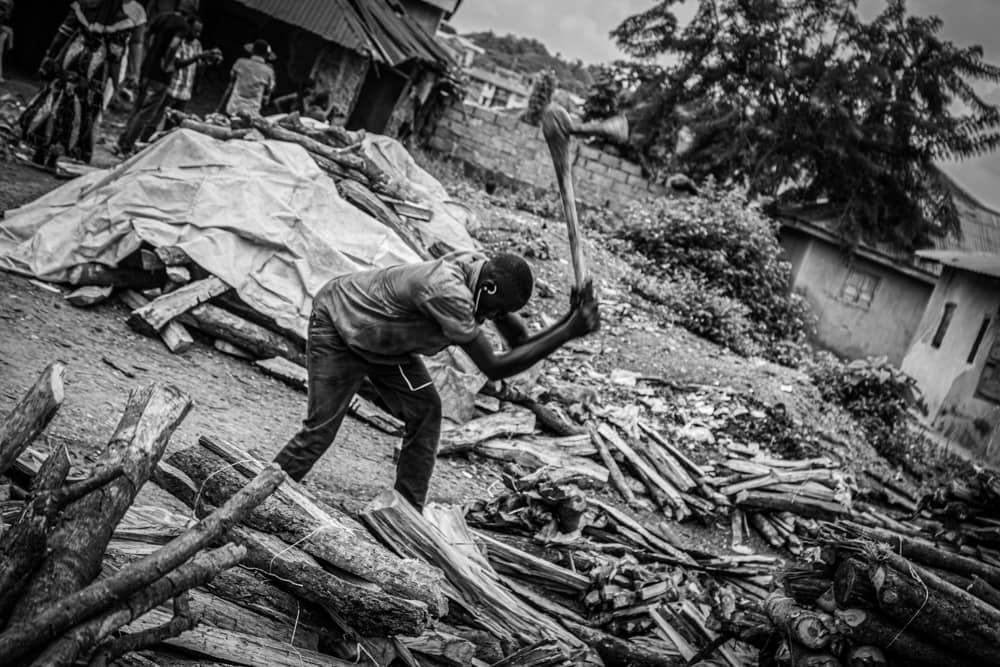
Figures featured in the collection include: Wood Cuter 1, Wood Cutter 2, Wood Seller, Bread Seller, Garri — picture of a woman frying garri, Hawking, and Mechanic — a technician in workwear repairing a tricycle.
Vivian, an interdisciplinary artist with academic background in Law and Business Management, explores subjects that resonate with her training and exposure: Justice, human dignity, entrepreneurship, interpersonal relationship, struggle for survival, production, maintenance, buying and selling of wares.
Labour Series amplifies the maxim “dignity in labour”, exploring overriding themes such as labour, culture, resilience, community, interdependence, and cultural inheritance.
Most of the recurring themes are realised via the photographs of critical, but often neglected workers who contribute to the mainstay of the economy. For instance, the wood cutter symbolically represents resilience and endurance. The wood cutter ferociously chops the firewood in anticipation of a future reward.
Though each image is isolated, the artist masterfully navigates through a visual narrative that could enable viewers to imagine how the figures interact with one another. Vivian Osuagwu’s subjects are interrelated as in a food chain — from production to consumption: the wood cutter and the garri fryer produce while the hawker and wood seller supply the commodities. The firewood can be mentally related to the fire for preparing the food (garri and others), consumed in every Nigerian home.
Using monochrome as her primary medium, Vivian portrays everyday manual labour, creating scenes reminiscent of typical suburbs. From woodcutting, which is usually done in rural setting to transportation as visualised in the “Mechanic” and the vehicles, the artist draws a roadmap, taking the viewer on a visual tour: rural to urban settings with hawkers along the way.
The food preparation process is captured in the imaginative journey from the rural community where the firewood is fetched to the trading point and the fireside. The visual narrative device, results in a graphic documentation of what it takes to have food on one’s table.
Also, the body of work succinctly documents communal life, the mutual interaction of distinct images. Producers, traders, and finished product consumers are bonded in the flow, creating a relative intimacy. By a stretch of the imagination the viewer can integrate other vocations into those the artist captured through her photographic lens.
Focusing on texture, and medium, the artist highlights labour as a salient vehicle to self actualisation, conveying a sense of personal responsibility.
In framing each figure as a worker, the artist conceptualises a localised economy driven by individuals whose enterprising efforts cumulatively contribute to building and preserving the larger community.
Images captured in the artistic narrative include an axe, a tricycle, firewood, kettles, benches, and machines. Each picture triggers a conversation about entrepreneurship, education, and semiotic representation of topical subjects.
The production chain is portrayed in frames like “Garri” which features a productive economic activity, illustrating dignity in labour.
In the piece subtitled “Wood Seller”, the seller, with a heavy load on the head, is somewhat caricatured as an overburdened, but undefeated persona. Besides the intended humour, the posture suggests that the model is striving in hope, instantiating themes of resilience, struggle for survival, diligence, and life of purpose among others.
Vivian deploys admirable innovative skills in depicting value-laden images that cut across different fields of endeavor, retaining their simple shape while avoiding both over simplification and sophistication. The artist showcases didactic conceptualisations embedded with moral lessons on personal development and discipline. But, beyond each frame, she leaves the viewer to include new perspectives in the conversation.
Vivian’s Labour Series points the observer to various types of labour without openly displaying all, providing a consistent storyline that can be further explored for diverse thematic concerns. Labour forms like driving, banking, and painting are not clearly captured in the photographs, but the displayed portraits provide clues to the implied ones, culminating in a comprehensive narrative sequence and nuanced explication of the subject matter.
Because of its rich local content, Nigerian viewers, art lovers, and collectors will particularly find the series inspiring. Aside the temporal sighting at galleries, the collection’s didactic potentials can be tapped into by art educators, civic teachers, and even parents for pedagogy and decorative purposes.
Vivian’s monochrome is impressive in black and white experimentation. Besides, its aesthetic appeal is a compelling rhetoric undertone, prompting the viewer to appreciate the value of honest labour while probing the figures for insights into other existential issues.
Although the artist downplays the likely hazards associated with each occupation, she positions work as what defines the engager’s worth in a community. She takes the viewer on a guided mental tour of the personae’s routine psycho-social engagements with physical objects.
With its emblematic title, Vivian’s Labour Series appears to have a straightforward message. The viewer first gets the impression that it is all about work, but on a closer examination understands the nature, benefits, and inherent challenges of the vocation in specific contexts.
Disclaimer
Comments expressed here do not reflect the opinions of Vanguard newspapers or any employee thereof.