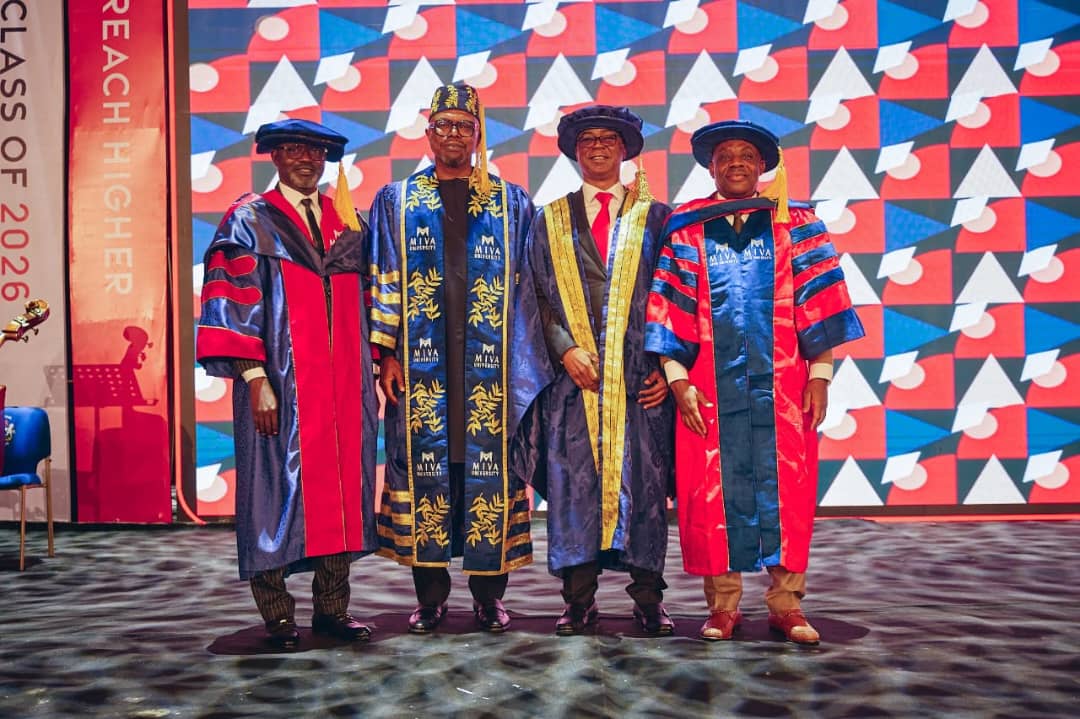
Newly installed Pro-Chancellor of Miva Open University, Dr. Tunji Olowolafe, has called for a radical rethink of higher education delivery in Nigeria, arguing that quality education should be accessible to all regardless of geographical, economic or social barriers.
Speaking at the maiden convocation ceremony of Miva Open University in Lagos during at the weekend, Olowolafe described open and distance learning as a transformative tool capable of democratizing access to education without compromising academic standards.
Olowolafe said the future of education lies in creating systems that adapt to students’ realities rather than forcing students to conform to outdated models.
“Democratizing education does not mean lowering standards. It means refusing to allow the conditions of learning to become a barrier to the quality of learning. It means designing systems that meet students where they are, not systems that demand students rearrange their entire lives to fit a model built for a different era.”
Drawing from Nigeria’s educational history, Olowolafe reflected on the vision of the late Chief Obafemi Awolowo, whose introduction of free education and educational broadcasting helped expand learning opportunities beyond traditional classrooms.
According to him, Miva Open University represents the modern evolution of that philosophy.
“Where the student cannot travel to the classroom, the classroom must learn to travel to the student,” he said, adding that the institution embodies a model that leverages technology to bridge educational gaps.
The academic challenged the perception of open and distance learning as an inferior alternative to conventional university education, noting that such assumptions have led to underinvestment in a system capable of expanding educational access across Africa.
He maintained that graduates of the institution had undergone rigorous academic training and should take pride in their accomplishments.
“The graduates before me today did not receive a diluted education. They were held to rigorous standards. They were assessed, challenged and stretched,” he said.
“They paid for their own data, sat their own examinations and asked no one for permission to be ambitious.”
Olowolafe also highlighted the challenge of maintaining quality amid growing enrolment, describing it as one of the most critical tests facing higher education institutions globally.
“It is relatively straightforward to deliver excellent education to a small cohort. The difficult thing that separates a serious institution from a merely ambitious one is maintaining that same integrity as the numbers grow,” he noted.
Commending Miva Open University for what he described as its commitment to quality at scale, Olowolafe said the institution had resisted the temptation to sacrifice academic depth in pursuit of expansion.
On the broader state of education in Nigeria, Olowolafe acknowledged recent policy interventions and investments in the sector by the current administration, expressing optimism that sustained reforms would strengthen educational outcomes across the country.
Addressing the graduating class, he urged them to embrace lifelong learning and serve as ambassadors of the university’s vision.
“The credential certifies that you can learn. The real test is whether you keep doing it, deliberately, aggressively, without waiting for an institution to organise it for you,” he charged.
The academic further challenged the graduates to contribute meaningfully to national development, arguing that Nigeria’s greatest deficit is not resources but a shortage of disciplined and purposeful leadership.
“What Nigeria lacks most is not resources. It is organised will. It is people with training, with values, and with the determination to point at something bigger than personal comfort,” he said.
As he assumed office as Pro-Chancellor, Olowolafe pledged to uphold the institution’s commitment to both accessibility and excellence, insisting that quality and openness must coexist in the pursuit of educational advancement.
“We do not have to choose between quality and openness, and we will not,” he declared.
He concluded by describing the pioneer graduating class as trailblazers whose achievements would shape the future reputation of the institution.
“You are not just graduates of a university. You are the first chapter of history that has not yet been fully written. Write it well,” he said.
Disclaimer
Comments expressed here do not reflect the opinions of Vanguard newspapers or any employee thereof.