By Ebunoluwa Sessou
The Coalition of Sickle Cell NGOs has called for increased healthcare funding, improved access to treatment, enhanced research and stronger support systems for people living with sickle cell disorder.
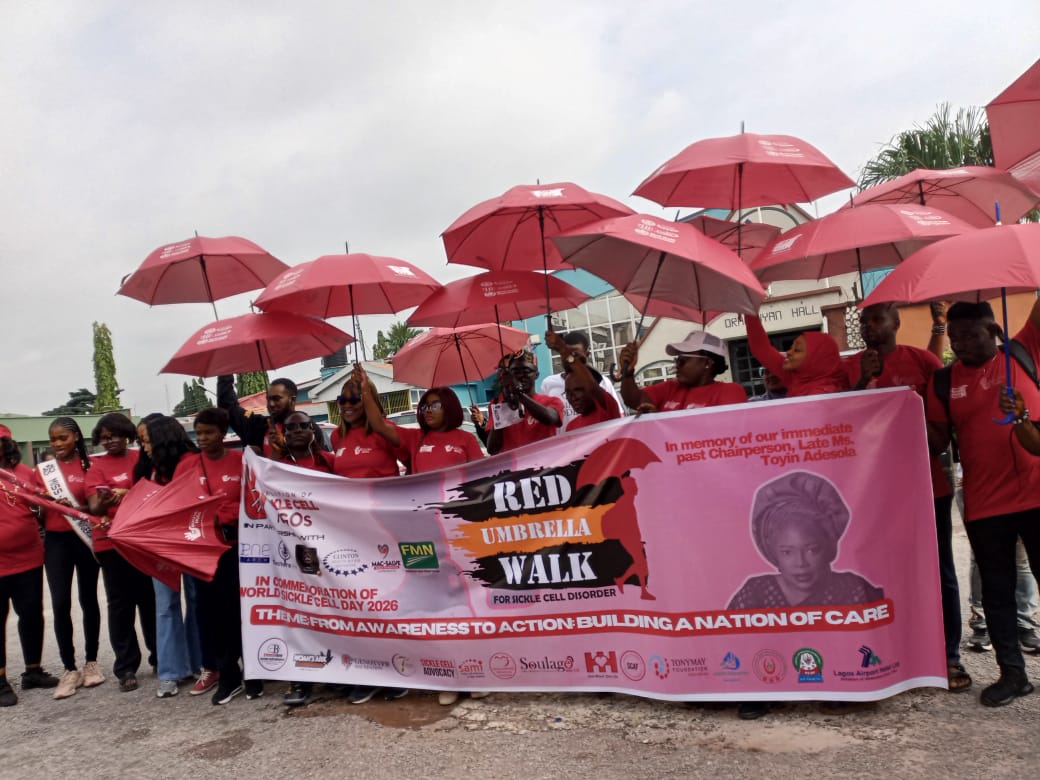
The stakeholders made the call during the Red Umbrella Walk tagged, “From Awareness to Action: Building a Nation of Care,” organised by the Coalition to commemorate the 2026 World Sickle Cell Day.
Stakeholders unanimously agreed that increased awareness, improved healthcare access, research funding and stronger partnerships were essential to improving outcomes for people living with sickle cell disorder in Nigeria.
They carried different placards bearing inscriptions such as, “Stop the Stigmatisation Today!”, “Join the Fight Against Sickle Cell Disorder” and “Care and Support People with Sickle Cell Disorder” as part of their campaign against stigmatisation.
Other messages included: “Sickle Cell is Not a Death Sentence”, “There is Danger in Not Knowing Your Genotype” and “Nigeria Needs a Newborn Screening Policy”.
Speaking, the coalition’s Chairperson, Ms Timi Edwin, said the annual walk was designed to amplify advocacy and improve care for people living with the disorder.
Edwin, who is also the Chief Executive Officer of CrimsonBow Sickle Cell Initiative, said the theme, “From Awareness to Action: Building a Nation of Care,” reflected the urgent need for governments at all levels to show empathy towards people living with the condition.
“We are here today because of the Red Umbrella Walk. It’s an annual advocacy walk that is set to mark the World Sickle Cell Day.
“We need a nation of care. We need all of us to come together. We need patient voices.
“We need the government, private individuals and corporate bodies to come together to ensure that people living with sickle cell are no longer stigmatised.”
According to her, people living with sickle cell disorder have remained underserved despite their contributions to society.
“We have been a bunch of people who have been left behind for too long. We are saying no more.
“We are bringing ourselves to the front and showing on the frontline of advocacy.
“We are saying, look, you have to recognise us because it is high time to recognise us.
“We are powerful members of society despite what is running through our veins,” she said.
Edwin, who has lived with sickle cell anaemia for almost 40 years, urged the Federal Government to devote more resources to healthcare and research.
Applauding President Bola Tinubu for the health budget, Edwin, who called for increased funding for scientific research on herbal medicine, said there was a need for sustained research to find a cure for the disease.
“A portion of that budget should be dedicated to research. Where there is a challenge, the solution is within us. We need research into our herbs so that we can get a cure, not management,” she said.
She noted that increasing life expectancy among sickle cell warriors had created new healthcare challenges.
“We are no longer dying young. We now have warriors in their 40s, 50s, 60s, 70s and beyond.
“Our bodies are slower to heal and we need to know why. That is why research is very important.”
Edwin added that the burden of sickle cell disorder extends beyond physical pain to psychological, financial and emotional challenges, calling for holistic care for patients.
Also speaking, the coalition’s Vice-Chairperson and Founder of Noan’s Ark Foundation for Sickle Cell Nigeria, Ms Osasele Esangbodo, said the awareness walk aimed to educate the public and inspire hope among people living with sickle cell disorder.
Esangbodo noted that sickle cell disorder was not a death sentence.
“This walk is to tell people that if you are living with this condition, it is manageable. Most parents think it is a death sentence. It is not,” she said.
She added that the walk was dedicated to the memory of Ms Toyin Adesola, the immediate past Chairperson of the coalition, who recently died at the age of 60.
Esangbodo identified access to healthcare and effective pain management as major challenges facing patients.
“Many hospitals still do not know how to manage our pain properly,” she said.
Speaking, Mrs Doris Gbemiloye, Executive Director of Genotype Foundation, urged Nigerians to know their genotype before marriage.
Gbemiloye, who noted that knowledge and early diagnosis remained critical to reducing the burden of sickle cell disorder, advocated prenatal diagnosis for couples who are carriers.
Also speaking, the coalition’s Public Relations Officer, Mr Peter Osikoya, who advocated compulsory newborn genotype testing, called for wider adoption of advanced genotype testing.
He advocated the use of High-Performance Liquid Chromatography (HPLC) to reduce cases of genotype misdiagnosis.
“The problem of misdiagnosis is what I want to emphasise. People believe they know their genotype and later discover otherwise.
“This creates serious social and emotional consequences. We need policies that will penalise laboratories that issue wrong results.”
Osikoya also called for regular training of laboratory personnel and improved regulation of testing facilities.
Mrs Khadijat Abdulkareem of the Lagos State Ministry of Health said the state government was expanding access to genotype screening.
She said free newborn screening was currently available in more than 70 public health facilities across Lagos State.
“We are advising parents to take advantage of the free newborn screening programme. It is available in many facilities across Lagos State,” she said.
Urging residents to patronise only accredited laboratories, Abdulkareem said the government was working hard to clamp down on unregistered laboratories and quackery.
Also speaking, Messrs Viavonu Folorunsho and Kelani Akeem, Directors at the Lagos State Office for Disability Affairs (LASODA), commended the coalition’s advocacy efforts.
The directors, who noted that the government was ready to partner with the coalition, said LASODA remains open to collaboration aimed at improving healthcare and welfare support for affected persons.
Also speaking, the Southwest Regional Director of the Coalition of Sickle Cell NGOs of Nigeria, Mudupe Sijuade, said sustained advocacy and proper care have significantly improved the life expectancy of sickle cell warriors.
According to her, advocacy groups across the country are focused on educating parents and caregivers on how to effectively manage children living with the condition.
“We counsel mothers on the best ways to handle their children. Gone are the days when sickle cell warriors die at the age of 10 or 20. Many of us are growing old because of better management and increased awareness,” she said.
She explained that regular hospital visits, prompt medical attention and adherence to prescribed treatment remain critical to the survival of individuals living with sickle cell disorder.
“When caregivers pay close attention to their children and ensure they receive regular medical care, their chances of survival increase significantly. We encourage mothers not to be discouraged despite the burden of managing the condition,” she added.
She also emphasised the importance of newborn screening, describing early diagnosis as one of the most effective ways to improve health outcomes for sickle cell patients.
“One of the major issues we are advocating for is newborn testing and screening. When sickle cell is diagnosed early, better management can begin immediately, rather than discovering the condition much later in life,” she said.
Sijuade disclosed that the advocacy campaign was being simultaneously carried out in five locations across Nigeria, including Abuja, Warri, Ilorin, Abeokuta and Lagos, as part of efforts to expand awareness and support services nationwide.
“We are spreading the message across the country. Various NGOs from different parts of Nigeria are involved, and we are all doing our bit to ensure that people living with sickle cell receive the support they need,” she stated.
Also speaking, a 63-year-old sickle cell warrior, Niniola Phillips-Adeleye, shared her personal experience of living with the condition for more than six decades, describing the journey as challenging but rewarding.
“I live with sickle cell and I will be 63 in August. The journey has not been smooth. There have been endless pains, crises and hospital visits, but I have learned to remain positive and find ways to enjoy life despite the challenges,” she said.
Phillips-Adeleye attributed her resilience to faith, determination and proper health management, noting that her experience proves that individuals living with sickle cell can live long and productive lives.
Addressing the financial burden associated with managing the disease, she lamented the high cost of medication and treatment, particularly for patients from low-income families.
“It is financially burdensome. Some of us can cope, but many warriors cannot. I belong to a group with over 1,000 warriors, and every day people are crying out for help to buy medications, dress wounds and even feed themselves,” she said.
She highlighted complications such as avascular necrosis and leg ulcers, describing them as painful conditions that require continuous and expensive medical attention.
“Many warriors are students or unemployed because of stigma and discrimination. When they seek help, people often label them as beggars, but they are simply trying to survive the challenges imposed by the condition,” she added.
She urged governments at all levels to provide more support for people living with sickle cell disorder, particularly in accessing quality healthcare and treatment.
She noted that many individuals with sickle cell have gone on to live successful lives, including some who now reside and work abroad, stressing that the condition should not be viewed as a death sentence.
The Chief Executive Officer of TonyMay Foundation, Edith Otokhina, also reiterated the need for sustained support, awareness campaigns and policies that will improve the quality of life of sickle cell warriors across Nigeria.
The advocates maintained that with early diagnosis, proper medical care, public awareness and government support, people living with sickle cell disorder can lead healthy and productive lives while contributing meaningfully to society.
The NGOs represented at the event included Sickle Cell Advocacy & Management Initiative (SAMI), Gail Sickle Initiative, Soulage A Biyi Odegbaike Foundation for Sickle Cell, Haima Health and Modupeire Sickle Cell Advocacy Initiative.
Others were Couples & Kids Social Initiative, Tiwa Sickle Cell Disease Foundation and TonyMay Foundation, among others, which took turns to harp on the importance of knowing one’s genotype early in life.
The Coalition comprises 40 active NGOs across Nigeria. Five other walks were also conducted in Abuja, Warri, Abeokuta, Ilorin and Sagamu respectively.
Disclaimer
Comments expressed here do not reflect the opinions of Vanguard newspapers or any employee thereof.