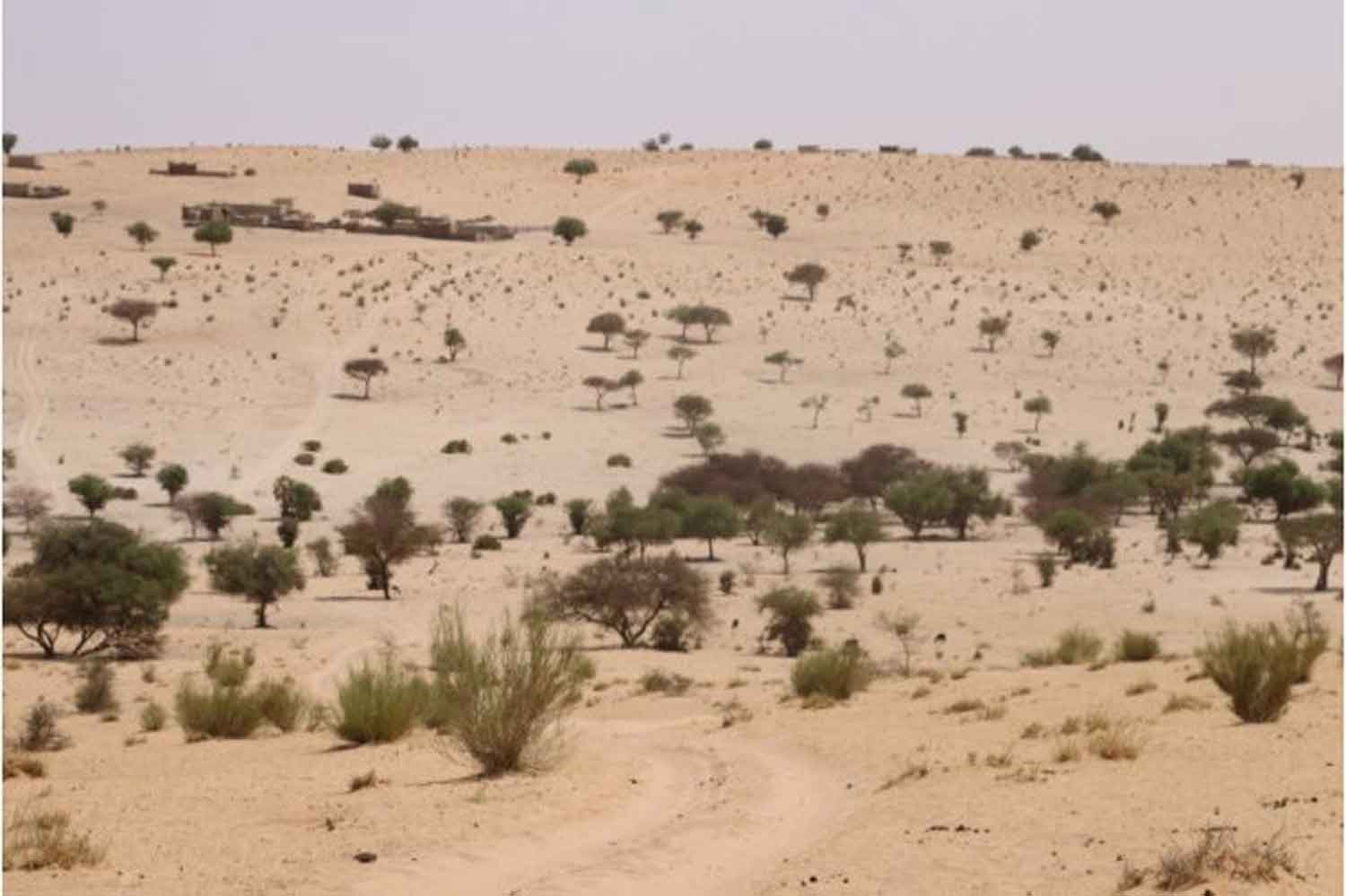
File image of desert.
By Agbonkhese Oboh
Journalists have been urged to interrogate the Great Green Wall and other initiatives aimed at addressing desert encroachment in northern Nigeria.
The challenge was made at a virtual Expert Training on Desertification in Northern Nigeria, organised by the Citizens Free Service Forum, CFSF, to commemorate the World Day to Combat Desertification and Drought (June 17).
In his welcome address, Comrade Sani Baba, Executive Director of CFSF, warned that Nigeria is facing a multi‑front environmental emergency and the media has a crucial role in bringing the true picture to the public and policy makers.
Baba noted that while the entire country is grappling with rising sea levels, coastal erosion, gully erosion, biodiversity loss, and deforestation, the northern region is experiencing a particularly devastating threat: the steady march of the Sahara Desert.
According to him, desertification now affects about 45% of Nigeria’s landmass, with states such as Adamawa, Borno, Gombe, Yobe, Jigawa, Katsina, Kebbi, Sokoto, and Zamfara losing an estimated 350,000 hectares of land annually.
He also highlighted the dramatic collapse of Lake Chad, which has shrunk from 25,000 km² in the 1960s to less than 1,500 km² today, destroying the livelihoods of more than 40 million people who once depended on fishing and farming.
In her intervention on Impact of Desertification on Livelihoods, Executive Director of Center for Transparency Advocacy, Faith Nwadishi explained that the impacts of desertification is largely underreported, even as she revealed that key states affected include Sokoto, Kebbi, Katsina, Zamfara, Kano, Jigawa, Bauchi, Gombe, Yobe, Borno, and Adamawa.
According to her, between 50% to 75% of the land in the affected states show advanced signs of desertification and over 40 million human lives rely directly on the rapidly deteriorating ecosystems there.
Impact on women
Azizat Mohammed Adangba, Trustee, Community Based Initiative for Growth and Sustainability, speaking on “Impact of Desertification on Women in Northern Nigeria”, explained that women in the region varied roles Including smallholder farming, food processing, water collectors, caregivers, and household managers. She noted however that they are denied rights and resources needed to cope with environmental shocks.
They also lack inheritance rights, access to credit and decision‑making power, among others.
Adangba outlined a comprehensive set of gender‑responsive solutions, including strengthening land rights, supporting women‑led green enterprises, expanding access to climate finance, mandating women’s inclusion in environmental governance, and investing in climate‑smart agriculture and water infrastructure.
Her message was unequivocal: “No desertification strategy is complete without a deliberate, resourced gender lens. Women’s resilience is Northern Nigeria’s resilience.”
Ayemhenre Kelvin, Chair, Socialist Workers League, who spoke on “Desertification Impacts on Nigerian Workers”, described desertification as both an environmental and economic crisis, with direct consequences for labour markets and household survival.
He said that the situation in the north has led to the collapse of smallholder farming and rising cost of living, loss of livelihoods across agriculture, fishing, and pastoralism, culminating in poor and unsafe working conditions for workers among others.
Kelvin warned that without urgent intervention, desertification could accelerate rural‑urban migration, deepen unemployment, and fuel social instability.
Great Green Wall
On the role of the media in reporting desertification, Philip Jakpor, Executive Director of Renevlyn Development Initiative (RDI) pointed out that for journalists to robustly report desertification they must reference the interconnecting issues such as impact of fossil fuels extraction and the role of the extractive industry in instigating the climate crisis.
Jakpor said that journalists must avoid armchair reporting and visit the front lines so that they can understand the plight of the locals and put real faces to their stories.
He also challenged the journalists to go beyond merely reporting the receding deserts but also initiatives like the Great Green Wall which is yet to achieve the desired results of regenerating the arid lands of the north.
“15% of Nigeria’s ecological funds go to the Great Green Wall initiative yearly. The allocation to the initiative in the 2026 budget is over N200 billion yet Nigerians are in the dark about the project”.
While eulogising journalists for their role in spotlighting issues of grave concern, the CFSF pledged to continue building the capacity of journalists to report environmental issues with depth, accuracy, and urgency.
Disclaimer
Comments expressed here do not reflect the opinions of Vanguard newspapers or any employee thereof.