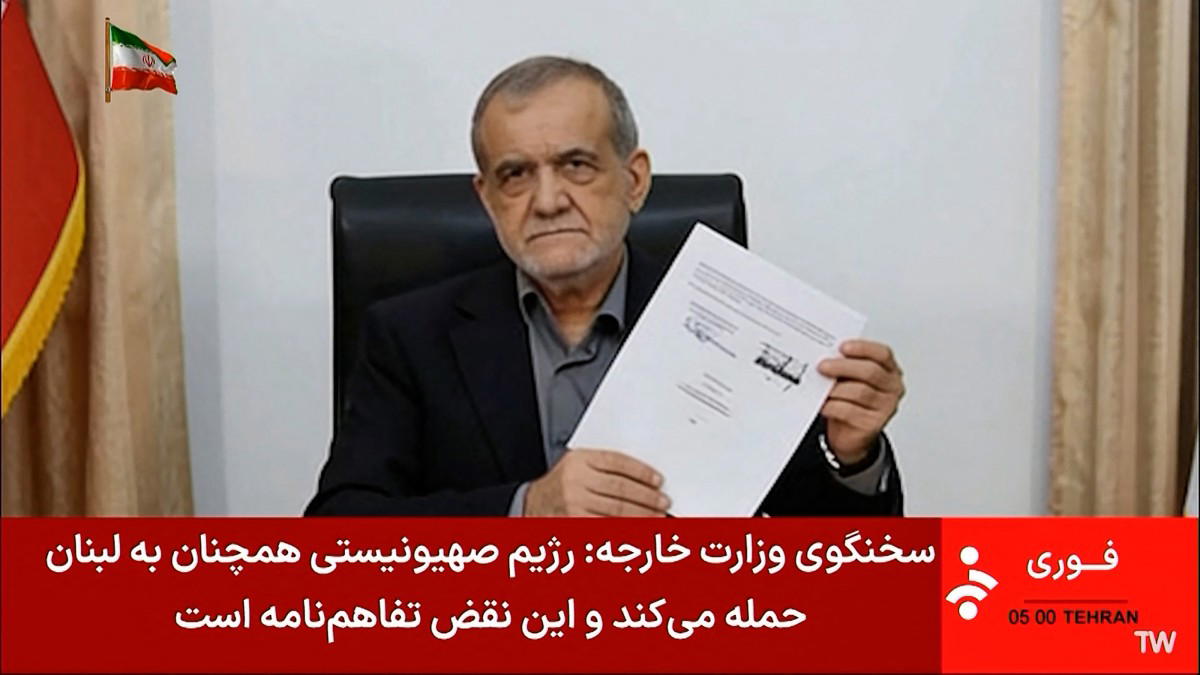
This screen grab taken from video footage broadcast by Iran’s IRINN Iranian state television network and made available via AFPTV on June 18, 2026 shows Iran’s President Masoud Pezeshkian holding a document showing a memorandum of understanding he signed to end the Middle East war. US President Donald Trump and Iran’s president signed a deal on June 17 meant to end the Middle East war, with Tehran agreeing to dilute its enriched uranium in return for large-scale economic relief. (Photo by Handout / various sources / AFP) / – Israel OUT / Israel OUT / NO Access Israel Media/Persian Language TV Stations Outside Iran / Strictly No Access BBC Persian / VOA Persian/Manoto TV / Iran International / / Radio Farda — / Attention editors: AFP covers the war in the Middle East through its extensive regional network, including bureaus in Tehran, Jerusalem, and several neighboring countries. Since the start of the conflict, journalists have been working under increasingly restrictive conditions. Authorities in several countries have limited reporters’ movements, photo and live video coverage from sensitive locations. Some governments and armed groups have banned images of missile or drone strikes and other security-related sites. RESTRICTED TO EDITORIAL USE – MANDATORY CREDIT “AFP PHOTO / IRINN via AFPTV” – HANDOUT – NO MARKETING NO ADVERTISING CAMPAIGNS – DISTRIBUTED AS A SERVICE TO CLIENTS /
Iran said on Thursday that its missile programme would not be part of future negotiations with the United States, after the two sides agreed a framework deal for ending their war.
US President Donald Trump and Iranian President Masoud Pezeshkian signed a memorandum of understanding early Thursday, ending a regional war that erupted on February 28 with US-Israeli strikes.
The agreement lays the groundwork for detailed negotiations on Iran’s nuclear programme and sanctions relief for Tehran.
There is no mention in the deal of Iran’s missile programme, a longstanding concern for Washington and its ally Israel.
“Our missiles do not like at all to be talked about by anyone,” foreign ministry spokesman Esmaeil Baqaei said in an interview with Iranian state television.
“Iranian missiles are only for firing, not for negotiations. Iran’s defence capability will not be discussed in any way, in any process or with any party.”
During the nearly 40-day war, Iran’s missile infrastructure came under heavy US-Israeli bombardment, but Tehran continued to respond with missile and drone attacks across the region.
Before the war, US Secretary of State Marco Rubio had warned that Iran would need to negotiate over its ballistic missile arsenal, which Washington views as a threat to Israel and US military bases in the region.
Iran has repeatedly refused to discuss what it describes as its defensive capabilities.
On Wednesday, Trump appeared to soften his position, saying it would be “unfair” for Iran not to have missiles.
“I’m saying that if other countries have them, it’s a little bit unfair for them not to have some,” Trump said.
“A ballistic missile is not the same thing as what we are talking about when we talk nuclear.”
AFP
Disclaimer
Comments expressed here do not reflect the opinions of Vanguard newspapers or any employee thereof.