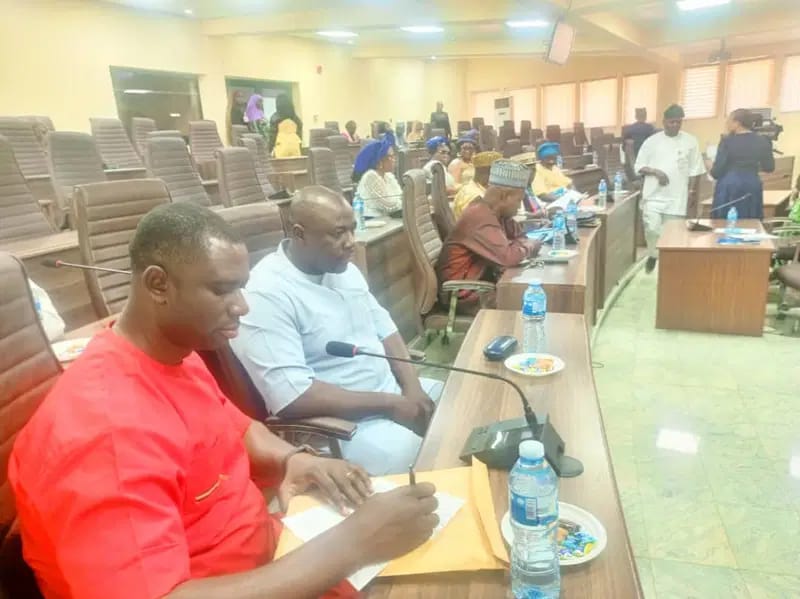
Meeting of Niger Delta Ciivil Society Forum with Chairman, Federal Commissioners of Revenue Mobilisation Allocation and Fiscal Commission (RMAFC) in Abuja
By Jimitota Onoyume
Civil society stakeholders in the Niger Delta have renewed calls on President Bola Tinubu to establish a Presidential board to administer the 13 per cent derivation fund, saying it would strengthen accountability, transparency and guarantee sustainable development in oil-producing communities in Niger Delta.
In a statement issued to commemorate Democracy Day and signed by its Coordinator, Comrade Ezekiel Kagbala, the Niger Delta Civil Society Forum (NDCSF) reacted to a letter by the Revenue Mobilisation Allocation and Fiscal Commission (RMAFC), dated April 15, 2026, on the constitutional administration of derivation revenues.
According to the forum, while the Commission stated that any policy action would depend on presidential directives, it also argued that the Petroleum Industry Act (PIA) had already introduced mechanisms—particularly the Host Community Development Fund—to address the developmental needs of oil-bearing communities.
However, the NDCSF rejected the position, describing it as legally flawed and a deliberate attempt to divert attention from the constitutional issues surrounding the 13 per cent derivation fund.
“It is unpalatable to redirect statutory funds meant for host communities and then claim that the PIA has addressed their needs. The derivation principle is constitutional, while the PIA is a separate legislation enacted for entirely different objectives,” the statement said.
The forum argued that the PIA governs the relationship between international oil companies and host communities through the provision of three per cent of operating expenditure for community development, whereas the 13 per cent derivation fund derives its authority directly from Section 162(2) of the 1999 Constitution (as amended).
It further maintained that there is no provision within the PIA that references or replaces the 13 per cent derivation principle.
“Legally, the 13 per cent derivation fund is not mentioned anywhere in the PIA. The derivation principle is tied to the volume of oil production from producing communities and was constitutionally designed as compensation.
“We are compelled to ask whether the Revenue Mobilisation Allocation and Fiscal Commission is unaware of the legal foundation and intent of this constitutional provision,” the group stated.
The group maintained that the derivation fund is compensatory in nature and fundamentally intended to benefit oil-producing communities directly. However, it lamented that the current disbursement structure has exposed the fund to elite capture, alleged misallocation and growing dissatisfaction across the Niger Delta states.
The group recalled previous engagements with the commission during which it referenced public comments made by a former Chairman of RMAFC, who stated that the 13 per cent derivation fund is a compensation to oil and gas-producing communities for the destruction of traditional livelihoods caused by oil exploration and production activities.
“The group also submitted constitutional documents to support its position, particularly on the doctrine of separation of powers and the provisions of the Exclusive Legislative List under Part I of the Second Schedule of the Constitution.
“The Forum notes that oil and gas matters fall under Item 39 of the Exclusive Legislative List, which covers mines and minerals, including oil fields, oil mining, geological surveys and natural gas.
” We maintain that matters on the Exclusive Legislative List fall under federal jurisdiction and that only the President and the National Assembly possess constitutional authority over such subjects.
“We explained that no state governor or State House of Assembly has legislative authority over matters on the Exclusive Legislative List. It is the National Assembly that possesses legislative competence in that regard.
“It is therefore difficult for us to understand why the Commission insists on continuing the payment of the 13 per cent derivation fund to state governments despite these constitutional realities,” the Forum stated.
The group consequently urged the commission to discontinue what it described as unconstitutional practices and instead revisit and transmit the bill earlier considered by the 6th National Assembly to the current 10th National Assembly for the establishment of a 13 per cent Derivation Fund Board in each oil and gas-producing state.
Citing constitutional provisions under the Exclusive Legislative List, the Forum insisted that the Presidency retains authority to guarantee accountability and proper utilisation of national revenues, warning that any attempt to weaken oversight undermines constitutional intent.
Making reference to recent allocation figures, the Forum claimed that several billions were distributed to oil-producing states within five months in 2025.
“Yet the host communities—the actual sources of the wealth—remain largely excluded from visible developmental benefits.Democracy is strengthened when constitutional provisions are implemented transparently and citizens can see measurable outcomes in their communities,” it said.
The group further appealed to President Tinubu to use the occasion of Democracy Day to demonstrate renewed commitment to sustainable development across the Niger Delta region.
Disclaimer
Comments expressed here do not reflect the opinions of Vanguard newspapers or any employee thereof.