By Nwafor Sunday
One year after the Trump administration launched the most dramatic restructuring of American foreign assistance in modern history, the debate over USAID has moved beyond Washington politics. Across Africa, civil society organizations, election-monitoring groups, policy institutes, and governance advocates are grappling with a new reality: how to sustain democratic accountability in the absence of one of the world’s largest sources of democracy assistance.
What began on January 20, 2025, as a 90-day pause on foreign aid quickly evolved into a sweeping overhaul. By March 2025, Secretary of State Marco Rubio announced that approximately 5,200 of USAID’s 6,200 programs — about 83 percent of its portfolio — had been terminated or marked for termination. For supporters, the decision represented a long-overdue effort to align aid with American interests. For critics, it amounted to the dismantling of an institution that had shaped development and democracy promotion for more than six decades.
For political scientist Taiwo Adeagbo, the significance of the decision extends far beyond budgets and bureaucracy. Adeagbo, a PhD candidate in the Department of Political Science and a Fellow at the Public Policy Lab at Temple University, argues that the most important consequences may emerge in the institutions that quietly support democratic governance.
“Democracy assistance was never a substitute for domestic political will,” Adeagbo argues. “But in many countries, it provided critical support to organizations working to strengthen accountability, civic participation, and electoral integrity. The question is not whether democracy can survive without USAID. The question is whether democratic institutions will be stronger or weaker in its absence.”
More than humanitarian aid
Public discussions of USAID often focus on health, education, food security, and humanitarian relief. Yet democracy assistance constituted a significant, if less visible, component of the agency’s work. Congressional appropriations directed approximately $2.9 billion toward programs supporting electoral integrity, independent media, civil society organizations, anti-corruption efforts, rule-of-law initiatives, and democratic governance worldwide.
These programs rarely produced the visibility of roads, hospitals, or schools. Instead, they strengthened election observation networks, supported investigative journalism, trained political parties, promoted transparency, and funded civic education initiatives.
Democracy scholar Thomas Carothers has long argued that democracy assistance works best when it supports local institutions rather than imposing external political models. Similarly, Stanford University’s Larry Diamond has repeatedly emphasized that democratic resilience depends on strong civil societies and accountable institutions. Their concerns have become increasingly relevant as democracy faces pressure globally.
The timing of the USAID reductions could hardly have been more consequential. Freedom House has documented nearly two decades of global democratic decline. Military coups returned to parts of West Africa, democratic backsliding accelerated in several regions, and public trust in political institutions continued to erode.
The African dimension
Few regions may feel the effects of these changes more acutely than Africa. For decades, USAID supported governance and democracy programs across the continent, including election administration, civic participation, anti-corruption initiatives, legislative strengthening, and conflict mitigation.
Development analysts have noted that while humanitarian and health programs attracted the greatest public attention, governance programs often played a crucial role in strengthening institutions capable of sustaining democratic development. In many countries, democracy-support organizations operated with a combination of domestic funding and international assistance. The reduction of external funding has forced many groups to rethink staffing, programming, and long-term strategy.
Several African civil society leaders have warned that shrinking democracy assistance could leave watchdog organizations vulnerable. Some groups have responded by seeking domestic funding, building regional partnerships, and diversifying donor support. Others have scaled back activities.
The challenge is particularly significant because democracy assistance often supports organizations that hold governments accountable rather than governments themselves. These institutions frequently struggle to attract sustainable domestic funding because their work is political, long-term, and difficult to monetize.
Nigeria’s 2027 election test
For Nigeria, the implications may become most visible during preparations for the 2027 general elections.
Since returning to civilian rule in 1999, Nigeria has completed seven consecutive election cycles and achieved multiple peaceful transfers of power. Yet democratic consolidation remains incomplete. Electoral disputes, political violence, misinformation, weak party institutionalization, and declining public trust continue to challenge democratic governance.
The 2023 elections highlighted both progress and persistent weaknesses. Technological innovations improved parts of the electoral process, yet controversies surrounding result transmission and electoral credibility generated widespread debate. National voter turnout fell to approximately 26.7 percent — the lowest level recorded since the country’s return to democracy.
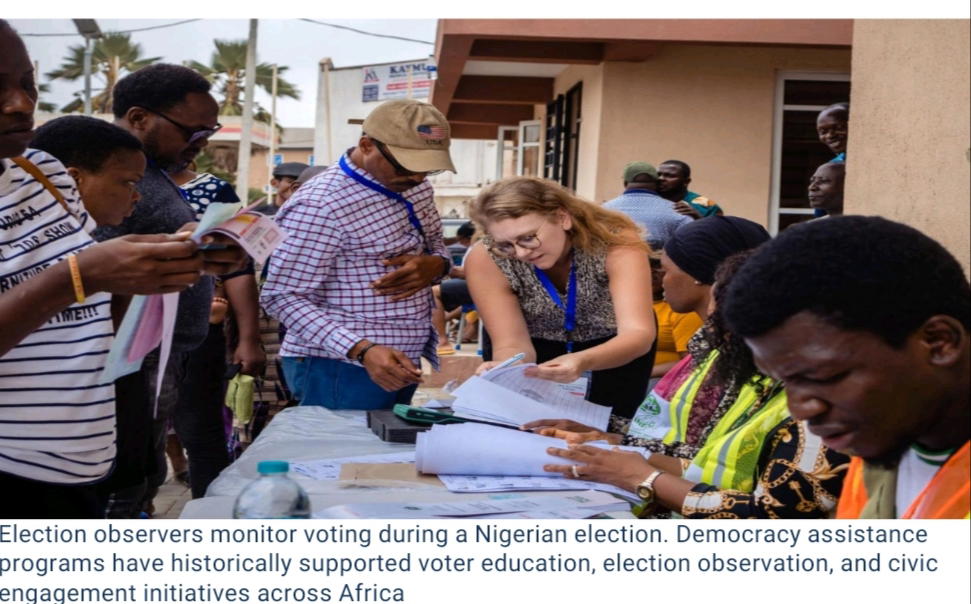
For more than two decades, organizations such as Yiaga Africa, the Transition Monitoring Group (TMG), CLEEN Foundation, and the Centre for Democracy and Development have formed part of Nigeria’s broader democratic infrastructure. These organizations have conducted voter education campaigns, deployed election observers, monitored political violence, tracked misinformation, and promoted citizen engagement.
Many of these organizations developed partnerships with international donors, including USAID-supported programs. While none are solely dependent on American funding, democracy practitioners acknowledge that external support often helped expand operational capacity, observer deployment, training programs, and civic outreach efforts.
The response has not been passive. Several Nigerian organizations have already intensified efforts to diversify funding sources, strengthen local philanthropy, pursue private-sector partnerships, and collaborate with regional networks. Yet adaptation takes time.
According to Adeagbo, the greatest risk is not institutional collapse but institutional weakening.
“The danger is not that elections will stop happening,” he argues. “The danger is that accountability mechanisms become weaker, voter education becomes less effective, election observation becomes less comprehensive, and citizens become more disconnected from democratic processes.”
If that occurs, the consequences may not become visible immediately. They could emerge gradually through declining public confidence, lower civic participation, and reduced oversight of electoral processes leading up to 2027.
The geopolitical question
The implications extend beyond democracy assistance.
For decades, foreign assistance functioned as one of the United States’ most important instruments of soft power. Through development partnerships and governance initiatives, Washington cultivated relationships with governments, universities, journalists, civil society organizations, and future political leaders.
As American engagement contracts, other powers are likely to expand their influence. China has already become a major economic partner across Africa through infrastructure financing, trade, and development investment. Unlike many Western democracy-support programs, however, Chinese engagement generally places less emphasis on electoral accountability, governance reform, or democratic institutions.
This does not mean African governments will simply replace Washington with Beijing. Rather, it suggests that the international environment supporting democratic governance may become more fragmented and competitive.
Looking beyond the numbers
The debate over USAID often falls into two opposing camps. One side views foreign assistance as wasteful spending disconnected from national interests. The other sees aid as an indispensable force for development and democracy.
Adeagbo believes both perspectives miss a larger point.
Democracy cannot be imported. It cannot be outsourced. And it cannot be sustained through foreign funding alone. Ultimately, democratic resilience depends on citizens, institutions, and political leaders committed to democratic norms.
Yet history also suggests that democratic institutions rarely develop in isolation. Throughout the post-Cold War era, international assistance provided resources, expertise, and political support that strengthened democratic actors in some of the world’s most challenging political environments
The true impact of the USAID shutdown will not be measured solely by canceled contracts or reduced budgets. It will be measured by whether the institutions left behind remain capable of defending accountability, transparency, and democratic participation.
One year after the most significant restructuring of American foreign assistance in modern history, that question remains unanswered. But for Nigeria, Africa, and emerging democracies around the world, the answer may help determine whether the coming decade is defined by democratic resilience or democratic retreat.
Author Profile
Taiwo Adeagbo is a PhD candidate in the Department of Political Science at Temple University and a Fellow at the Public Policy Lab. His research focuses on democratization, democratic consolidation, foreign aid, party system institutionalization, populism, polarization, and political development in Africa.
Disclaimer
Comments expressed here do not reflect the opinions of Vanguard newspapers or any employee thereof.