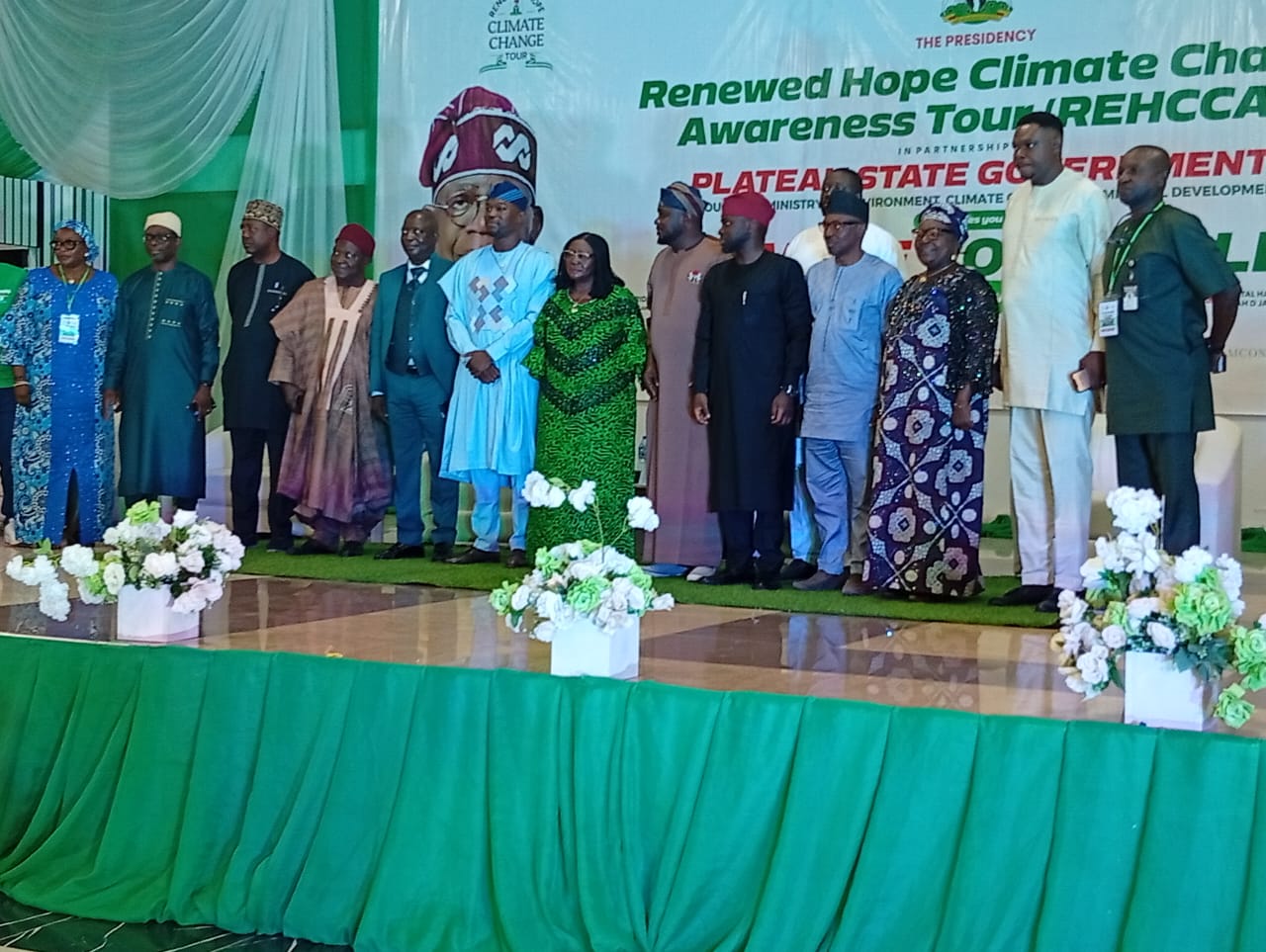
Experts, government officials, traditional leaders, the media, civil society organisations, and others have called for stronger collaboration to address the growing impacts of climate change on communities, livelihoods and the environment across Nigeria.
The call was made on Friday at a two-day Climate town hall in Jos, organised by the Renewed Hope Climate Change Awareness Tour (REHCCAT) in partnership with the Plateau State Government as part of activities marking World Environment Day.
The meeting brought together environmental experts, policymakers, development partners, traditional rulers and community representatives to discuss practical solutions to climate-related challenges.
Speaking at the event, the State Governor, Caleb Mutfwang, represented by his Deputy, Josephine Piyo, described climate change as one of the most pressing challenges facing societies today and urged citizens to embrace environmentally responsible practices.
He said the awareness tour was a timely initiative aimed at mobilising communities towards climate action.
“Climate change continues to threaten ecosystems, livelihoods, infrastructure, food security and public health, particularly in developing nations,” Mutfwang said.
The governor noted that the State’s rich biodiversity, fertile landscapes and unique ecological assets place a responsibility on government and citizens to safeguard the environment for future generations.
“For us in Plateau State, environmental sustainability is not merely a policy aspiration; it is a moral obligation,” he said.
Mutfwang stated that his administration has prioritised environmental restoration, watershed protection, afforestation, sustainable agriculture and ecosystem management.
He added that programmes such as the Agro-Climatic Resilience in Semi-Arid Landscapes (ACReSAL) Project are helping to strengthen the State’s resilience against environmental degradation and climate-related vulnerabilities.
He stressed the need for greater investment in green infrastructure, renewable energy, climate-smart agriculture, sustainable transport systems and effective waste management.
“As urban populations continue to grow, we must prioritise investments in green infrastructure, renewable energy, climate-smart agriculture, sustainable transportation, waste management systems and nature-based solutions that enhance the resilience of our communities,” he stated.
He also commended President Bola Tinubu for sustaining national efforts aimed at addressing climate change and promoting environmental sustainability.
Special Assistant to the President on Climate Matters, Yusuf Kelani, said the town hall formed part of the Federal Government’s strategy to connect national climate policies with the realities faced by communities across the country.
Kelani warned that climate-induced migration is becoming an increasing concern as people relocate in search of safer environments and better livelihoods.
“The objective is to bridge the gap between national climate policies and local realities by taking these conversations directly to communities,” he said.
He noted that the Federal Government is supporting climate adaptation and resilience efforts, while commending the Plateau State Government for its commitment to environmental protection.
He explained that the Sustainable Climate Resilience Initiative for People and Transformation (SCRIPT-E) was designed to support climate-smart agriculture, improve food security and strengthen resilience among vulnerable communities.
Also speaking, Ibrahim Shelleng, Senior Special Assistant to President Tinubu on Climate Finance and Stakeholder Engagement) said climate action must be supported by sustainable financing and strong accountability mechanisms.
Shelleng urged States to position themselves to attract international climate financing by developing credible policies, strengthening institutions and encouraging stakeholder participation.
He added that development partners maintain strict monitoring and auditing systems to ensure climate funds are utilised transparently and effectively.
Earlier, the State Commissioner for Environment, Climate Change and Mineral Development, Peter Gwom, highlighted measures undertaken by the State to mitigate the effects of climate change.
He said the Ministry has implemented projects focused on environmental restoration, water resource management, afforestation, climate adaptation and sustainable development planning.
Gwom disclosed that solar-powered boreholes have been installed across local government areas to improve access to water for domestic use, irrigation and livestock production.
He added that the state had established over 2,000 hectares of woodlots across the three Senatorial zones to support carbon sequestration, biodiversity conservation, and ecosystem restoration.
The Commissioner also cited progress in erosion control projects, including interventions around Plateau Club and Bingham University Teaching Hospital, as well as biodiversity conservation efforts at the Jos Wildlife Park.
The Gbong Gwom Jos, Da Jacob Buba, represented by the Ata Aten of Ganawuri, Yakubu Chaimang, assured stakeholders that traditional institutions would continue to mobilise communities in support of environmental sustainability.
Participants at the town hall, including Nansik Onu, the Executive Director of Centre for Gospel Health and Development, CeGHaD and others, unanimously called for stronger partnerships, increased public awareness and locally driven solutions to address the effects of climate change.
Highlights of the event included the signing of a memorandum of understanding on climate action and the presentation of a climate policy document by the Plateau State Government to the REHCCAT team.
Disclaimer
Comments expressed here do not reflect the opinions of Vanguard newspapers or any employee thereof.