By Chukwuma Ajakah
Q Gallery Contemporary Art, Apapa, is poised to redraw the map of Nigerian art with a show of 14 all-female artists working in painting, sculpture, and mixed media.
The exhibition, opening Saturday, June 6 will run through June 27, 2026 with two sessions starting at 1 and 4 p.m.
Curated by Oke Gabriel, the women show themed, Voices of Eyà, puts youth and legacy in the same room with the women lending their voice through their craft to topical socio-cultural issues.
QGallery Contemporary Art has successfully showcased the works of young and iconic artists over the years, but this is the first time the fast growing gallery is giving it all to women, most of whose work art enthusiasts and collectors will find fascinating.
According to the Curator, “Eyà” meaning “women” is more than a title; it is a reflection of identity, resilience, memory, and presence. “Voices of Eyà is an exhibition that amplifies the realities of women across personal, social, professional, and creative spaces, giving room for stories that are often silenced, overlooked, or misunderstood,” she says, adding, “A woman wears many hats as it appears, they happen to be the first models that children learn a lot of things from-like bond, trust, dependence, nurture, and behavioural patterns that turn out to influence adult life in a contemporary society.”
Talking of “wearing hats”, the quintessential curator is the rare triple threat in this show. She wears “many hats” as Gallery Manager, Curator, and participating artist. With her sculpture and canvas, sitting alongside the 13 other women she selected, she blurs the line between organizer and creative.
Many of the artworks lined up for the exhibition echo Gabriel’s curatorial vision via their form, thematic preoccupation, and emblematic titles. The artists explore the complexities of womanhood, travails with socio-cultural expectations, conflict between personal aspirations and socio-cultural responsibilities at family, workplace, and communal levels, social inequality, emotional labour, and gender bias, expecting women to prove their mettle in systems that relegate them to the background, restrict their voices and censor their visibility.
Oke reveals that the challenges confronting career women and artists transcend physical barriers as they include emotional, psychological and cultural barriers. “Where ambition is questioned, leadership is resisted, and identity is shaped by cultural expectations,” she observes. She adds that “Women continue to nurture, create, lead, innovate, and transform society through courage, resilience, and self-expression.”
Voices of Eyà is curated to speak about women empowerment and new realities, mirroring the roles and values of solidarity, mentorship, education, creative freedom, and support as tools for breaking barriers, reclaiming space, and reconstructing identity.
The exhibition is staged to advocate a society where women freely exist, expressing their individuality and purpose by making marks in their respective careers and creative engagements.
Noting that the upcoming exhibition will resonate with most viewers, Oke captures the essence of its thematic choice in a few words, saying: “Voices of Eyà stands as both reflection and resistance honoring the strength, vulnerability, dreams, and achievements of women while encouraging conversations that inspire equity, healing, visibility, and lasting change.”
Artists lined up for the show are octogenarian Cynthia Dafinone (embroider), Adedoyin Adelani-Bello (painter and embroider), Falilat Ibrahim (sculptor with stone), Faith Michael (painter), Ogoluwa Christiana Obaseemo (mixed media artist and a community organizer), Titilayo Abdulrazaq (painter), Oke Gabriel(sculptor, painter, and curator), and Caroline Useh (mixed media).
Others include: Idemudia Mercy (Ceramist), Juliet Ezenwa (painting and mixed media), Adiza Nzekwe (sculptor), Klaranze Okhide (painter and mixed media), Korede Aremo (painter), and Khadija Adeboye (painter).
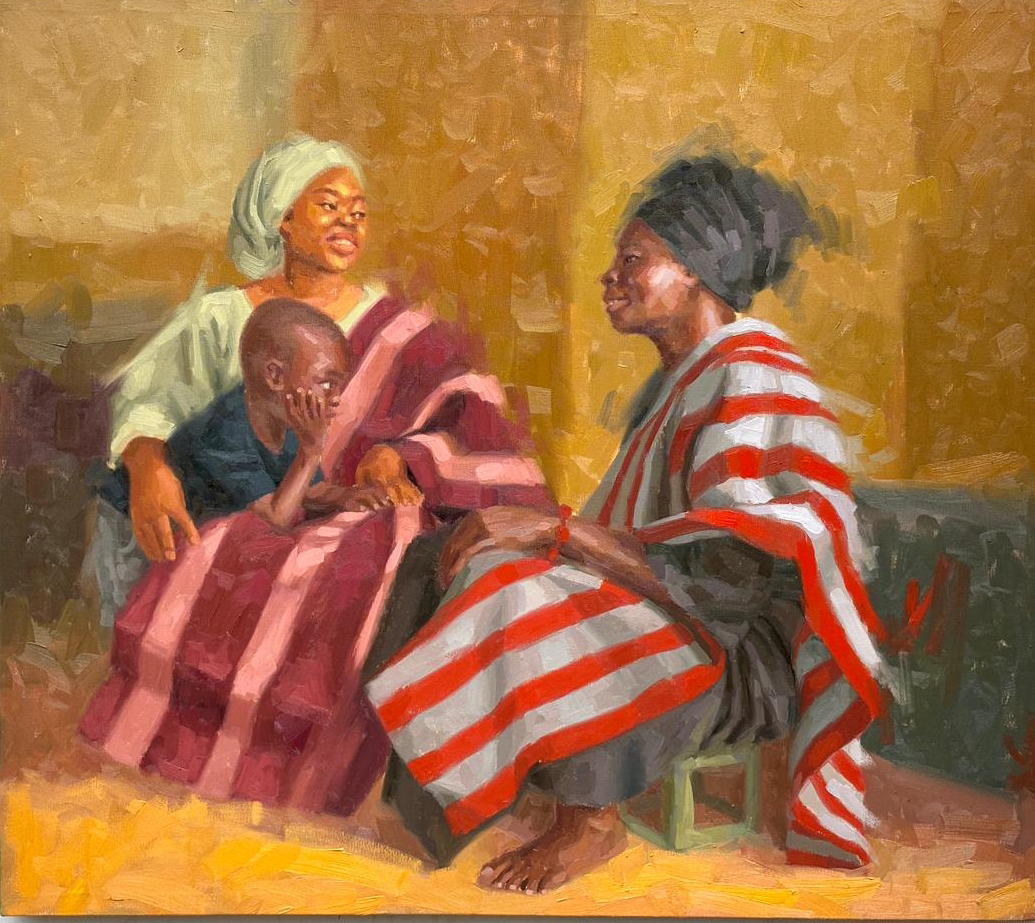
Among the 14 women artists, Titilayo Abdulrazaq listens where others speak. She is exhibiting two paintings of a girl-child vicariously learning from her mother and grandmother, absorbing a talk meant to exclude her. “My practice explores the intimate intergenerational bonds that shape the essence of womanhood,” she says of the canvas that grounds the thematic thread, emphasizing the importance of the bond between children and their mothers. Falilat’s work documents “tenderness, wisdom, and resilience” not as slogans, but as a child learning by eavesdropping and observing.
In that canvas, Titilayo shows the young girl seated with her mother and grandmother, listening as the older women talk, unaware she’s absorbing every word. The “quiet relationships” she paints depict the theme of eavesdropping as inheritance.
Titilayo’s work portrays women as silent custodians of culture, role models, and caregivers that have intergenerational relationships with children. “I see myself as a visual narrator, using painting to document, preserve, and propagate culture nuances like gestures, rituals, and everyday interactions passed to children from their grandmothers that might otherwise fade with time.”
For Adedoyin Adelani-Bello who is also an art educator, her work is inspired by childhood experiences. Through painting, sketching, and embroidery, she challenges social norms that define gender roles and limit women’s place in society, even within a family setting. “My work is influenced by childhood experiences and the restrictions I was subjected to as the first female child of the family,” she says, adding “There were many things my brothers freely did that my parents didn’t allow me to do. Although I still conform to some of such societal expectations, I resolved to challenge the status quo by doing everything the other gender does and my artwork portrays feminism at its best, focusing on female figures such as mother, girl-child, and woman.”
Noting that guests are invited to a novel exhibition where they will listen, see, and and hear the voices of Eyà, the Curator reveals that the auspicious event will feature critical dialogue, networking, and diverse categories of contemporary art. According to her, each afternoon starts at 1 p.m. with artist conversations session, “Let’s Talk about It All” which leads to the exhibition proper at 4 p.m.
Through minimalist symbolism, expressive textures, and thoughtful spatial composition, Oke creates visual conversations that invite introspection and dialogue. Besides studio and curatorial practice, she actively engages in cultural development initiatives, including building globally relevant creative platforms that inspire reflection, innovation, and cultural pride.
Oke’s curatorial interest is etched on contemporary African narratives, shared experiences, and collaborations that connect art with society,
Every featured work resonates with that vision.
Mixed media artist, Ogoluwa narrates her artistic journey, saying, “Growing up in Warri, I became aware of how identity and tribe shape where people belong. Living between different cultures without belonging to one made me question acceptance, visibility, and connection. These experiences inspire my practice and shape the stories I tell through my work.
“Using watercolor, acrylic, discarded newspapers, and waste fabric, I create expressive portraits with distorted forms, bleeding colors, rough lines, and unfinished surfaces. Human mouth appears often in my work – bleeding, cracked, enlarged, or silent, as a symbol of expression, pain, silence, and resistance.
“I intentionally embrace imperfection to reflect vulnerability and emotional truth. By combining fragments of Nigerian culture with contemporary expression, my work challenges ideas of identity, beauty, belonging, and social expectation. I want viewers to look beyond appearances and reflect on what it means to feel accepted, unheard, visible, or excluded in society.”
While most of the exhibiting artists turn their gaze to women and girls, Caroline Useh stands apart by focusing on men and the boy-child. The Winner of the Chinwe Russel Awards Art Prize (2025) is a multidisciplinary artist whose work in mixed media and painting explores the themes of awakening for mental reformation, emotional relearning, identity crisis, restructuring unhealthy memories, and humanity before gender differences. Useh is exhibiting two art pieces, using a unique medium- Cotton Biased Tapes on Canvas. The works, measuring 42×48 inches are “How They Unfold” (2025) and “Fluid Man” (2025).
Caroline has participated in local and international exhibitions, including the Kuenyahua Art Competition and Exhibition held in Ghana (2024) and the juried art competition, Next of Kin Series 5 where emerged a top finalist. She is sure to excite guests at Voices of Eyà with her unique art that mirrors the boy-child as a victim of societal “bias”.
Caroline highlights how her work connects with the show, saying, “This body of work is a reflection on societal expectations of young men.” She notes that men are overburdened with unrealistic societal expectations, causing them to lose emotional care, miss out on love, and run life’s race on the fast lane that the society has conditioned them in without any comfort.
“Little or no attention is paid to men’s burnouts as society neglects and misunderstands their rubber-band nature,” she decries, adding that the boy-child is culturally primed as a burden bearer, figuring out life’s lessons from the streets in silence, without positively connecting with self.
Faith Michael’s practice is built on what she calls an “unintended entry into painting,” shaped by “failure” and “persistent repetition” rather than schooling. Her work in oil portrays vulnerability as “a site of endurance.” The creative deploys muted palettes, leaving figures hovering “between definition and erasure,” intentionally unresolved. Faith believes that painting is “reconstruction, holding the broken without forcing resolution”. Viewers are challenged to observe each piece quietly and closely as meaning dawns slowly.
Among the dignitaries expected to grace Voices of Eyà is prominent art collector and scholar, Prof. Ebun Clark.
Disclaimer
Comments expressed here do not reflect the opinions of Vanguard newspapers or any employee thereof.