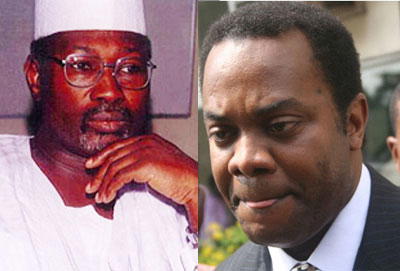
INEC boss, Jega and Ex- C/River Governor, Imoke
By EMMANUEL AZIKEN, POLITICAL EDITOR
A bold attempt by INEC to prosecute election offenders in Cross River State is swallowed in a web of judicial intrigues in the state. Former Governor Donald Duke was the one who gave the shocking revelation on how governors rig elections to a stunned audience of civil society activists at a gathering at the Transcorp Hilton Hotel, Abuja in July 2010.
The former governor, however, fell short of also revealing how after rigging elections governors and their allies move on to protect their agents used in upturning the will of the electorate.
Now, a revealing report on the recent gubernatorial election in Duke’s one time fiefdom of Cross River has given a lead into how election riggers are protected and shockingly, by the judicial branch of government.
The Cross River electoral space inevitably became a point of focus ahead of the 2011 general election when the civil rights activist and lawyer, Mr. Mike Igini was appointed as the Resident Electoral Commissioner, REC.

INEC boss, Jega and Ex- C/River Governor, Imoke
In no time after his appointment in late 2010 , the first test came with Mr. Igini’s rejection of the list of candidates submitted by the dominant Peoples Democratic Party, PDP for the 2011 general elections. The list, Igini ruled, did not emanate through due process. It was as such not surprising that the party grandees in the state soon declared Igini a persona non grata who they alleged was determined to derail the ways and manners of the party in the state.
Following that brush the party and the State office of the Independent National Electoral Commission, INEC also had other occasions to exchange words, before they reached an agreement on good behavior by either side.
If the PDP and other political parties had looked bad before in their conduct during elections, it was perhaps because the party cast a shadow over other institutions. Or maybe because other institutions dealing with elections and post election issues had not been seriously scrutinized.
Remarkable irony
Besides, not until recently with the arrival of the Prof. Attahiru Jega leadership of the commission was a serious effort made to deal with electoral cheats. It is indeed a remarkable irony that whereas Nigerians continuously complain of election rigging that no deliberate effort had been made to prosecute election riggers.
However, if reports emerging from Cross River is anything to go by, then bringing election cheats to book would be no easy task. A report articulated by INEC in Cross River on efforts to bring four alleged offenders to book paints a picture of institutionalized corruption aimed at defeating such a purpose. The report obtained by Vanguard names four officials of INEC in Cross River alleged to have compromised their duties during the February 25 gubernatorial election.
The quartet including three Corps Members in three units, in Etung Local Government Area were alleged to have compromised their duties to the extent of distorting the election results and process in their areas of jurisdiction.
Though the results from the affected registration areas were expunged, INEC in a bid to serve a lesson and in according to the Electoral Act had sought the prosecution of the quartet.
The suspects were charged under Sections 123 and 124 of the Electoral Act, 2010 before a Chief Magistrate Court in Effraya, in Etung Local Government Area. INEC had secured the services of a private legal practitioner, Barrister Emmanuel Sani to prosecute the case on its behalf.
However, as the report of the Cross River INEC was to show, the prosecution of the alleged offenders was not something that other stakeholders in the state were supportive of.
According to the report:
“On the 11th June 2012, the issue before the Court was whether, Barr. Sani, a private Legal Practitioner required the Fiat of the Attorney-General before he can prosecute electoral offences. In his reply, Barr. Sani tendered the original of his letter of engagement issued to him by the Commission. He rightly informed the Court that electoral offences are triable in either the Magistrate Court or High Court of a State in which the offence is committed.
Again, that the trial is at the instance of the Commission either through its Legal Officers or private Legal Officers appointed by it, pursuant to s. 150 (1) and (2) of the Electoral Act. He stated further that electoral matters being sui generis are therefore excluded from the general practice regarding the prosecution of general offences.
Furthermore, he added that the Electoral Act, being an Act of the National Assembly and also being a specialised legislation must be complied with, more so, when the provisions respecting prosecution is not ambiguous. “The Magistrate ignored the law as cited by Barr. Sani and rather requested to know the position of the law regarding the appearance of private Legal Practitioner in prosecuting a crime as contained in the Criminal Procedure Act.
“The Chief Magistrate requested opinion from other Counsel in Court. Barr. Eneji Amajama in his submissions aligned himself with the position of Barr. Sani and added that the Electoral Act having stated s. 150 unequivocally, no authority can question the powers of the Commission to appoint private Legal Practitioners to prosecute electoral offences.
He added further that the only authority that could question the authority of Barr. Sani to appear, would be the Commission, where he was not duly appointed. With regards to the provisions of the CPA, Barr. Amajaman stated that the CPA is not applicable in this case, because electoral offences are not offences covered by the Criminal Code. He concluded that Barr. Sani should be allowed to go on with the matter.
“The Chief Magistrate enquired whether there were witnesses in Court and whether there where documentary evidence. To these questions, Barr. Sani replied in the affirmative, since the Electoral Officer for Etung L.G.A. and the Investigating Police Officer (IPO) were in Court, including the accused persons and their confessional statements.
At a point during the course of the proceedings, the prosecuting Counsel applied that the Electoral Officer, Mrs Uduak Jackson should be permitted to sit down, having stood for a long time. The Magistrate replied in a very ridiculous manner that she should continue to stand, after all, it was a criminal matter, and that “she would soon enter the witness box”.
He did not grant the application for her to sit down. Thereafter, the Chief Magistrate read his ruling on the arguments. He asked “why did she have to bring the matter to court now and why did she not go to the tribunal” In the ruling, he recognised that the Magistrate Court had jurisdiction to try the matter. He however struck out the charges and consequently discharged the accused person because, according to him:
a.“There is no evidence before him that the Fiat of the Attorney-General has been obtained”
b. “There is no evidence that Barr. Sani accepted his appointment by the Commission to prosecute the offences as a private practitioner pursuant to paragraph 4 of the said letter of engagement”
c.“There were no witnesses in Court”
d.“There were no exhibits in Court, and;
e.“The party agents were at large”
The discharge of the accused persons in the face of all the evidence to the contrary as postulated by the Chief Magistrate have left heads in wonder on the prospects of bringing electoral cheats in the country to book.
Disclaimer
Comments expressed here do not reflect the opinions of Vanguard newspapers or any employee thereof.