TSOEDE BRONZE
BY APOLLOS IBEABUCHI OZIOGU
The Nupe Kingdom occupies the northern part of Igala Kingdom. According to oral tradition, Tosede like Oduduwa, the legendary founder of Yoruba – Land is the legendary founder of Nupe Kingdom who lived in the 16th century. He was the son of Igala hunter prince and a Nupe mother. Tosede finally went to live with his father when his father ascended the Igala throne as the Attah of Igala.
Because of Tosede’s qualities such as oratory, courage and bravery, his half brothers were jealous of him, and he had to flee for his dear life on the advice of his father.
The half-brothers to Tosede, like the half-brothers of the Gileadite, Jephthah of the Bible time took a firm decision that Tosede should not be allowed to inherit anything with them. The Bible records a similar statement of Jephthah’s half brothers to him saying: “You shall inherit nothing in our family, for you are the son of another woman” (Judges 11:2b, NAB).
Like Jephthah too, Tosede was a man of valour and great military might. Eventually, Tosede took to flight, during which he conquered a lot of cities in Nupe-Land and installed twelve faithful slaves as chiefs with insignia of brass, bangles and chains. The chains are said to be in the possession of the twelve Nupe chiefs of today.
According to oral history of the people of Nupe-Land in which village Tosede figures were found, it is said that these objects were transported up the River Niger by Tosede. Three of those cultural objects or works of art are the largest cast bronze and copper works from Sub-Sahara Africa. Tosede figures are said to be the most monumental bronzes in Black Africa.

TSOEDE BRONZE
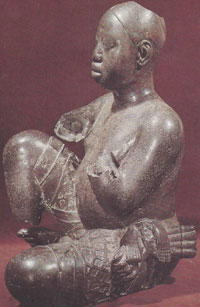
An example of Tosede bronze is the bronze seated figure of a man in the Nupe village of Tada, on the River Niger. The seated figure is a stunning technical achievement because it was cast from pure copper which is very difficult to handle in its molten state. The proportion of the head to the body is more true to life than with bronzes may represent the hero, Tsoede, the legendary founder of Nupe.
The seated figure of man is in the style of Ife bronze; though found some 175 miles away from a place, north of Ife. The people of Tada look upon it as an influence in the fertility of their people and harvest of crops and fish. There are however two views of Tada seated figure; front and side. It sits with ease and composure and the appearance though rigid displays some serenity and inner cohesion. It is dated between 12th c-15th AD. Its height is 53.7cm.
Besides the seated Tada bronze figures there are also standing Tada bronze figures. Some are males and some females. The female standing bronze figure has vertical wide-spaced striations over the abdomen. It is about 42.5cm in height. Dated 17th C AD.
More importantly is the male standing bronze figure, in tasseled coat of mail. It has a headdress of birds and beads as well as a large disc on the forehead bearing the design of a horned human head with snakes or fishes coming from the nostrils: a theme or works of art which appears also in Benin Art.
It is a bronze figure of a chief or Tada warrior. The figure, about 115cm high is one of the Tada bronze which comes from Nupe Village on the River Niger, said to have been brought to the place from Idah by the legendary founder of Nupe Kingdom, Tosede.
About 40 kilometers away from the village of Nupe-Land is the Island of Jebba where we have a bronze figure of standing male warrior similar to Tada warrior, and a standing female nude. The figure represents a bowman or an archer in his hunting clothes. The bowman wears a cap or helmet. The crest on the helmet shows a remarkably stylized bird with a large beak.
He has protruding eyes and his face bears vertical and horizontal scarifications and multi-link catwhisker marks. He wears a large chain collar around his neck. He carried a quiver of arrows on his back. The forearms and the bow being one of the tallest bronze figures in Black Africa, and dated 17thC AD.
Disclaimer
Comments expressed here do not reflect the opinions of Vanguard newspapers or any employee thereof.